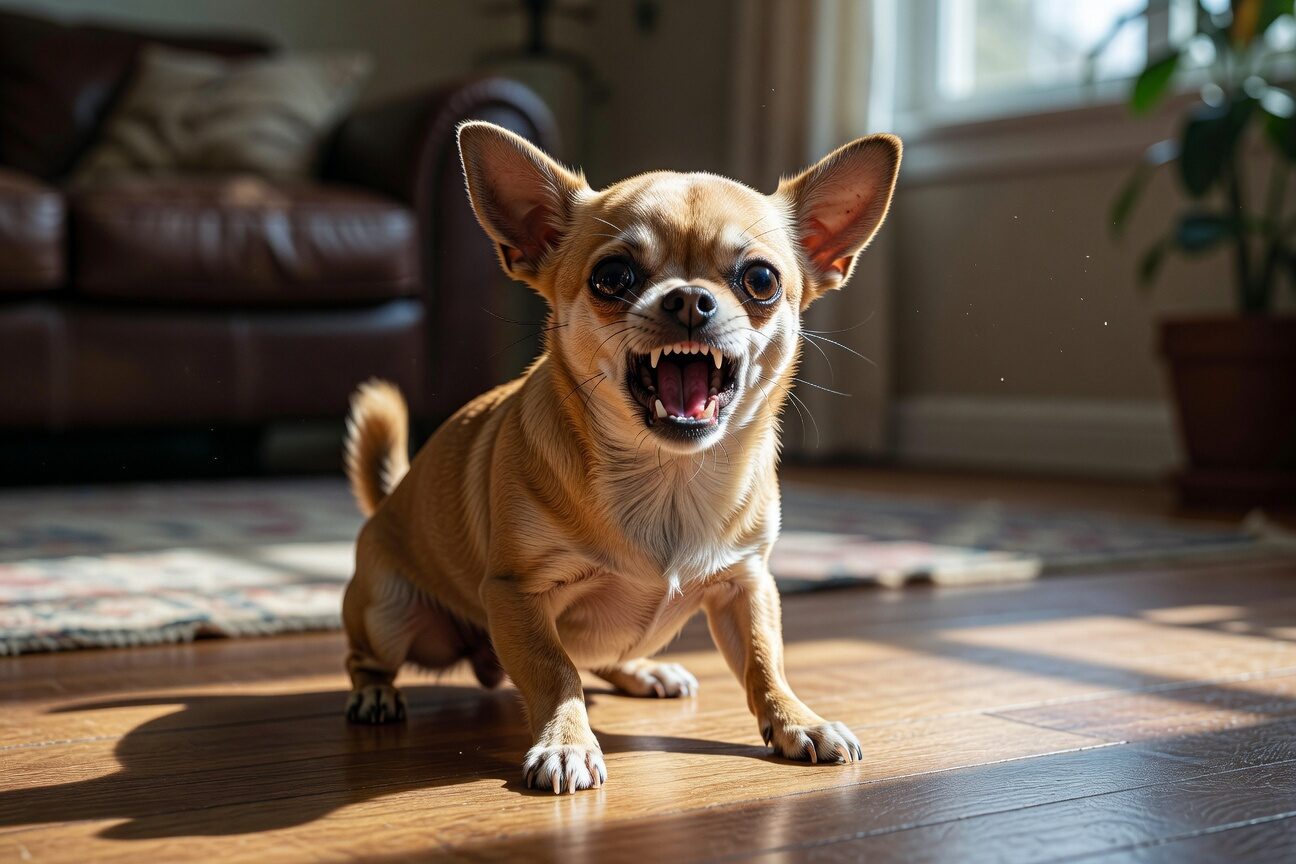

I was sitting on my friend’s patio last summer when her two-year-old reached for my chihuahua Biscuit and Biscuit snapped. Not a playful nip. A real, teeth-bared snap that missed the toddler’s hand by an inch. My stomach dropped. My friend went pale. And I stood there holding a four-pound dog who was trembling so hard I could feel his heartbeat through his ribs. I had been calling him “cranky” for months when the real problem was that my chihuahua is nervous enough to bite, and he had been screaming it at me in a language I never bothered to learn.
Fear-based aggression is the most common behavioral problem in chihuahuas. It almost never appears out of nowhere. There are always signals first, body language cues that your chihuahua is nervous and climbing toward a breaking point. We tend to laugh these off in small dogs. We call them “sassy” or “feisty” and in doing so we miss the fact that our dog is genuinely terrified and begging for help in the only way they know how.
Whole-Body Trembling When Your Chihuahua Is Nervous
Every chihuahua shivers. It is practically a breed trademark. But there is a massive difference between the shiver Biscuit does when I pull him from a warm blanket and the full-body earthquake he produces at the veterinarian’s office. Context tells you everything. If your chihuahua is nervous in a social setting, around new people, in a crowded place, or confronted with something unfamiliar, and they start trembling, that is not temperature regulation. That is their nervous system flooding with cortisol and preparing their tiny body for fight because flight means getting stepped on.
The AKC canine body language guide describes this kind of trembling as a reliable early stress indicator in small breeds. Biscuit would start shaking the moment we pulled into the vet parking lot. I used to tell the receptionist “he’s just dramatic” while he vibrated against my chest like a broken phone on silent. He was not dramatic. He was terrified.
Anxiety Trembling Versus Cold Shivering
Watch the ears and tail. A cold chihuahua shivers but their ears stay neutral and their tail position does not change. A chihuahua is nervous and trembling with anxiety when the shaking comes with pinned-back ears, a tucked tail, dilated pupils, and a body that has gone rigid. They become smaller, tighter, like they are trying to fold themselves into nothing. That posture shift is the key difference.
Whale Eye and Head Turning When a Chihuahua Is Nervous
Whale eye is the single most useful warning sign I ever learned to recognize. It happens when your chihuahua turns their head away from something but keeps their eyes locked on it, showing the whites in a half-moon crescent. It looks almost comical, like a cartoon double-take, but it means your dog is saying I see that threat and I am preparing for it and I really wish it would leave. Biscuit does this every single time a stranger reaches toward him.
Along with whale eye, you will see active avoidance behaviors. Ducking behind your legs. Leaning away from whatever is approaching. Trying to walk in the opposite direction. These are distance-increasing behaviors and they are your chihuahua’s polite way of saying “no thank you” before they escalate to something less polite. The ASPCA identifies these as primary pre-aggression signals across all breeds.
Why Most People Miss These Signals
People miss whale eye because they are focused on petting the cute small dog and not watching the small dog’s face. They miss avoidance because they interpret ducking behind your legs as “shy” rather than “terrified.” You can learn more about reading these cues in our guide on chihuahua aggression.
Stress Yawning and Lip Licking Outside Mealtimes
This one fooled me for an embarrassingly long time. I would see Biscuit yawning at the dog park and think “aw, he is sleepy.” He was not sleepy. He was so stressed that his body was running through its entire repertoire of calming signals trying to de-escalate a situation he found overwhelming. Stress yawning looks different from tired yawning. It tends to be longer, wider, sometimes with a high-pitched whine at the end, and it happens repeatedly in quick succession.
Lip licking outside of mealtimes is the same story. A chihuahua is nervous and lip-licking is using a displacement behavior, something their body does automatically to cope with stress. VCA Hospitals, these calming signals appear well before any overtly aggressive behavior. They are the earliest warning on the ladder.
Memorize the Escalation Ladder
Lip licking leads to yawning leads to whale eye leads to growling leads to snapping. That is the typical sequence. Once you know it, you can intervene at lip-licking stage instead of waiting until your chihuahua has climbed to the top. I keep this mental checklist running every time Biscuit encounters something stressful and it has prevented more incidents than I can count. Our article on recognizing chihuahua anxiety covers each stage in detail.
The Freeze That Means a Chihuahua Is Nervous Enough to Bite
There is a moment trainers call a “freeze” when a stressed dog stops moving entirely. Not relaxed stillness. Rigid, locked, every muscle engaged, like someone pressed pause. When Biscuit freezes, his eyes get huge, his body goes stiff, and the temperature of his ears drops because blood rushes to his core muscles. I can actually feel his ears get cold in my hand when this happens.
Freezing is dangerous because it is the last stop before fight. A dog who is lip-licking still has emotional bandwidth. A dog who freezes has stopped trying to manage the situation and is calculating whether to bite. If you see your chihuahua freeze, do not wait. Pick them up calmly, create distance, and decompress. Our guide on helping a stressed chihuahua covers specific techniques.
Growling Is Communication, Not Disobedience
Growling is good. Growling is your chihuahua saying “I am scared and I need space and I am telling you before I do something we will both regret.” If you punish a growl, yelling, squirting water, shaking a penny can, you do not eliminate the fear. You eliminate the warning. And a dog who has been taught that growling gets punished will skip it and go straight to biting without any signal at all.
My trainer told me “that growl just saved that child from a bite, and if you punish it, the next time there will be no growl.” I have never scolded a growl since. When Biscuit growls, I calmly remove him and note what triggered it. A chihuahua is nervous enough to growl means respecting the communication, not silencing it. The PetMD behavior guide recommends this exact approach for fear-reactive dogs.
Frantic Barking That Gets Higher and More Desperate
Not all barking is anxiety. Biscuit barks at the mailman because patrolling the border is his self-appointed duty and he takes it very seriously. That bark is sharp, rhythmic, and stops the moment the mailman leaves. Anxiety barking sounds completely different. Higher pitched, more frantic, escalating instead of steady. It often comes with pacing, spinning, or running between you and the trigger. Our guide on why chihuahuas bark at everything explains the different bark types in detail.
Watch for the transition from barking to silence. A chihuahua who has been barking frantically and suddenly goes quiet has not calmed down. They have escalated past barking into the freeze state, and teeth may follow. This pattern is especially common when people ignore the barking and keep approaching.
What Changed When I Learned to Read These Warning Signs
Biscuit is not a different dog now. He is still anxious, still suspicious of strangers, still deeply offended by the vacuum cleaner. But he has not snapped at anyone in over a year because I changed, not because he did. I learned to read the trembling, the whale eye, the lip licking, the freeze. I learned that when my chihuahua is nervous, my job is not to force him through it. My job is to notice and respond before he has to escalate.
We worked with a certified trainer for four months. We did careful desensitization. We established a safe zone protocol where Biscuit can always retreat to his crate and nobody follows him. If you recognize any of these signs in your own chihuahua, please do not wait until there is a snap. Every signal is your dog asking for help in the only language they have. Learn it. Trust it. And be the owner your nervous chihuahua needs — the one who listens. See also our socialization guide for building confidence in anxious chihuahuas.
Most fear-based aggression emerges between 6 and 18 months during the critical socialization window. However, chihuahuas can develop anxiety-driven aggression at any age after trauma, illness, or major environmental change. Early positive socialization between 3 and 14 weeks dramatically reduces the likelihood of nervous aggression developing later.
Yes, removing your chihuahua from a stressful situation is the correct response when you see early warning signs like trembling, whale eye, or lip licking. Picking them up creates immediate distance from the trigger. Avoid scooping them up frantically though, as your panic transfers to the dog. Stay calm, lift gently, and move away without drama.
Most chihuahuas with fear-based aggression improve significantly with consistent desensitization training and proper management, though completely cured is too strong for most cases. The goal is raising their stress threshold so they handle everyday situations without escalating. A certified trainer specializing in small breeds and fear-based behavior gives you the best results.
Chihuahuas are not inherently more aggressive but they are more easily frightened due to their tiny size. A Great Dane has less reason to feel threatened by a stranger’s reaching hand because that hand is not the size of their entire body. Poor socialization and owners who dismiss fear signals as cute contribute heavily to higher reported aggression rates in the breed.
Chihuahuas generalize fear based on characteristics of people who previously frightened them. If your dog was startled by a tall man in a hat, they may become nervous around all tall men in hats. They also react to approach style. People who lean over them, make direct eye contact, or approach quickly trigger more defensive responses than people who crouch sideways and let the dog approach first.
At what age do chihuahuas start showing nervous aggression?
Most fear-based aggression emerges between 6 and 18 months during the critical socialization window. However, chihuahuas can develop anxiety-driven aggression at any age after trauma, illness, or major environmental change. Early positive socialization between 3 and 14 weeks dramatically reduces the likelihood of nervous aggression developing later.
Should I pick up my chihuahua when they show nervous signs around other dogs?
Yes, removing your chihuahua from a stressful situation is the correct response when you see early warning signs like trembling, whale eye, or lip licking. Picking them up creates immediate distance from the trigger. Avoid scooping them up frantically though, as your panic transfers to the dog. Stay calm, lift gently, and move away without drama.
Can nervous aggression in chihuahuas be completely cured?
Most chihuahuas with fear-based aggression improve significantly with consistent desensitization training and proper management, though completely cured is too strong for most cases. The goal is raising their stress threshold so they handle everyday situations without escalating. A certified trainer specializing in small breeds and fear-based behavior gives you the best results.
Is it true that chihuahuas are naturally more aggressive than bigger dogs?
Chihuahuas are not inherently more aggressive but they are more easily frightened due to their tiny size. A Great Dane has less reason to feel threatened by a stranger’s reaching hand because that hand is not the size of their entire body. Poor socialization and owners who dismiss fear signals as cute contribute heavily to higher reported aggression rates in the breed.
Why does my chihuahua only show aggression toward certain people?
Chihuahuas generalize fear based on characteristics of people who previously frightened them. If your dog was startled by a tall man in a hat, they may become nervous around all tall men in hats. They also react to approach style. People who lean over them, make direct eye contact, or approach quickly trigger more defensive responses than people who crouch sideways and let the dog approach first.