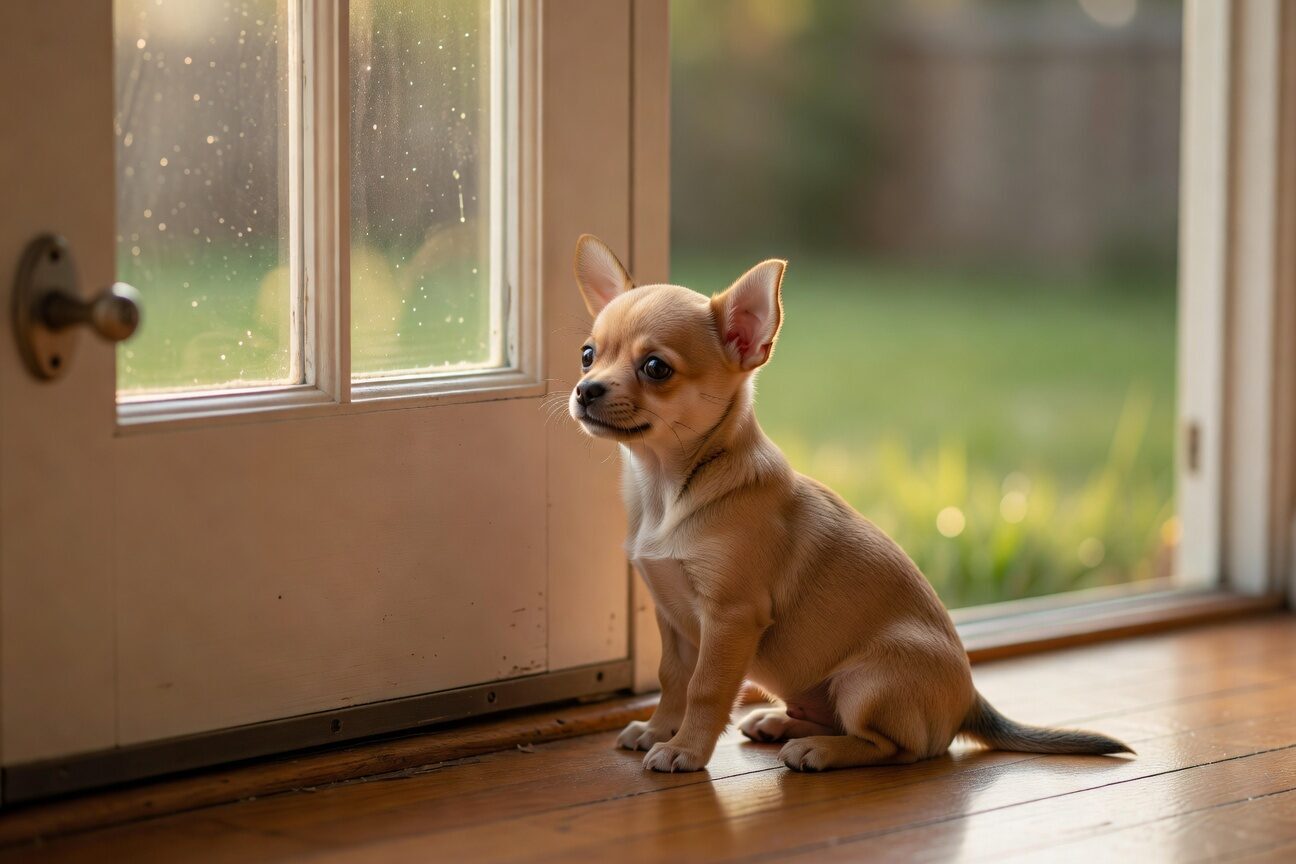

Nobody tells you that housebreaking a chihuahua puppy is going to feel like a second job that you are deeply unqualified for. When I brought Mochi home at ten weeks old, I had this vision of a smooth transition, a few accidents, some positive reinforcement, and we would be golden within a week. What actually happened was three weeks of standing outside in my pajamas at 5 AM waiting for a four-pound puppy to stop investigating every leaf on the ground and just pee already.
The thing about chihuahuas is that their bladders are roughly the size of a thimble. I am exaggerating, but barely. A chihuahua puppy needs to go out more frequently than larger breeds simply because there is less room to hold it in. When I first started tracking Mochi’s schedule, I was shocked to realize that he needed to go outside roughly every 45 minutes during his waking hours. That is not a typo. Every 45 minutes.
Why Chihuahuas Have a Reputation for Being Hard to Housebreak
I have heard people say that chihuahuas are stubborn, that they are impossible to housebreak, that small dogs just never really get it. I believed some of this myself during week two, when I discovered Mochi had been using the corner behind the armchair as his personal bathroom and I had no idea how long it had been going on.
Related: common Chihuahua health issues.
But here is what I have come to understand after going through this process twice now with two different chihuahuas. They are not stubborn about housebreaking any more than any other breed. They are just smaller, which means their accidents are easier to miss, their bladders fill up faster, and the signals they give when they need to go are more subtle. A German Shepherd puppy pacing by the door is pretty obvious. A chihuahua puppy sniffing in circles in the corner of the living room can look like normal puppy behavior if you are not paying attention.
The Crate Method Changed Everything for Us
I resisted crate training at first because the idea of putting Mochi in a box felt wrong to me. He was already so small and I wanted him to feel free and comfortable in his new home. What I did not realize is that dogs actually want a den. It is instinctive. They like having a small, enclosed space that belongs to them, and more importantly, they do not want to soil that space.
Once I got the right-sized crate, small enough that Mochi could stand up and turn around but not so big that he could use one end as a bedroom and the other as a bathroom, housebreaking started clicking. The routine was simple even if it was exhausting. Mochi would go in the crate when I could not directly supervise him. When he came out, we went straight outside to his designated spot. He did his business, I praised him like he had just won an Olympic medal, and then he got some supervised free time before the cycle started again.
The Schedule That Finally Worked
Here is what our housebreaking schedule looked like during those first few weeks, and yes, it was as intense as it sounds.
First thing in the morning, straight outside before anything else. After breakfast, outside within fifteen minutes. After every nap, outside immediately. After any play session, outside. Before bed, one last trip outside. And because Mochi was very young, I set an alarm to take him out once during the night for the first two weeks.
I kept a small notebook where I tracked when he ate, when he drank, and when he went to the bathroom. It sounds obsessive because it was obsessive, but patterns emerged quickly. I learned that Mochi always needed to go about twenty minutes after eating and almost immediately after waking up from a nap. Once I knew his patterns, I could anticipate his needs instead of reacting to accidents.
Dealing With Accidents the Right Way
I am going to be honest. During the worst of it, I found myself getting frustrated. There was one evening where Mochi peed on the rug literally five minutes after coming inside from a walk where he had done nothing. I could feel my patience fraying. But here is what I know now that I wish I had understood from the start. Punishing a chihuahua for having an accident does absolutely nothing productive. Understanding chihuahua housebreaking makes a real difference.
If you catch them in the act, you scoop them up mid-stream, take them outside, and praise them when they finish in the right spot. If you find the accident after the fact, you clean it up without saying a word. Dogs do not connect punishment with something they did ten minutes ago, and chihuahuas in particular can become anxious and fearful if they associate going to the bathroom with being yelled at. That fear leads to hiding it from you, which leads to discovering mystery puddles behind furniture, which leads to a much longer housebreaking process. com/chihuahua-puppy-socialization-guide/” title=”Why Socializing Your Chihuahua”>Why Socializing Your Chihuahua.
Enzyme cleaners are essential. Not optional, essential. If your chihuahua can still smell where they went before, they will go there again. Their noses are thousands of times more sensitive than ours. Even if you think you have cleaned the spot thoroughly, if you did not use an enzyme-based cleaner that breaks down the urine at a molecular level, your chihuahua knows it is still there.
What Nobody Tells You About Small Dog Housebreaking
There are a few chihuahua-specific realities that I had to learn the hard way. First, cold weather makes everything harder. Mochi absolutely refuses to go outside when the temperature drops below a certain point, and I cannot entirely blame him. He weighs six pounds and has almost no body fat. Standing on frozen ground is genuinely uncomfortable for him. During winter, I use a combination of a warm coat and a sheltered outdoor spot to make the experience less miserable for both of us.
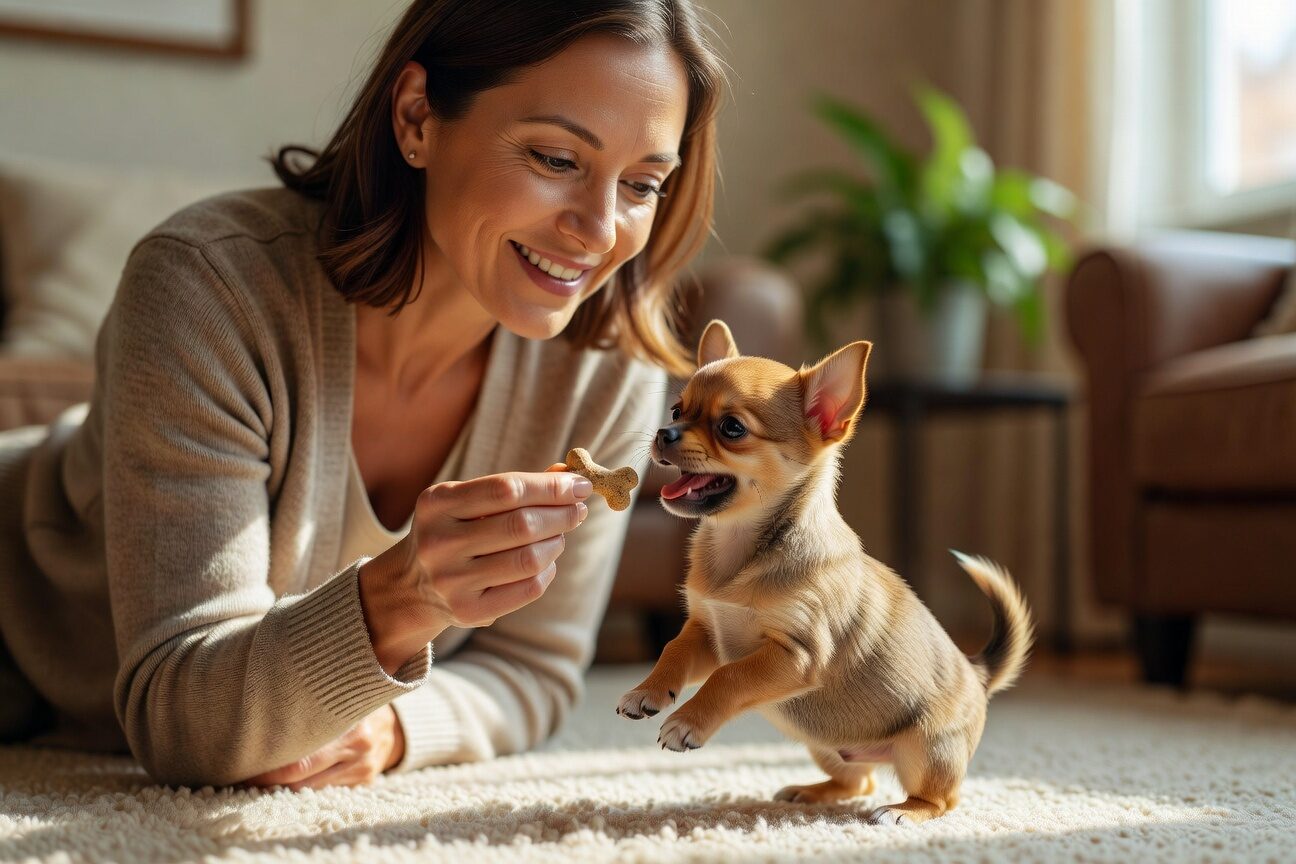
Second, if you live in an apartment, you need a plan for those moments when getting outside fast enough is not realistic. Some chihuahua owners use indoor potty pads as a backup, and while I personally found that this confused Mochi about where he was supposed to go, other owners have made it work by always keeping the pad in the same spot and treating it as the indoor equivalent of the outdoor bathroom area. That is the reality of chihuahua housebreaking.
Third, regression happens. Mochi was almost fully housebroken at about four months when he suddenly started having accidents again. I panicked and called the vet, who told me this was normal and that many puppies go through a regression phase. We went back to basics, tightened up the schedule, and within a week he was back on track.
The Light at the End of the Tunnel
Mochi is two years old now and I cannot remember the last time he had an accident. He goes to the door when he needs to go out, he has a specific spot in the yard he prefers, and he handles car trips and visits to other people’s homes without any issues. It took about three months of consistent effort to get to this point, which felt like an eternity at the time but is actually pretty standard.
If you are in the middle of housebreaking your chihuahua right now and you are questioning every decision that led you here, I want you to know that it does get better. Be consistent, be patient, and remember that your chihuahua is not being defiant. They are learning something completely new with a very small bladder and a very big world to figure out. For more tips on training your chi, check out this guide on how to train a chihuahua puppy and this piece on top tips for training a chihuahua.
For more detailed guidance on this topic, the American Kennel Club offers excellent resources backed by veterinary professionals.
I have been through this with my own chihuahua. It is one of those things that looks simple on paper but gets complicated fast when you are actually dealing with a four-pound dog who has opinions about everything.
The truth about chihuahua housebreaking is that there is no single right answer. What works for one chihuahua might be completely wrong for another. Mine took weeks to adjust. Some dogs figure it out in days. The size of your chihuahua matters. Their age matters. Their personality matters most of all.
Here is what I wish someone had told me earlier. Start small. Do not try to change everything at once. Chihuahuas are stubborn but they are also sensitive. Push too hard and they shut down. Go too slow and nothing changes. The sweet spot is somewhere in the middle and you have to find it yourself.
I talked to other chihuahua owners about chihuahua housebreaking and heard the same thing over and over. Patience. Consistency. And a willingness to look a little silly in public because chihuahuas do not care about your dignity.
If you are just getting started with chihuahua housebreaking, give yourself grace. You will make mistakes. Your chihuahua will make more of them. That is the whole process. And honestly, once you get through the hard part, it is worth it.