
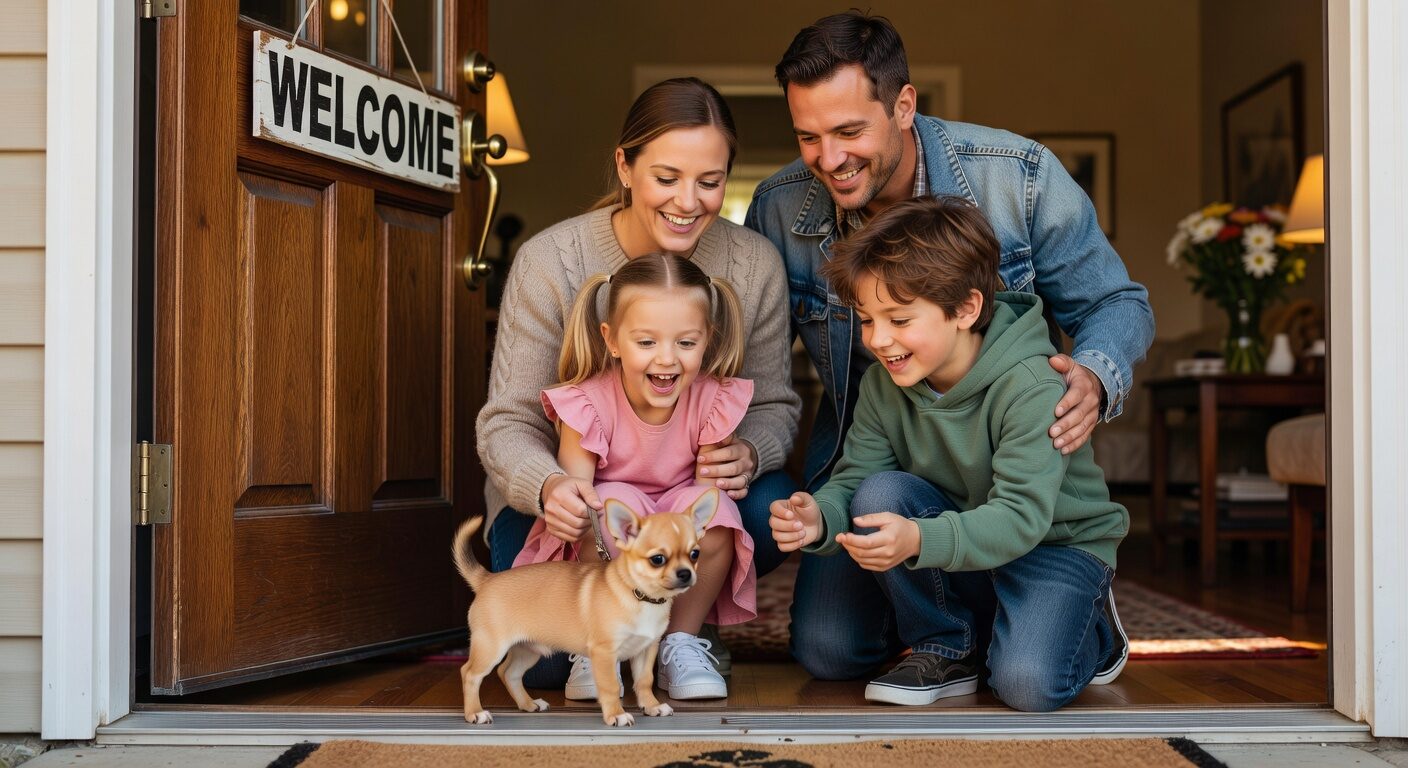

The day I picked up my chihuahua puppy Waffles from the breeder, I drove forty-five minutes on the highway with her on my lap, unsecured. I thought she would be calmer if she could feel me. She trembled the entire way, threw up once on my jeans, and tried to climb under the brake pedal twice. Getting your chihuahua puppy home safely sounds like the easiest part of the process. It is not.
The Car Ride: Getting Your Chihuahua Puppy Home Safely
The safest way to transport a chihuahua puppy home in a car is inside a secure carrier buckled in with a seatbelt. The carrier should be small enough that the puppy feels contained but large enough for them to stand up, turn around, and lie down. Line it with a soft towel or pad. Put something in there that smells like their litter or their previous home if you can, because familiar scents reduce stress dramatically.
The carrier goes on the back seat, never the front. Airbags are designed for adult humans and they can kill a small dog if they deploy. The carrier should be facing forward and secured so it cannot slide around during stops or turns. I learned all of this after my disastrous first trip with Waffles. If I could do it again, I would have the carrier set up and ready before I even left the house. The AKC’s safe driving with dogs guide recommends crash-tested carriers or harnesses for every car trip, not just the first one.
Keep the drive as short as possible. Stop every hour for a brief potty break if it is a long trip. Bring paper towels, waste bags, water, and a spare towel in case of motion sickness. Some puppies vomit from nerves alone, and a chihuahua puppy on their first car ride has plenty of reasons to be nervous. Talk to them softly. Play low music. Be the calm they need you to be.

Flying Your Chihuahua Puppy Home: What to Know First
If your chihuahua puppy is coming from a breeder in another state, you may be dealing with airline transport. Most major airlines allow small dogs in the cabin in an approved carrier that fits under the seat. For a chihuahua puppy, sizing is rarely an issue. The dog is small enough. The question is whether the experience is worth the stress on a puppy who has never been in an environment louder than your living room.
Book a direct flight if at all possible. Layovers mean more handling, more noise, and more time in the carrier without a break. According to PetMD’s air travel guide for dogs, puppies under twelve weeks should not fly at all unless medically necessary. Their immune systems are still developing and the stress of air travel can compromise them further.
Never ship a chihuahua puppy as cargo. The temperature fluctuations, the noise, the isolation, it is too much for any small dog and it is especially dangerous for a breed that is already vulnerable to cold and stress. If a breeder suggests cargo shipping as the only option, find a different breeder. Your chihuahua puppy home journey should start with safety, not convenience.
The First Day in Your Chihuahua Puppy’s New Home
I made so many mistakes on Waffles’ first day. I invited three friends over to meet her. I let her explore the entire house at once. I bought her five different toys and spread them across the living room. She spent the first four hours hiding under the couch, shaking, and I could not figure out why.
A chihuahua puppy coming into a new home needs the opposite of what our excitement wants to give them. They need one small room. One bed. One toy. One person sitting quietly on the floor. Let them come to you. Let them sniff the corners. Let them figure out that this new space is safe before you start adding variables. com/the-chihuahua-who-walked-three-miles-home-after-being-dumped-on-the-highway/” title=”The Chihuahua Who Walked Three Miles Home After Being Dumped”>The Chihuahua Who Walked Three Miles Home After Being Dumped.
The first night is usually the hardest. Waffles cried for two hours straight. I sat next to her crate with my hand against the door and read out loud from whatever book was closest because the sound of my voice seemed to help. By the third night she was sleeping through until five in the morning, which felt like a victory. For more on those early days, check out what I bought before bringing my chihuahua home.

The Research That Saved Us Heartache During Our Chihuahua Puppy Home Journey
Before Waffles, I did not know that chihuahua puppies are prone to hypoglycemia during stressful transitions. I did not know that their fontanels might still be open at eight weeks. I did not know that a temperature drop of just a few degrees could send a tiny puppy into a dangerous spiral. I learned all of this in the first seventy-two hours after bringing her home, mostly through panicked late-night internet searches.
Do the research before you bring your chihuahua puppy home, not after. Know what signs of hypoglycemia look like: lethargy, trembling, uncoordinated movement, glazed eyes. Keep Karo syrup or honey on hand. Know your emergency vet’s number and hours. Have a heating pad ready for the crate. Understand that a chihuahua puppy’s temperature regulation is unreliable for the first several weeks and that room temperature might not be warm enough for them.
I also wish someone had told me about the socialization window. The period between three and fourteen weeks is critical for exposing your chihuahua puppy to new people, sounds, surfaces, and experiences. If you miss it, you spend the next two years trying to undo the anxiety that settled in during those weeks of isolation. You can read about what happens when socialization gets skipped in my honest account of that mistake.
What I Would Do Differently Bringing a Chihuahua Puppy Home
If I could go back to the day I brought Waffles home, I would do almost everything differently. I would have the carrier in the car ready to go. I would drive in silence instead of playing music I thought she would like. I would have one quiet room prepared with everything she needed instead of giving her the run of the house.
I would not invite anyone over for at least a week. I would sit on the floor more. I would let her cry in the crate without trying to fix it every time, because she needed to learn that the crate was safe and that she could survive being alone for ten minutes. Every chihuahua puppy home transition is different, but the principles stay the same: go slow, stay calm, make the space small, and let the puppy tell you when they are ready for more.
Waffles is three now. She is confident, healthy, and has opinions about everything. The rough start did not break us. But it would have been so much easier on both of us if I had known then what I know now. If you are bringing a chihuahua puppy home soon, learn from my mess. Your tiny new family member is counting on you to get it right, or at least close enough. Also read my experience with chihuahua emergencies so you are prepared for anything.

What do I need before bringing a chihuahua puppy home?
You need a small secure carrier for transport, a crate sized for a chihuahua, soft bedding, puppy food recommended by the breeder, shallow water and food bowls, puppy pads, a few small toys, Karo syrup or honey for hypoglycemia emergencies, paper towels, and your emergency vet’s contact information. Set up one quiet room with all essentials before pickup day so the space is ready when your puppy arrives.
How long will a chihuahua puppy cry the first night?
Most chihuahua puppies cry for one to three hours on their first night in a new home. This is completely normal. Place the crate near your bed so the puppy can hear and smell you. A ticking clock or white noise machine can help simulate the heartbeats of their littermates. Avoid taking the puppy out of the crate every time they cry, as this teaches them that crying earns freedom. By the third or fourth night, most chihuahua puppies settle significantly.
Can I fly with a chihuahua puppy in the cabin?
Yes, most airlines allow chihuahua puppies in the cabin in an approved soft-sided carrier that fits under the seat. However, puppies under twelve weeks should not fly due to their developing immune systems. Book a direct flight to minimize stress, and check your airline’s specific pet policies including any required health certificates. Never ship a chihuahua puppy as cargo, as the temperature changes and isolation are too dangerous for a small breed.
What temperature is safe for a chihuahua puppy?
Chihuahua puppies need ambient temperatures between 70 and 80 degrees Fahrenheit for the first several weeks. Their tiny bodies cannot regulate temperature effectively, and even a few degrees below their comfort zone can lead to dangerous chilling. Use a heating pad on low under half the crate so the puppy can move away if they get too warm. Never place a chihuahua puppy in a drafty area or near air conditioning vents.
How do I prevent hypoglycemia in a new chihuahua puppy?
Feed your chihuahua puppy small meals every three to four hours for the first few weeks to maintain stable blood sugar. Keep Karo syrup or honey available for emergencies. Signs of hypoglycemia include lethargy, trembling, uncoordinated movement, and glazed eyes. If you notice these symptoms, rub a small amount of syrup on their gums immediately and contact your vet. Stress from a new environment can trigger episodes, so keep the transition as calm and gradual as possible.