
When Biscuit was a puppy, the jumping was adorable. He weighed two pounds. He would stretch his front paws up my shin, vibrating with excitement, and I would scoop him up every single time. What a sweet little dog, I thought. He loves me so much. If you’re reading about stop chihuahua jumping, you’re in the right place.
What I was actually doing was training him to believe that jumping on people was the correct way to get attention. I did this for approximately eight months before I realized the problem. By then, Biscuit was a fully committed jumper. On me. On guests. On my elderly mother. On the delivery person. On anyone who stood still long enough.
I know what you are thinking. He is a chihuahua, how bad can it be. He weighs five pounds. Here is the thing. A five-pound dog scratching up your legs when you are wearing shorts draws blood. A five-pound dog launching himself at a toddler’s face is genuinely dangerous. And a five-pound dog who jumps on every guest that walks through your door makes people not want to visit your house.
Related: common Chihuahua health issues.
Why Your Chihuahua Jumps and Why It Is Partly Your Fault
Chihuahuas jump for the same reason any dog jumps – to get closer to you. They are greeting you. They are expressing excitement. They want your face because that is where the attention comes from. The difference with chihuahuas is that we reward the behavior more consistently than we would with a large breed, because it seems harmless when they are tiny.
We send mixed signals constantly. The jumping is cute in the morning when Biscuit wakes you up. The jumping is helpful when you are trying to clip his leash on. The jumping is a problem when your boss is at the door. But Biscuit does not understand context. He does not know the difference between Tuesday morning and Saturday evening with company over. He knows one thing: jumping has historically gotten him picked up, pet, and praised.
Dogs cannot do “sometimes.” This is the single most important thing I learned about training chihuahuas. If jumping is allowed sometimes, it is always allowed in their mind. You are either training against jumping or you are training for it. There is no neutral.
The Four Steps That Actually Work
Step One: Decide and Commit
Before you do anything else, decide if you want the jumping to stop completely. Not mostly. Completely. Then ask yourself when you are being inconsistent. When do you reward the jumping? When do you allow it? When do you actively encourage it? Be honest. I was not honest with myself for months and it slowed everything down.
Everyone in the household needs to be on the same page. If you are discouraging jumping but your partner picks Biscuit up every time he leaps at their legs, you are wasting your time. Consistency requires consensus.
Step Two: Stop Reinforcing the Behavior
This sounds obvious. It is not. Every time you look at your chihuahua when he jumps, you are reinforcing it. Every time you push him down with your hands, you are reinforcing it – to a chihuahua, even negative physical contact is still contact. Even yelling his name is a form of attention.
The hardest part of this process is doing nothing. When Biscuit jumps, I go still. Completely still. I turn my body slightly away. I do not look down. I do not speak. I become the most boring object in the room. For a chihuahua who is used to getting a reaction, this is severe. You can practically see the confusion.
Step Three: Give an Incompatible Command
This is the technique that changed everything. Instead of trying to stop a behavior, you replace it with a different one. A dog cannot jump and sit at the same time. These are physically incompatible actions.
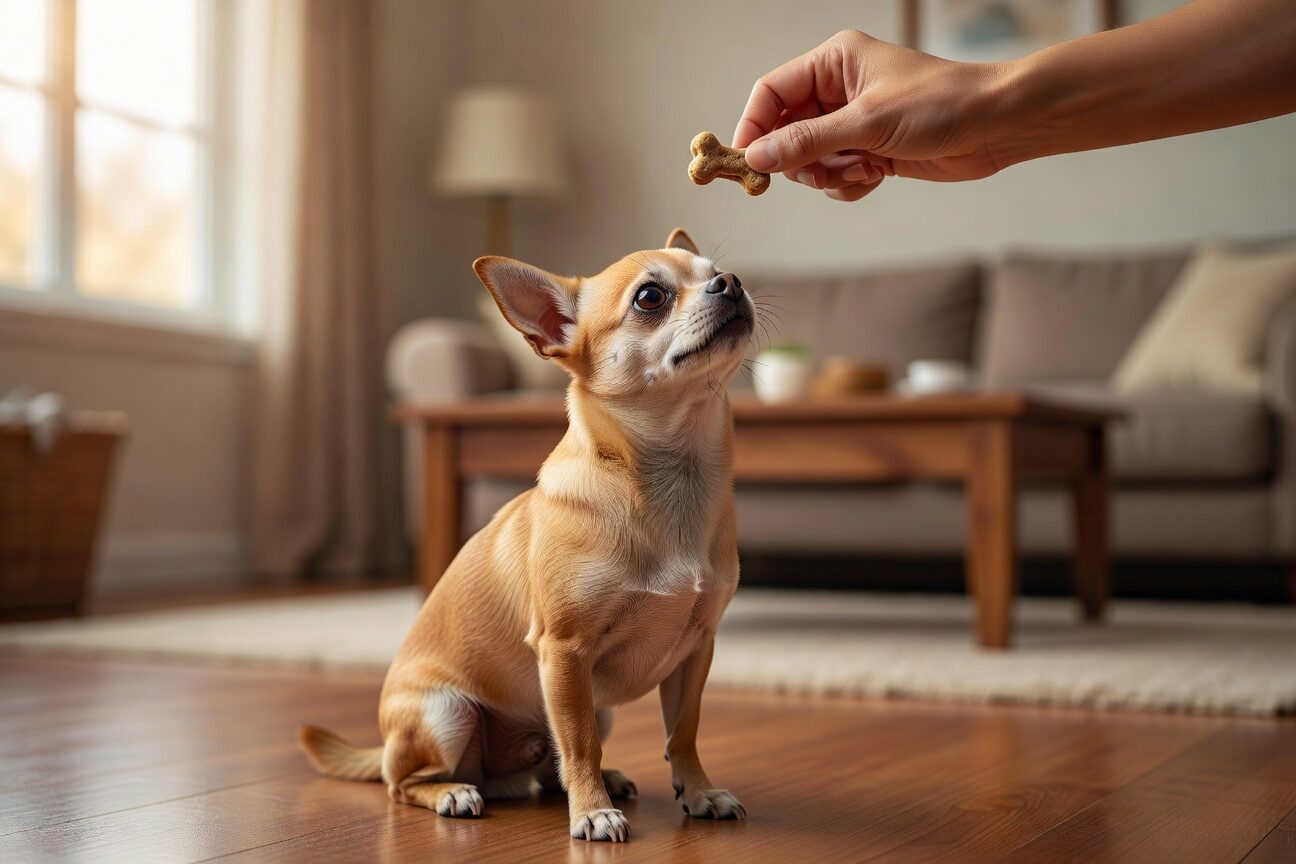
When Biscuit starts jumping, I go still, then calmly say “sit.” If he does not sit on his own, I gently help him into the position. The moment his bottom touches the ground, he gets everything – praise, attention, treats if I have them. Sit becomes the new way to say please. Sit becomes the behavior that unlocks all the good things jumping used to provide.
If he pops back up and jumps again, we start over. Go still. Turn away. Wait. Ask for sit. Praise the sit. It is repetitive. It is sometimes tedious. It works. com/training-older-chihuahua-new-tricks/” title=”Can You Really Train an Older Chihuahua?”>Can You Really Train an Older Chihuahua?.
Step Four: Practice With Guests
The real test is other people. Chihuahuas are especially excitable around visitors because visitors represent new energy, new smells, and new potential for attention. Brief your guests before they come in. Tell them not to pet the dog until he is sitting. Tell them to ignore the jumping entirely.
This is hard because most people’s instinct when a tiny dog jumps on them is to coo and pick it up. You need to be firm with your humans the same way you are firm with your dog. The training is for everyone.
Why This Matters More for Chihuahuas Than People Think
There is a physical reason to stop the jumping beyond good manners. Chihuahuas are prone to luxating patella – a condition where the kneecap slides out of place. Repeated jumping and landing puts stress on those tiny knee joints. Every time your chihuahua launches himself off his back legs, he is loading those joints with force they were not designed to handle repeatedly.
There is also the issue of what trainers call “small dog syndrome.” When we allow chihuahuas to do things we would never allow a large dog to do – jumping, nipping, demanding to be held – we create behavioral patterns that look like aggression and anxiety from the outside. The dog that jumps on everyone is often the same dog that barks at everything and snaps at strangers. These behaviors are connected. They all stem from a dog who has never learned that calm behavior gets rewarded.
How Long It Takes
With consistent effort from everyone in the household, most chihuahuas show significant improvement within two to three weeks. Complete reliability takes longer – maybe two or three months of absolute consistency. Super-exciting situations like visitors or coming home after a long day will be the last to improve. That is normal.
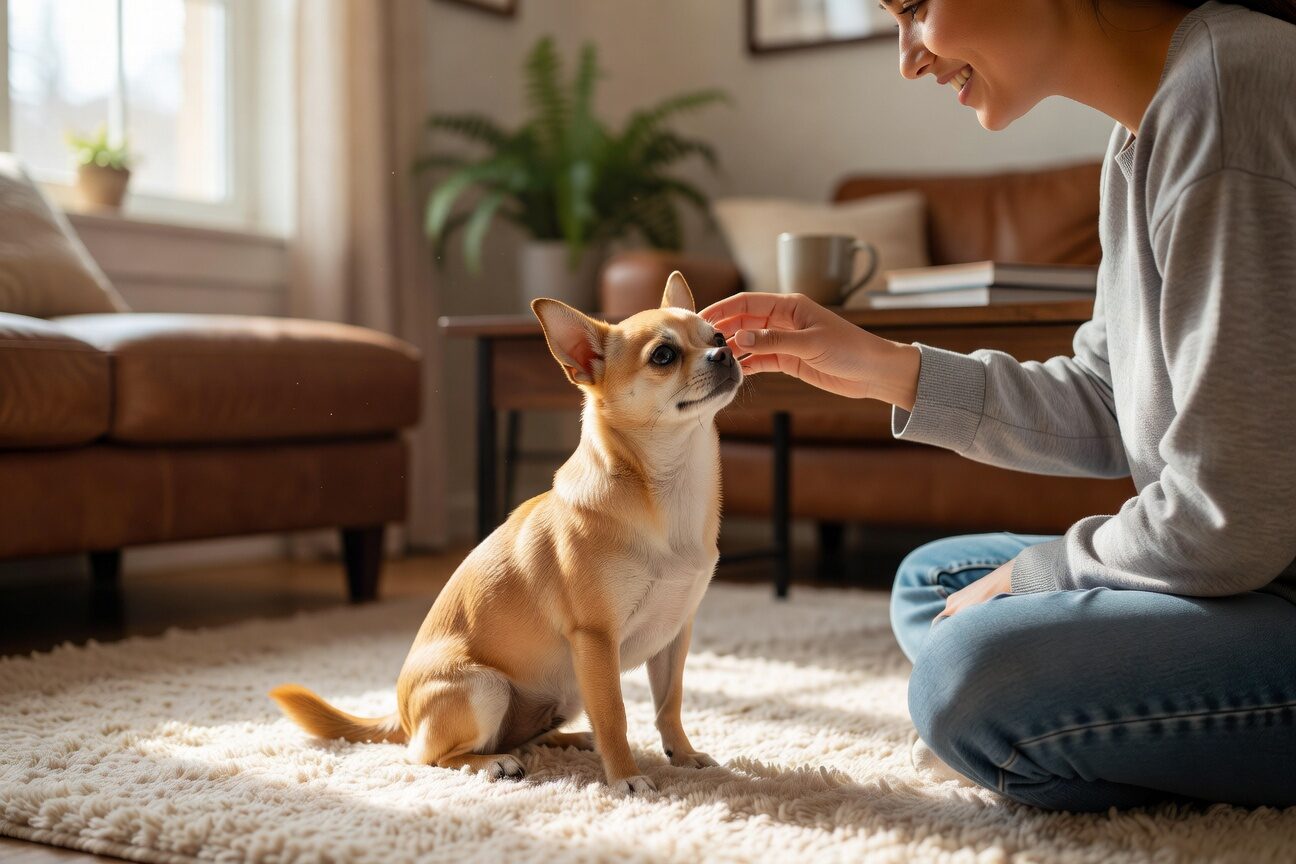
Biscuit still occasionally forgets himself when someone new walks in. He starts to jump, catches himself, and sits instead. Sometimes you can see the internal battle happening in real time. The sit wins more often than not now. When it does, he gets praised like he just graduated from an Ivy League university. That is the deal. Sit gets you everything. Jumping gets you nothing.
It is not complicated. It is just consistent. And with a chihuahua, consistency is the hardest part – because they are so small and so cute that every instinct in your body wants to reward exactly the behavior you are trying to stop.
For more detailed guidance on this topic, the American Kennel Club offers excellent resources backed by veterinary professionals.
I have been through this with my own chihuahua. It is one of those things that looks simple on paper but gets complicated fast when you are actually dealing with a four-pound dog who has opinions about everything.
The truth about stop chihuahua jumping is that there is no single right answer. What works for one chihuahua might be completely wrong for another. Mine took weeks to adjust. Some dogs figure it out in days. The size of your chihuahua matters. Their age matters. Their personality matters most of all.
Here is what I wish someone had told me earlier. Start small. Do not try to change everything at once. Chihuahuas are stubborn but they are also sensitive. Push too hard and they shut down. Go too slow and nothing changes. The sweet spot is somewhere in the middle and you have to find it yourself.
I talked to other chihuahua owners about stop chihuahua jumping and heard the same thing over and over. Patience. Consistency. And a willingness to look a little silly in public because chihuahuas do not care about your dignity.
If you are just getting started with stop chihuahua jumping, give yourself grace. You will make mistakes. Your chihuahua will make more of them. That is the whole process. And honestly, once you get through the hard part, it is worth it.
Are chihuahuas hard to train?
Chihuahuas are intelligent but independent. They respond well to positive reinforcement with high-value treats. Harsh corrections are counterproductive. Short, consistent training sessions of five minutes produce better results than longer ones.
How long does it take to train a chihuahua?
Basic commands can be learned in two to four weeks with daily practice. Behavior modification for established issues like barking or biting typically takes six to twelve weeks of consistent work. Patience is more important than intensity.
What is the best training method for chihuahuas?
Positive reinforcement using food rewards works best. Chihuahuas are food-motivated and respond to clear, consistent cues paired with immediate rewards. Punishment-based methods increase fear and worsen most chihuahua behavior problems.
What should I know about chihuahua jumping?
Understanding chihuahua jumping requires attention to breed-specific needs. Chihuahuas are small dogs with unique health, behavioral, and care requirements. Consulting your veterinarian and learning from experienced owners provides the most reliable guidance for your specific situation.