
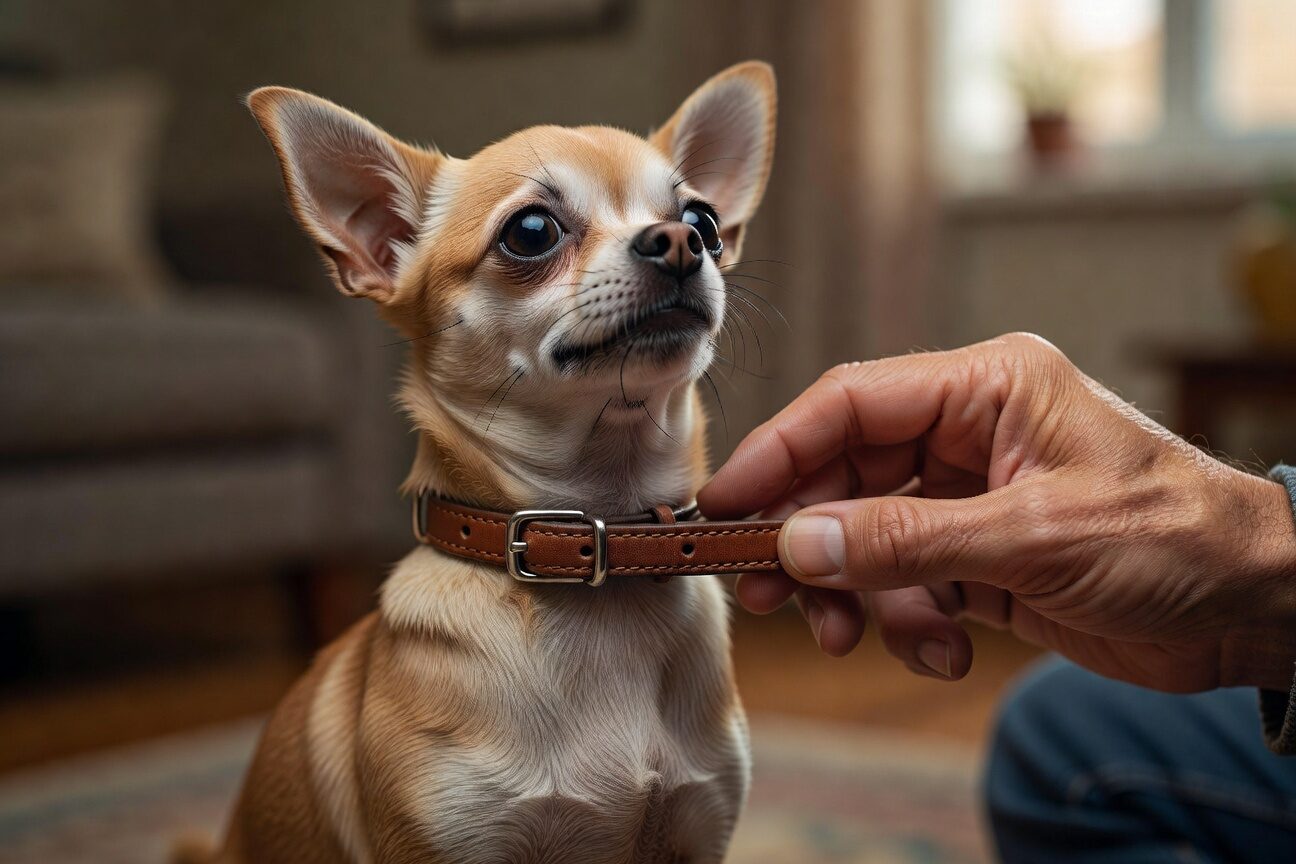

I used a standard flat collar on my chihuahua Rosie for the first three years. Nice leather. Pretty tag dangling from the ring. It looked good. It felt right. Then one morning she yelped when I picked her up – a sharp, startled sound I had never heard before – and the vet told me she had cervical subluxations. Misaligned vertebrae in her neck. Probably from collar pressure during walks. This chihuahua collar safety guide has everything you need.
I had caused this. Not deliberately. Not through cruelty or neglect. Through ignorance. I did not know that the collar I chose, combined with the way I handled the leash, could damage a four-pound dog’s spine. Nobody told me. I had to find out at the vet, watching my chihuahua flinch when the doctor pressed along her neck.
This is the article I wish someone had written for me before that happened.
Related: common Chihuahua health issues.
Why Chihuahua Necks Are Especially Vulnerable
Chihuahuas have delicate cervical spines. Their necks are thin. Their tracheas are narrow. And many chihuahuas are prone to a condition called tracheal collapse, where the cartilage rings supporting the windpipe weaken and flatten over time. External pressure on the neck – from collars, from leash tension, from being pulled or restrained – accelerates this process.
The upper two cervical vertebrae are where the body meets the brain. According to veterinary chiropractors, improper collar use is the number one cause of cervical subluxations in dogs. For chihuahuas, this is amplified by their size. What is a minor tug on a sixty-pound dog’s neck is a significant force on a three-pound dog’s spine.
And here is the part that got me. Most of the damage does not show up immediately. The subluxations and disc problems develop slowly over months and years of repeated stress. By the time symptoms appear – reluctance to look up, stiffness, yelping when touched – the damage is already significant.
Chihuahua Harness Vs Collar: What Every Collar Type Actually Does to Your Chihuahua
Flat Collars
The standard flat collar – nylon or leather with a buckle and a D-ring for the leash. This is what most people buy first. It is fine for holding tags. It is not fine for walking a chihuahua who pulls, lunges, or needs to be restrained.
Every time you pull back on the leash to stop your chihuahua from surging forward, the collar concentrates that force directly on the cervical spine. Muscles tighten. Vertebrae shift. Over time, disc problems develop. If your chihuahua pulls on walks – and honestly, most chihuahuas pull because they have opinions about where they should be going – a flat collar is slowly doing damage you cannot see.
Choke Chains
<!– wp:If I could ban one product from being used on chihuahuas, it would be the choke chain. The theory is that the dog feels the chain tighten and eases back. The reality is that a dog's instinct when it feels something tightening around its neck is to pull away from it, which tightens the chain further. Your chihuahua could literally restrict its own airway. should consider.
On a breed already prone to tracheal collapse, this is not a training tool. It is a health hazard. There is no scenario where a choke chain is appropriate for a chihuahua. None. com/the-chihuahua-who-chased-a-coyote-out-of-a-backyard-and-became-a-neighborhood-legend/” title=”The Chihuahua Who Chased a Coyote Out of a Backyard”>The Chihuahua Who Chased a Coyote Out of a Backyard.
Head Collars and Gentle Leaders
These fit over the dog’s muzzle and the leash attaches under the chin. The idea is to redirect the head rather than restrain the neck. In theory, this is gentler. In practice, turning a chihuahua’s head too sharply or with too much force can cause the same upper cervical problems as a flat collar. Chihuahua necks are simply too small and too fragile for aggressive redirection.
Standard Harnesses
This is what most chihuahua owners switch to – and it is a significant improvement over any collar. A harness distributes pressure across the chest and shoulders instead of concentrating it on the neck. For chihuahuas with tracheal concerns, a harness is considered essential by most veterinarians.
But harnesses are not perfect. If the fit is wrong or if you yank the leash when your chihuahua pulls, you can cause subluxations in the lower neck, shoulder, and chest area. The force has to go somewhere. A properly fitted harness with a calm leash hand is the key. com/recognizing-chihuahua-anxiety/” title=”Chihuahua Anxiety: Recognizing”>Chihuahua Anxiety: Recognizing. The American Kennel Club provides detailed guidance on health considerations for small breeds.
I switched Rosie to a step-in harness the day after her diagnosis. It took her three days to stop being suspicious of it and about a week to accept it as normal. Her neck symptoms improved noticeably within a month.
How to Choose the Right Harness for a Chihuahua
Not all harnesses are created equal, especially for dogs this small. Here is what I have learned through trial and error and one embarrassing harness that Rosie stepped right out of in a parking lot.
Look for a step-in design rather than an over-the-head style. Many chihuahuas resist having things pulled over their heads, and the struggle itself can strain the neck. A step-in harness lets the dog walk into it and you clip it across the back.
The harness should fit snugly but not tightly. You should be able to slide two fingers between the harness and your chihuahua’s body. Check the fit regularly – chihuahuas can fluctuate in weight and a loose harness is as bad as no harness regarding control.
Padded straps reduce friction and pressure points. Mesh material breathes better than solid nylon, which matters for chihuahuas who overheat easily. And make sure the D-ring attachment is on the back, not the front – front-clip harnesses can cause gait problems in very small dogs. Understanding chihuahua collar makes a real difference.
Leash Handling Matters as Much as the Equipment
Even with the best harness, poor leash technique causes problems. The number one mistake chihuahua owners make is yanking the leash when the dog pulls or stops. We do it out of frustration. We do it without thinking. And every yank sends force into our tiny dog’s body.
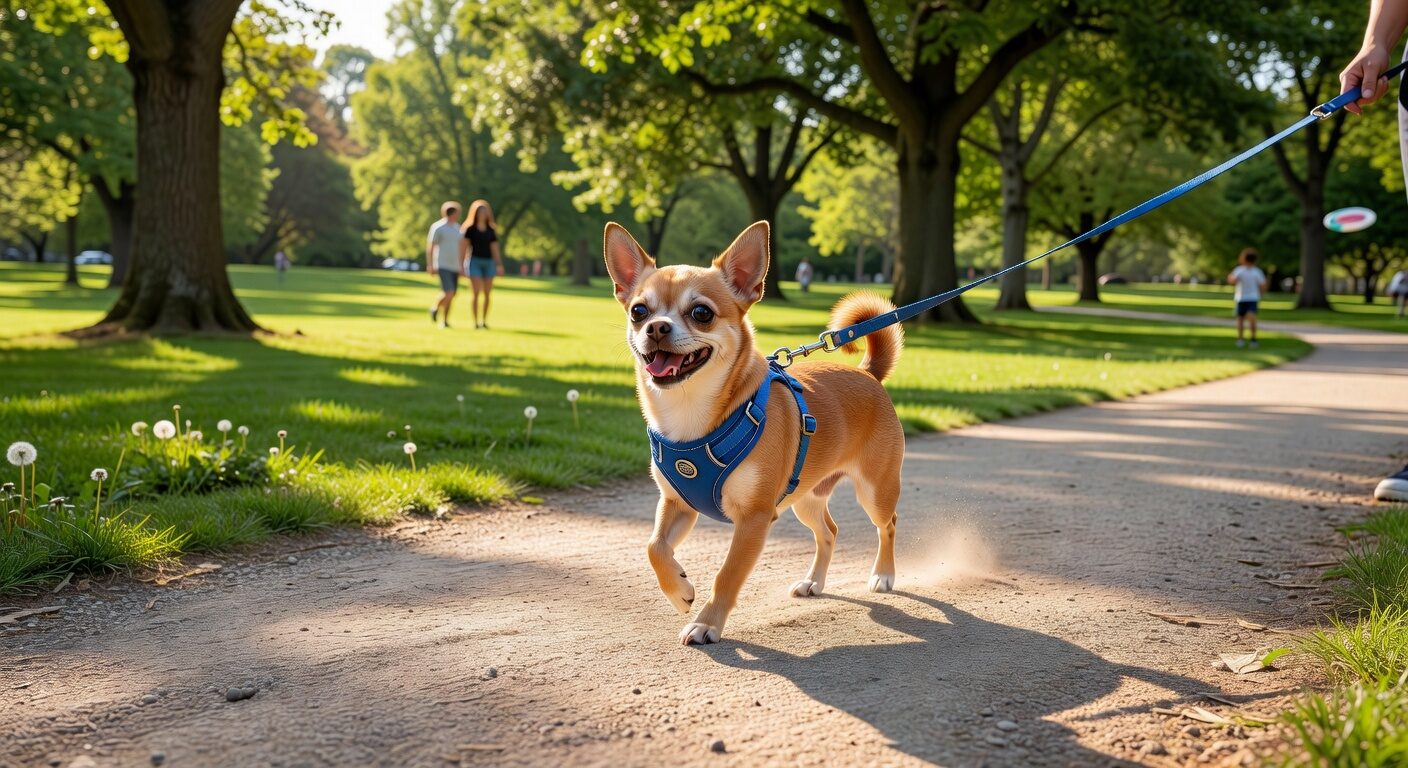
Instead, practice loose-leash walking. When your chihuahua pulls, stop walking. Stand still until the leash relaxes. Then move forward. The message is simple – pulling gets you nowhere, walking nicely gets you everywhere. It takes patience. More patience than most people expect. But it protects your chihuahua’s neck and spine in the long run.
Use a four to six foot leash, not a retractable one. Retractable leashes encourage pulling by design – the constant tension teaches your dog to pull against resistance. They also allow your chihuahua to build up speed and hit the end of the leash at full force, which is terrible for the neck and spine.
Other Things That Strain a Chihuahua’s Neck
Collars are the biggest culprit, but they are not the only one. Sleeping on hard surfaces without proper support can cause stiffness. Jumping down from heights – off the couch, off the bed – puts impact stress on the spine. Rough play, especially tug-of-war games where the dog is shaking its head violently, can cause misalignment.
Even the way we hold our chihuahuas matters. Picking them up by the front legs, carrying them without supporting their back end, or holding them in positions that force their neck into extension – all of these create strain over time. The American College of Veterinary Surgeons documents cervical disc disease as a common issue in small breeds, often resulting from chronic mechanical stress.
Rosie is five now. She wears her harness on walks and a lightweight flat collar at home for her tags. Her neck has been fine since we made the switch. Sometimes she looks up at me while we are walking and I think about all the times I yanked that leash without knowing what I was doing to her. She does not hold it against me. Dogs are better than we deserve in that way. But knowing better means doing better, and every chihuahua owner deserves to know what I learned the hard way.
You might also enjoy our chihuahua obedience training guide.
Understanding this starts with recognizing the specific needs and behaviors of the breed. Chihuahuas are unique in their sensitivity, size, and temperament, and what works for larger breeds often needs adjustment for these tiny dogs.
Living with a chihuahua means adapting to their personality and physical requirements. This affects everything from your schedule to your home environment, and being prepared makes a significant difference in both your quality of life and your dog’s.
If you notice persistent changes in your chihuahua’s behavior, appetite, energy level, or physical condition related to chihuahua collar, schedule a vet visit. Early intervention is always better than waiting, especially with a breed as small as a chihuahua.
What should every chihuahua owner know about this?
Understanding this starts with recognizing the specific needs and behaviors of the breed. Chihuahuas are unique in their sensitivity, size, and temperament, and what works for larger breeds often needs adjustment for these tiny dogs.
How does this affect your daily life with a chihuahua?
Living with a chihuahua means adapting to their personality and physical requirements. This affects everything from your schedule to your home environment, and being prepared makes a significant difference in both your quality of life and your dog’s.
When should I talk to a vet about this?
If you notice persistent changes in your chihuahua’s behavior, appetite, energy level, or physical condition related to chihuahua collar, schedule a vet visit. Early intervention is always better than waiting, especially with a breed as small as a chihuahua.