
The Myth That Will Not Die
People love saying it. You cannot teach an old dog new tricks. They say it about dogs. They say it about themselves. They say it like it is carved into stone somewhere and the conversation is over.
com/training/be-friendly" target="_blank" rel="noopener" title="Wag: How to Train Your Chihuahua to Be Friendly”>Wag: How to Train Your Chihuahua to Be Friendly, this matters more than most owners realize.
It is wrong. Completely, provably, stubbornly wrong. Especially chihuahuas.
Related: common Chihuahua health issues.
I adopted Biscuit when he was seven. He came from a home where the rules were, apparently, optional. He bolted through open doors like his life depended on it. He ignored the word “come”, as if it were spoken in a language he had never heard. He growled at visitors. He stole food off the table, which was impressive given that he needed a running start to reach the edge.
Six months later, Biscuit sits on command, waits at doorways, and comes when called about 85% of the time. That remaining 15% is usually when a squirrel is involved, and I have accepted that some battles are not worth fighting.
Training Older Chihuahua: Why Older Chihuahuas Are Actually Easier to Train
Puppies are chaotic. Their attention span is measured in seconds. They are distracted by everything. A leaf. A shadow. Their own tail.
An older chihuahua has maturity on their side. They have lived in human homes. They understand routines. They have already figured out that humans are the ones who control the food, the walks, the warm spots on the couch. That understanding is leverage you can work with.
Older dogs also tend to bond quickly with new owners. They have often lost a home already. They know what it means when someone is kind to them consistently. That bond is the foundation of all training. A chihuahua who trusts you will work for you. One who does not will stare at you like you are furniture.
The Three Things That Actually Matter
Timing. Consistency. Motivation. That is the entire secret. Every training method that works comes back to these three elements. Every method that fails is missing at least one.
Timing
Your correction or praise needs to happen within two seconds of the behavior. Not five seconds. Not after you walk across the room. Dogs live in the present. If Biscuit bolts out the door and you scold him thirty seconds later when you catch him, he has no idea what you are upset about. He thinks you are upset about being caught. That teaches him to run faster next time.
Consistency
This is where most people fail with chihuahuas specifically. Because they are small. Because they are cute. Because when a five-pound dog jumps on the couch uninvited, it does not feel like a problem the way it would with a rottweiler.
But rules are rules. If jumping on the couch is not allowed on Tuesday, it cannot be allowed on Wednesday because you feel guilty. Your chihuahua will not understand the exception. They will understand that the rule is meaningless.
Motivation
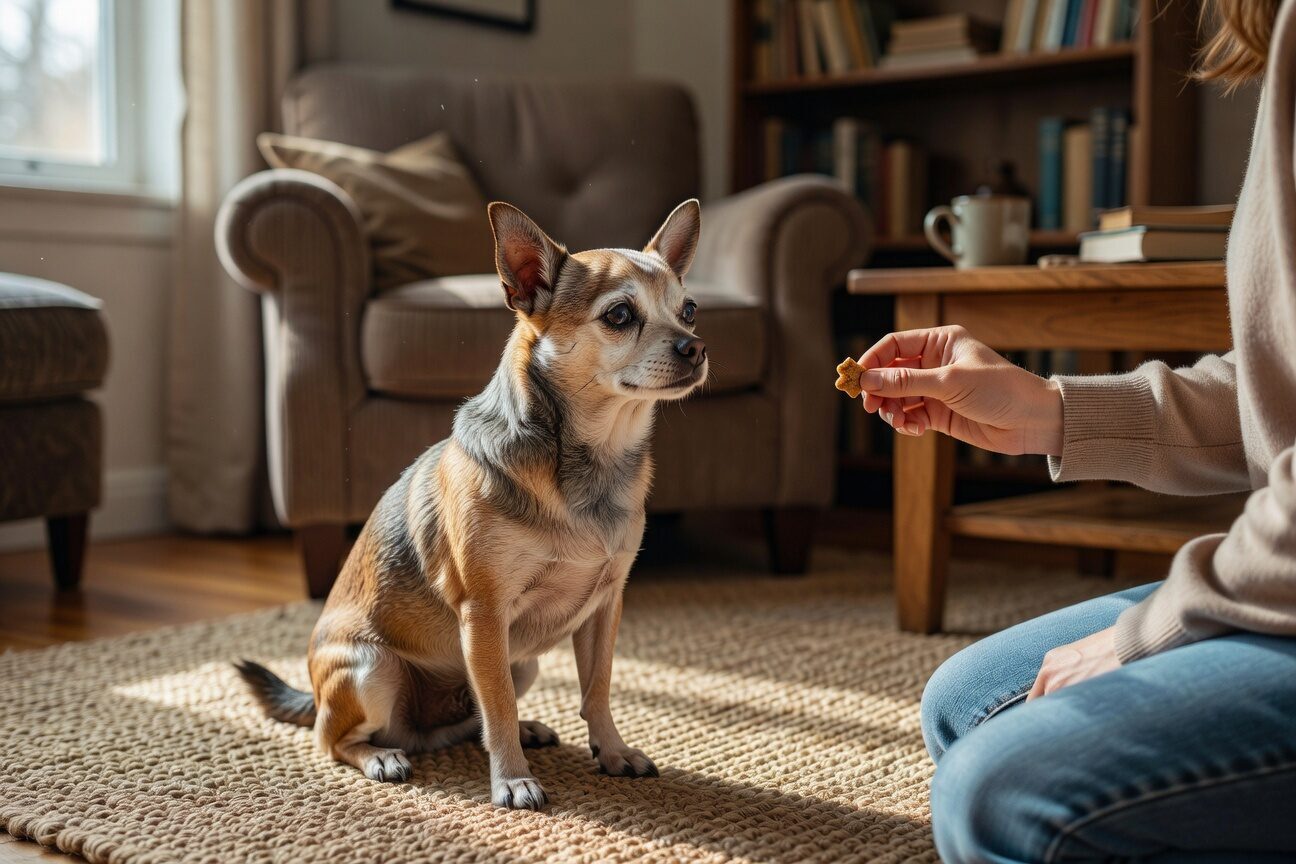
Find what your chihuahua will work for. For Biscuit, it was freeze-dried chicken. He would betray his own principles for freeze-dried chicken. For other chihuahuas, it might be a specific toy or even just enthusiastic praise. The point is that the reward has to mean something to your dog, not to you.
Common Mistakes People Make With Older Chihuahuas
Confusing the dog with mixed signals. Saying “good dog, no growl”, while the dog is already being quiet teaches the dog absolutely nothing. Praise happens when the dog makes the right choice in the moment. Not before. Not after as a general commentary on their character. com/how-to-train-a-chihuahua-puppy-a-practical-step-by-step-guide/” title=”How to Train a Chihuahua Puppy”>How to Train a Chihuahua Puppy.
Door Bolting
This was Biscuit’s worst habit and the most dangerous one. A chihuahua loose in a neighborhood is a chihuahua in danger. They are small enough for hawks. Fast enough to reach the road. Invisible enough that a driver will not see them.
The fix was simple but required discipline from me, not just from him. Every single time I opened the door, Biscuit had to sit and wait. If he moved toward the door, the door closed. No drama. No scolding. Just a closed door. The door only stayed open when he stayed seated.
It took three weeks of doing this at every exit, every time. My friends thought I was insane. But now Biscuit sits automatically when any door opens. Muscle memory replaced the old habit.
Aggression Toward People
A growling chihuahua is usually a scared chihuahua. People forget this because the dog is small and the growl sounds more like a complaint than a threat. But fear-based aggression does not improve with punishment. It gets worse.
If your older chi snaps at visitors, the answer is controlled exposure combined with positive association. Visitor arrives. Your dog gets a high-value treat. Visitor sits quietly. Your dog gets another treat. Over time, “stranger in the house”, becomes linked to “good things happen”, instead of “threat detected.”.
If the aggression is severe, a professional trainer who has experience with small breeds is worth the investment. Not a YouTube tutorial. Not a friend who once trained a labrador. Understanding why chihuahuas show aggression is the first step toward fixing it.
Training an older chihuahua requires more patience than training a puppy. It also requires more honesty. You have to look at your own behavior first. Are you being consistent? Are your corrections timed properly? Are you accidentally rewarding the behavior you want to stop?
Most of the time, the human needs more training than the dog. Biscuit did not have a learning problem. I had a teaching problem. Once I fixed that, everything changed.
Your older chihuahua is not a lost cause. They are a dog with history, habits, and a brain that works perfectly fine. The same fundamental training principles that work on puppies work on seniors. The timeline is just longer and the stakes feel higher because you already love them.
Give them the chance. They will surprise you.
The Advantages Older Chihuahuas Have
Here is something that gets lost in the conversation about training older chihuahuas: they actually have significant advantages over puppies in several areas. An older chihuahua already has a fully developed brain. They can focus for longer periods. They have better impulse control than a puppy who gets distracted by every leaf that blows across the yard. And they already understand the basics of living in a human household, like where the door is, what the leash means, and that the sound of a treat bag opening is relevant to their interests.
My senior rescue learned to sit and wait for her food within three days. A puppy would have taken three weeks of consistent practice to achieve the same result. She already knew how to read my body language and tone of voice, which meant we could communicate effectively from the start. The challenge with older dogs is not ability. It is undoing habits that have been reinforced for years, which requires more patience than teaching something new from scratch. But once an older chihuahua decides to cooperate, and they do decide because chihuahuas always make it feel like a choice, they learn faster than most people expect. Age does not close the door on training. It just means you are walking through a different one.
For more detailed guidance on this topic, the American Kennel Club offers excellent resources backed by veterinary professionals.
I have been through this with my own chihuahua. It is one of those things that looks simple on paper but gets complicated fast when you are actually dealing with a four-pound dog who has opinions about everything.
The truth about training older chihuahua is that there is no single right answer. What works for one chihuahua might be completely wrong for another. Mine took weeks to adjust. Some dogs figure it out in days. The size of your chihuahua matters. Their age matters. Their personality matters most of all.
Here is what I wish someone had told me earlier. Start small. Do not try to change everything at once. Chihuahuas are stubborn but they are also sensitive. Push too hard and they shut down. Go too slow and nothing changes. The sweet spot is somewhere in the middle and you have to find it yourself.
I talked to other chihuahua owners about training older chihuahua and heard the same thing over and over. Patience. Consistency. And a willingness to look a little silly in public because chihuahuas do not care about your dignity.
If you are just getting started with training older chihuahua, give yourself grace. You will make mistakes. Your chihuahua will make more of them. That is the whole process. And honestly, once you get through the hard part, it is worth it.