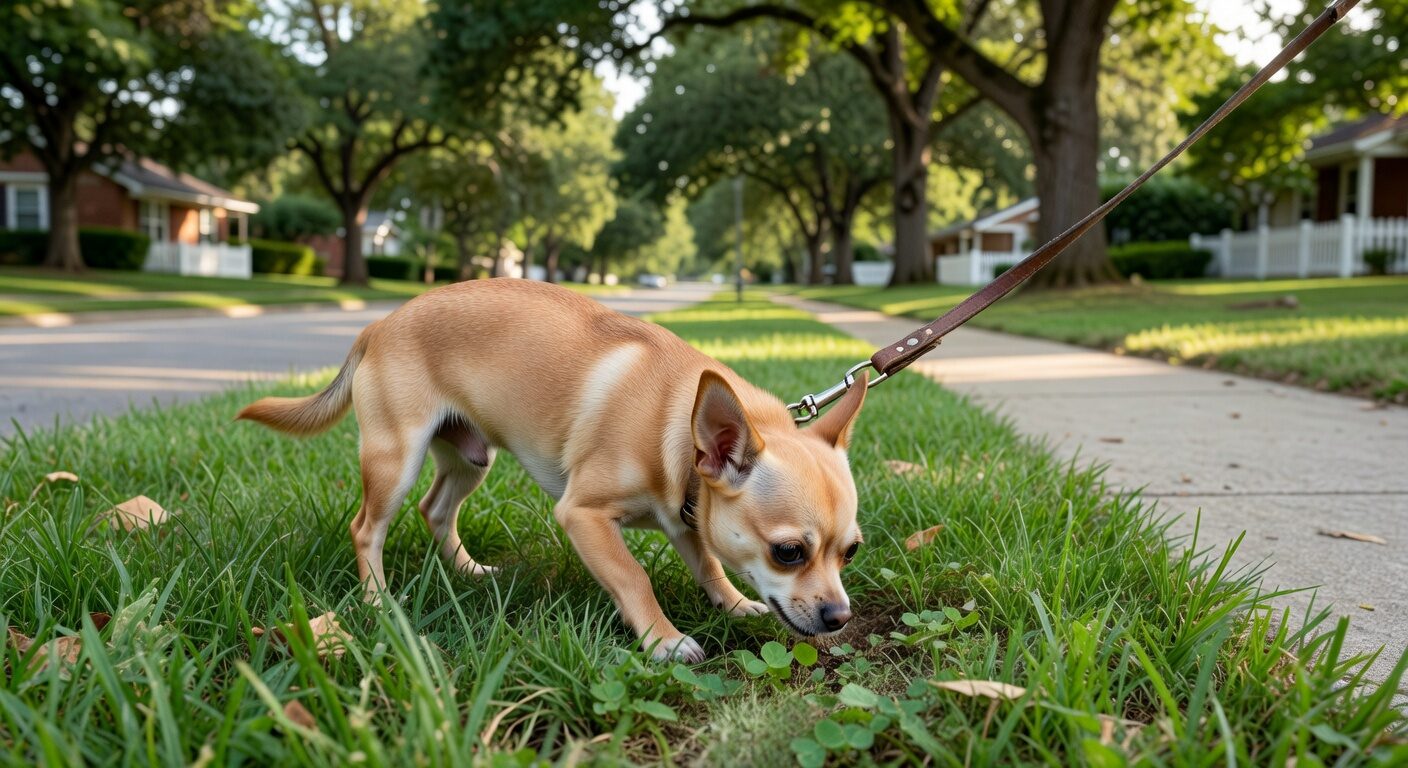
If you want to know about walking chihuahua, you are in the right place. The first time I walked my chihuahua on a leash, she sat down on the sidewalk and refused to move. Just planted her tiny body on the concrete and stared at me with an expression that said “you cannot make me.” She was right. I could not. She weighed four pounds and had the willpower of a dog ten times her size. I stood there for five minutes holding a leash attached to a motionless chihuahua while my neighbors watched, and I realized that walking a chihuahua was going to require a completely different approach than walking any other dog I had ever known. When it comes to walking chihuahua, I learned most of what I know the hard way. When it comes to walking chihuahua, I have learned a few things the hard way.
Walking Chihuahua: The Right Gear Makes Everything Easier
Do not use a collar and leash on a chihuahua. I cannot stress this enough. Chihuahuas are prone to tracheal collapse, a condition where the cartilage rings in the windpipe weaken and partially close, making breathing difficult. A collar puts pressure directly on the throat, which can worsen this condition or trigger coughing fits in dogs who are already prone to it. A harness that distributes pressure across the chest is safer and gives you more control without risking injury.

Choose a harness specifically designed for toy breeds. Most standard small-dog harnesses are still too big for a chihuahua and will slip or chafe. The harness should fit snugly without restricting movement, and you should be able to fit one finger between the harness and your dog’s body. According to Top Dog Tips, a step-in harness is usually the easiest style for chihuahuas because they do not require pulling anything over the head, which many chihuahuas hate.
Use a lightweight leash, not a retractable one. Retractable leashes give your chihuahua too much range and not enough control, and the thin cord can cause injuries if it wraps around a leg or gets tangled. A four to six foot fixed leash keeps your chihuahua close enough to protect from larger dogs, traffic, and the various ground-level hazards that chihuahuas are perfectly positioned to encounter.
How Long and How Far
Chihuahuas do not need marathon walks. Two walks a day, fifteen to twenty minutes each, is enough for most adult chihuahuas. Puppies need shorter walks. Senior chihuahuas may need even less. Pay attention to your dog’s signals. If she slows down, pants heavily, or stops walking, she has had enough. Chihuahuas tire faster than larger dogs because their small legs have to work much harder to cover the same distance.
The Honest Truth
Quality matters more than quantity. A twenty-minute walk with sniffing time, new routes, and some light training is more valuable than a forty-minute forced march on the same boring path. Let your chihuahua sniff. Sniffing is mental exercise for dogs, and denying it turns the walk into a chore instead of an enrichment activity. This is one thing every walking chihuahua owner should consider.
What I Wish I Knew Earlier
My chihuahua has a winter coat that makes her look like a tiny astronaut. She hated it at first. Now she stands by the door waiting for me to put it on when it is cold outside. Chihuahuas are indoor dogs by nature, and outdoor time should be managed carefully to keep them comfortable and safe.
Dealing with Reactivity on Walks
Here is where walking a chihuahua gets challenging. Many chihuahuas are reactive on leash, meaning they bark, lunge, or pull when they see other dogs, people, bikes, or anything else that triggers their alert instincts. This is not aggression in most cases. It is fear, excitement, or frustration expressed through the limited vocabulary a leashed dog has.
When my chihuahua sees another dog on a walk, she transforms into a barking, spinning, snarling tornado. She is four pounds of pure auditory chaos. The approach that works for us is creating distance. When I see a trigger approaching, I cross the street or turn the other direction before she hits her threshold. I give her treats for looking at the trigger without reacting. Over time, the threshold has gotten smaller. She is not cured, but she is better.
Chihuahua reactivity is best addressed with patience and positive reinforcement, not correction. Yanking the leash or yelling at a reactive chihuahua confirms their belief that the trigger is dangerous and makes the problem worse. Understanding walking chihuahua makes a real difference.
Safety on Walks
Chihuahuas are vulnerable on walks in ways that larger dogs are not. Birds of prey have been known to target small dogs. Larger dogs can cause serious injury in seconds. Chihuahuas can slip through fence gaps and disappear. They are low enough to the ground to eat discarded food, dead animals, or toxic substances without you noticing immediately.

Stay alert. Keep your chihuahua on a short leash in areas with off-leash dogs. Avoid walking near known coyote territory at dawn and dusk. Pick your chihuahua up if a larger dog approaches without its owner in control. And make sure your chihuahua is microchipped and wearing identification, because if she slips her harness, you need every advantage to get her back.
Walking a chihuahua is not like walking any other dog. It requires more awareness, more gear adjustments, and more patience with a dog whose legs are short and whose opinions are strong. But when you find your rhythm, when the harness fits right and the route is familiar and your chihuahua trots beside you with her tail up and her ears forward, it is one of the best parts of having a tiny dog. Even if she does sit down and refuse to move sometimes. She is a chihuahua. That is her right.
Reading Your Chihuahua Walking Signals
I used to think a walk was a walk. You clip on the leash, go around the block, come home. But my chihuahua taught me that walking is a whole conversation if you pay attention. When she pulls hard to the left, she has caught a scent she needs to investigate and I have learned to let her. When she slows down and starts lagging behind, she is getting tired and it is time to head home. When she plants her feet and refuses to move, something ahead is making her nervous, usually a bigger dog or a loud noise she has not identified yet.
The biggest mistake I see chihuahua owners make on walks is dragging their dog along at human pace without reading these signals. A chihuahua stride is a fraction of yours. What feels like a casual stroll to you might be a full sprint for them. I adjusted my pace downward and started letting her set the rhythm, and our walks went from stressful power struggles to something we both actually enjoy. She sniffs when she wants to sniff. She walks when she is ready to walk. And when she sits down in the middle of the sidewalk and stares at me, I know we are done, and I carry her home without complaint.
For more detailed guidance on this topic, the American Kennel Club offers excellent resources backed by veterinary professionals.
What I Learned
I have been through this with my own chihuahua. It is one of those things that looks simple on paper but gets complicated fast when you are actually dealing with a four-pound dog who has opinions about everything.
The truth about walking chihuahua is that there is no single right answer. What works for one chihuahua might be completely wrong for another. Mine took weeks to adjust. Some dogs figure it out in days. The size of your chihuahua matters. Their age matters. Their personality matters most of all.
Here is what I wish someone had told me earlier. Start small. Do not try to change everything at once. Chihuahuas are stubborn but they are also sensitive. Push too hard and they shut down. Go too slow and nothing changes. The sweet spot is somewhere in the middle and you have to find it yourself.
I talked to other chihuahua owners about walking chihuahua and heard the same thing over and over. Patience. Consistency. And a willingness to look a little silly in public because chihuahuas do not care about your dignity.
If you are just getting started with walking chihuahua, give yourself grace. You will make mistakes. Your chihuahua will make more of them. That is the whole process. And honestly, once you get through the hard part, it is worth it.
Walking Chihuahua FAQ
What is the right Gear Makes Everything Easier?
Do not use a collar and leash on a chihuahua. I cannot stress this enough. Chihuahuas are prone to tracheal collapse, a condition where the cartilage rings in the windpipe weaken and partially close, making breathing difficult.
What should I know about how Long and How Far?
Chihuahuas do not need marathon walks. Two walks a day, fifteen to twenty minutes each, is enough for most adult chihuahuas. Puppies need shorter walks.
What should I know about dealing with Reactivity on Walks?
Here is where walking a chihuahua gets challenging. Many chihuahuas are reactive on leash, meaning they bark, lunge, or pull when they see other dogs, people, bikes, or anything else that triggers their alert instincts.
What should I know about safety on Walks?
Chihuahuas are vulnerable on walks in ways that larger dogs are not. Birds of prey have been known to target small dogs. Larger dogs can cause serious injury in seconds.
What should I know about what I Learned?
I have been through this with my own chihuahua. It is one of those things that looks simple on paper but gets complicated fast when you are actually dealing with a four-pound dog who has opinions about everything.