

The most useful cue you can teach a small dog is one that tells her, in a way she has practiced and trusts, that the moment is calm. Trainers call it a settle. It is not a sit and it is not a down. It is a separate behavior, on its own cue, that produces a relaxed body and a slow breath.
For chihuahuas, the settle is the cue that solves the most behavior problems at the same time. The dog who cannot settle is the dog who barks at the door, shakes at the vet, lunges on a walk, and resource-guards a couch. The settle cue does not eliminate any of these on its own. It is the foundation that every other intervention builds on.
Reward-based training, applied consistently, produces the same outcomes in small dogs as in larger breeds, according to a 2020 review by Vieira de Castro and colleagues, published in PLOS ONE. The work has been settled on this point for over two decades. The persistent gap is not in the science. The gap is in chihuahua owners getting the consistent practice in.
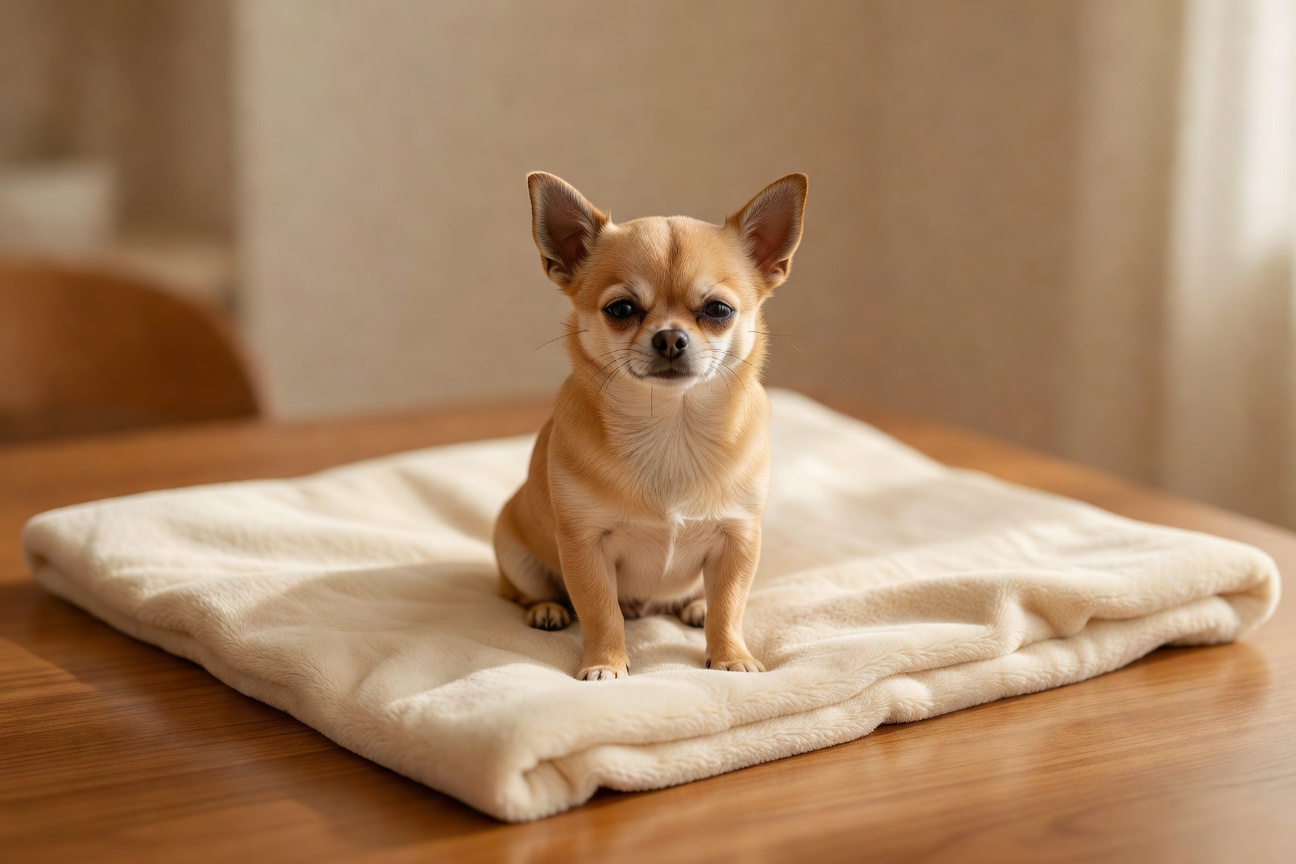
What a settle cue actually is
A settle is a learned association between a verbal cue, a relaxed body, and a reward. The dog hears the word, lies down on a mat or a bed, breathes slowly, and gets a treat. Over weeks, the dog learns that the cue predicts the state, not the position.
The settle is a separate behavior from a "down" because the goal is the emotional state, not the shape. A dog can lie down and be tense. A dog can lie down and be coiled. A settle, trained correctly, is a dog lying with one hip rolled to the side, eyes soft, breathing through a relaxed jaw.
The cue word does not matter. Many trainers use "settle." Some use "relax." Some use a sound. Pick one short word, use it consistently, and never use it to mean anything else.
Why this matters for chihuahuas specifically
The 2010 work by Mehrkam and Wynne on small-dog behavior, published in the Journal of Veterinary Behavior, found that toy-breed dogs are more likely to display reactive behaviors and less likely to have received basic obedience training than larger dogs. The pattern is well known to small-dog trainers. It is sometimes called the toy-breed undertraining problem.
The mechanism is simple. Owners of small dogs can pick the dog up, carry her away from a stressor, and physically manage the situation. The behavior gets managed. The behavior never gets trained. The dog learns nothing about how to handle the trigger. The next encounter is the same encounter.
A settle cue is the alternative. The dog learns a relaxed response to the trigger, not a removal from it. Over weeks, the trigger itself becomes a predictor of the relaxed state. That is the mechanism behind every fearful-dog and reactive-dog protocol that works.
The basic exercise on a mat
Start indoors with no distractions. Put a small towel or mat on the floor near you. Wait.
- The moment your chihuahua sniffs the mat or steps on it, mark it (a clicker or a calm "yes") and place a small treat between her front paws, on the mat. Not in your hand. On the mat.
- Repeat until she is offering interest in the mat on her own. This usually takes five to ten short repetitions.
- Wait for her to lie down on the mat. Mark and treat on the mat. Do not say a cue word yet.
- Wait for her to soften. Treat the soft body, not the alert body. A treat for a flat chin on the mat is worth ten for a stiff chin.
- Add the cue word only when the behavior is already happening reliably. Say it once, quietly, as she settles. Treat.
Three sessions a day, three minutes each, for two weeks. That is the protocol. The total time is about an hour and a half spread across fourteen days, and most chihuahuas have a usable settle cue by the end of it. The research on training session length is mixed, but the consensus across reward-based work is that short and frequent beats long and rare.
Three common mistakes
Using the cue before the behavior is reliable. The cue should follow the behavior for the first dozen repetitions. The order is: behavior first, cue second, reward third. Saying "settle" while the dog is bouncing teaches the dog that "settle" means bounce.
Treating the position instead of the state. A dog can lie down and be tense. Treat the soft body. If she is not soft yet, wait. The shaping is slow and that is fine.
Skipping the mat. The mat is a portable visual cue. It moves with you to the vet, to a cafe patio, to your in-laws' living room. A settle without a mat is a settle that works in one location. A settle with a mat travels.
What the research says about method
The evidence on aversive training methods has been consistent across more than a decade of welfare research. The 2020 Vieira de Castro review, the 2020 China and colleagues paper in Frontiers in Veterinary Science, and the earlier work by Ziv (2017) all point in the same direction. Aversive methods, including shock, prong, and alpha-roll-style corrections, are associated with higher fear and stress measurements in companion dogs, with no measurable advantage in training outcomes.
For a small dog, the welfare margin is narrower. A correction that a 60-pound Labrador absorbs and forgets is a correction that a 5-pound chihuahua experiences as a near-fatal event. The settle cue, trained with food and patience, is the recommended approach because it works and because the alternative comes with documented downside risk.
What to do this week
Pick the cue word. Pick the mat. Run three short sessions a day, three minutes each, for the next seven days. By the end of the week your chihuahua should be offering a relaxed lie-down on the mat without a prompt. That is the foundation. The rest is duration and distractions, added one at a time.
For deeper reading, the earlier guide on chihuahua barking covers the same calm-state principle applied to threshold reactivity. The settle cue is the precondition for the work in that piece.
The good news: this is one of the few training projects where the research and the practical advice agree completely. Reward-based, short sessions, soft body, consistent cue. The dog learns. Your chihuahua is not too small to train. She is, on every available measure, the easiest dog in the room to set up for a successful settle.
Gear That Works backpack
Harness (Not Collar)
A step-in harness is safer and more comfortable.
Lightweight Leash
4–6 feet gives freedom without losing control.
Treat Pouch
Keep rewards accessible and distraction-free.
ID Tag & Microchip
Always be prepared in case of separation.
Trainer Tip: Success on walks starts with reading your Chihuahua's signals and respecting their pace.
Was this guide helpful?
Was this guide helpful? Save the guide. Share it with one other chihuahua owner this week.
favorite