
If you have ever watched a Chihuahua tear across the living room and skid into the sofa, you already know the answer to the popular question is "faster than you would think." So let us start there, then talk about what actually matters: how to turn that little burst of speed into safe, happy exercise for a dog who weighs less than a bag of sugar.
So how fast can a Chihuahua actually run?
There is no official Chihuahua land-speed record, and you should be suspicious of any article that gives you one to the decimal point. What we can say is sensible and general. A healthy adult Chihuahua at a full sprint usually reaches somewhere in the range of roughly 8 to 15 miles per hour, with the occasional athletic individual pushing a little higher in a short, excited dash. For comparison, the average dog across all breeds runs at around 15 to 20 miles per hour, so your Chihuahua sits at the lower end, and that is exactly what you would expect.
The reason is simple physics, not a lack of try. A Chihuahua has very short legs, so even when those legs cycle quickly, each stride covers little ground. Speed is stride length multiplied by stride rate, and a tiny dog is always going to be short on the first number. The honest takeaway is this: your Chihuahua is fast for her size, she will never out-run a Greyhound, and that is completely fine. Speed is not the point of exercising a small dog. Let us talk about what is.
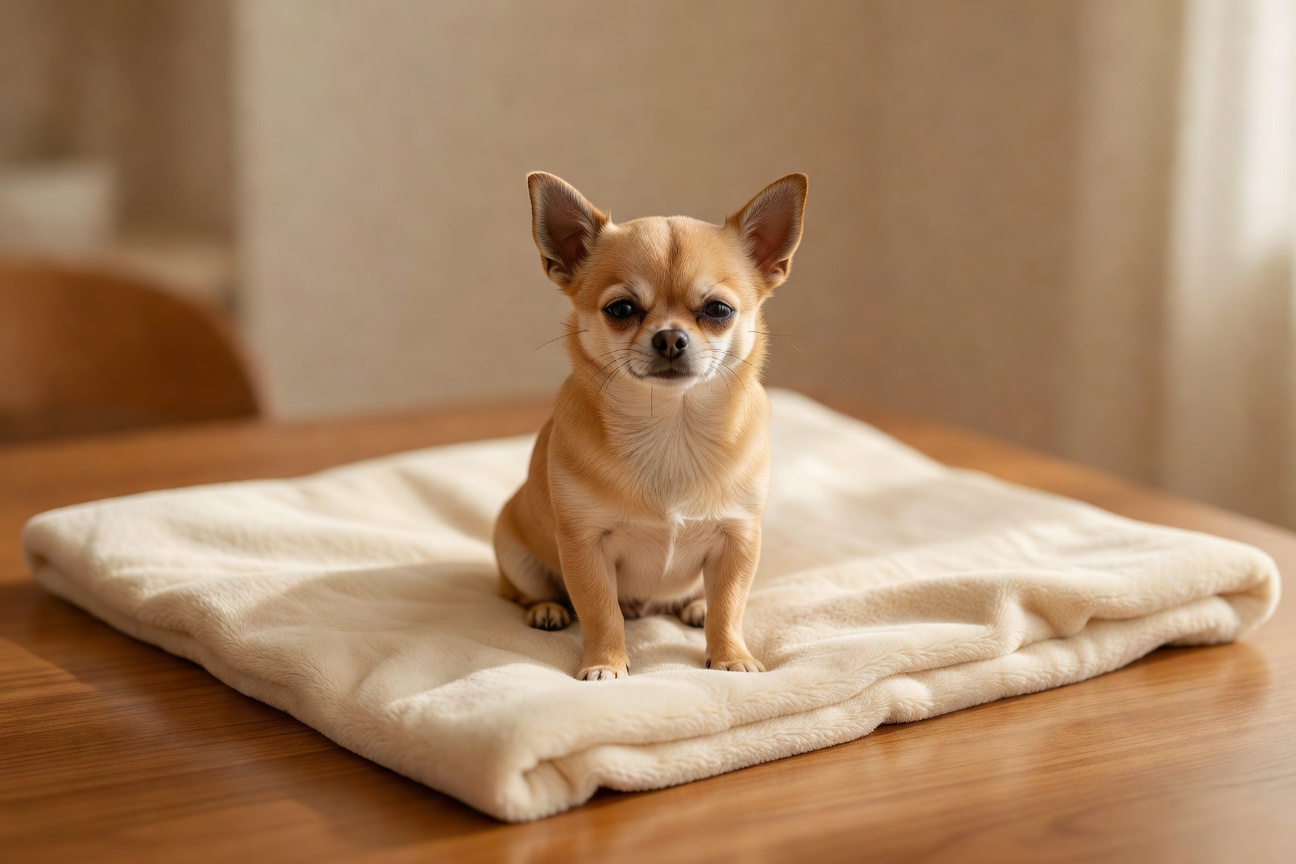
How much exercise does a Chihuahua really need?
The good news is that Chihuahuas are easy to keep active. As a small, energetic companion breed, most adults do well on roughly 30 to 60 minutes of activity a day, and that total does not have to come in one block. Two or three shorter walks, plus some indoor play and a bit of sniffing time in the garden, adds up quickly. The American Kennel Club's general guidance on dog exercise is a reasonable starting point, but watch your own dog rather than a number. A Chihuahua who is pacing, restless, or chewing things she should not is often a Chihuahua who needs a little more to do.
There is a quiet trap worth naming here. Because small dogs can be picked up and physically managed, owners sometimes skip the walking and the training that a larger dog would get by necessity. The result is an under-exercised, under-trained little dog who then gets labelled as "yappy" or "difficult." Your Chihuahua is neither. She is a dog who needs a job, the same as any other.
Safe activities for a tiny dog
The aim is plenty of movement with very little impact on small joints. A few activities suit Chihuahuas especially well.
Short, frequent walks are the backbone. Let your dog set a fair amount of the pace and stop to sniff, because sniffing is genuinely tiring in the good way and does real enrichment work. On warmer days, walk on grass or dirt where you can, since pavement is harder on joints and can get dangerously hot underfoot. Gentle fetch down a hallway or across a small garden gives you that lovely sprint without asking for distance. Flat, soft surfaces are kinder than concrete for a dog whose whole body weighs a couple of kilograms.
Two cautions belong in every plan. Patellar luxation, a kneecap that slips out of its groove, is common in Chihuahuas and other toy breeds, as VCA Hospitals explains in its overview. If you see your dog skip a step, hold up a back leg for a stride, then carry on as if nothing happened, mention it to your vet. It does not mean the end of exercise, but it does mean choosing low-impact activity and getting a professional opinion before you ramp anything up. A vet check before you start a new exercise routine is always a good idea with a small dog.
Build a reliable recall before you unclip the lead
If you want your Chihuahua to enjoy a proper off-lead sprint, the safest gift you can give her is a recall she actually responds to. A tiny dog at speed in an open space is hard to catch and easy to lose sight of, so "come when called" is not a nicety. It is the difference between a safe romp and a frightening chase.
The method is straightforward and force-free. The AKC's guide to a reliable recall sums up the approach that the training science supports: start indoors with almost no distractions, pay generously with a high-value treat every single time she comes, and make the whole thing feel like the best game in the house. A few rules make it stick. Never call your dog and then do something she dislikes, like ending playtime or clipping the lead to go home, or the cue will start to predict bad news. Avoid repeating the word when she is ignoring you, because a cue that is sometimes obeyed and sometimes not simply loses meaning. Only progress to a bigger, more distracting space once the easy version is solid, and use a long training line outdoors until you genuinely trust the response.
Games and enrichment that tire the brain
Physical exercise is only half the picture. A Chihuahua's mind needs work too, and mental effort is wonderfully tiring for a small dog who cannot safely run for miles.
Scatter feeding is the simplest place to start: toss part of a meal into the grass or across a snuffle mat and let her hunt for it. Food puzzles and stuffed toys turn dinner into a project. Short training sessions of two or three minutes, teaching a hand target, a spin, or a tidy "find it," give you a focused, happy dog and a recall game rolled into one. A favourite is the back-and-forth recall game: two people, a handful of treats, taking turns calling the dog between them. It builds speed, it builds enthusiasm for coming when called, and it wears her out without a single hard landing.
Heat and joints: the two cautions to plan around
Small bodies overheat quickly, so timing matters. Walk in the early morning or the evening when it is warm, carry water, and rest in the shade. The American Veterinary Medical Association's warm-weather pet safety advice is worth a read: it covers heat-stress warning signs such as heavy panting, drooling, and unsteadiness, and the firm rule that no dog should ever be left in a parked car. Use the back of your hand on the pavement before you set off; if it is too hot for your skin, it is too hot for her feet.
On joints, the principle is gentle and gradual. Build distance slowly, keep play on soft surfaces, and stop while your dog is still enjoying herself rather than pushing her to the point of limping or exhaustion. A short, joyful outing repeated often beats one long, punishing one.
What this means for you and your dog this week
Your Chihuahua's top speed is a fun fact, not a fitness goal. The thing worth measuring is whether she is getting enough varied, low-impact movement and enough to think about. So here is one practical action to take this week: spend five minutes a day, indoors, paying your dog generously for coming when you call her name. Build that recall now, on easy mode, and you are laying the groundwork for safe sprints, happy walks, and a tired, contented little dog for years to come.
Gear That Works backpack
Harness (Not Collar)
A step-in harness is safer and more comfortable.
Lightweight Leash
4–6 feet gives freedom without losing control.
Treat Pouch
Keep rewards accessible and distraction-free.
ID Tag & Microchip
Always be prepared in case of separation.
Trainer Tip: Success on walks starts with reading your Chihuahua's signals and respecting their pace.
Was this guide helpful?
Was this guide helpful? Save the guide. Share it with one other chihuahua owner this week.
favorite