
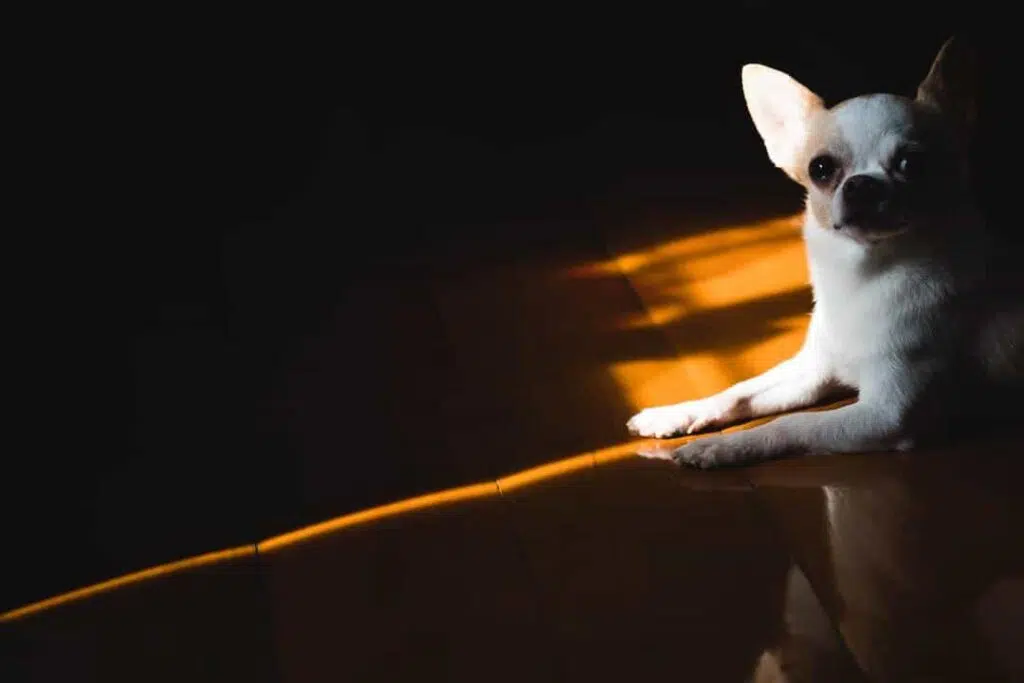
Can Chihuahuas see in the dark? Better than you can, but not as well as the cat who keeps stealing their bed. Your Chihuahua is built to function in low light far more capably than the average human, yet true darkness, the no-light-at-all kind, leaves them about as stuck as it leaves you. The difference comes down to a few clever features in the back of the eye.
How a Chihuahua's eye handles the dark
The dog eye is built from the same basic parts as yours: a cornea, a pupil, a lens, and a retina at the back where the image actually forms. The retina is lined with two kinds of photoreceptors. Rods handle dim light, motion, and shades of gray. Cones handle color and fine detail in bright light. Humans are cone-heavy, which is why we see rich color and read fine print. Dogs are rod-heavy, which is why they read a dark room better than we do.
Two anatomical features give your Chihuahua the low-light edge. The first is that rod-rich retina, which soaks up whatever scattered light is available. The second is the tapetum lucidum, a reflective layer of tissue sitting just behind the retina. Think of it as a mirror. Light enters the eye, passes the photoreceptors, and instead of being absorbed and lost, it bounces back off the tapetum for a second pass at the rods. Your dog gets two chances to register the same faint light. That reflective layer is also why your Chihuahua's eyes flash green or gold when headlights or a camera flash catch them at night. Humans do not have a tapetum, which is why our eyes only do the red-eye thing in photos.

Add a pupil that opens wide to let in more light, and you have an eye that is genuinely good at making the most of a little glow: a streetlamp, the TV, the moon through the blinds.
What your Chihuahua can and cannot see at night
Here is the honest version. In dim light, your Chihuahua sees better than you do. In pitch black, with no light source at all, your Chihuahua sees about as little as you do. Dogs do not have night vision in the science-fiction sense. They cannot generate light or see heat. They amplify what is already there. Take away every photon and even the best tapetum has nothing to reflect.
A few specifics worth knowing about how your Chihuahua experiences the dark:
- Motion is their strong suit. The rod-dominant retina is excellent at catching movement in low light. A squirrel darting across a dusky yard will get your dog's attention long before a still object will.
- Detail is not. Dogs sit around 20/80 on the vision scale, meaning what you can see clearly at 80 feet, your dog needs to be within about 20 feet to see as clearly. Low light blurs that further.
- Color is muted. Dogs are dichromatic, seeing mostly in blues, yellows, and grays rather than the full rainbow. In dim light, color matters even less, because the cones that read color are barely working.
- The field is wide. Eyes set toward the sides of the head give dogs a broad peripheral view, which helps them catch motion at the edges even when central detail is fuzzy.
So at 2 a.m., your Chihuahua navigating to the water bowl is not seeing a crisp, detailed room. They are reading a soft, motion-sensitive, low-color sketch of it, plus relying heavily on their nose and their memory of where the furniture lives.
What this means for a Chihuahua at home
Practically speaking, your Chihuahua does not need the lights on to move around a familiar room at night, and most do fine. A few small accommodations help, especially for a tiny dog who can be genuinely hard to see underfoot. A nightlight in the hallway or near their bed gives them just enough scattered light to work with, and it lowers the odds that you step on a five-pound dog on a midnight trip to the kitchen. Keep furniture and water bowls in consistent spots, because your Chihuahua maps the house partly by memory and partly by smell. If you have stairs, a dim light at the top and bottom is a kindness, particularly for a small breed where a tumble carries real injury risk.
When changing night vision is a health flag
Some loss of low-light vision is a normal part of aging, the same way it is for people. But a change in how your dog handles the dark can also be the first sign of an eye problem worth a veterinarian's attention. The good news is that these signs are usually easy to spot once you know to look.
If you notice any of the following, it is worth a conversation with your veterinarian:
- New bumping into walls, furniture, or door frames, especially in dim light or unfamiliar spaces
- Hesitating at stairs or curbs your dog used to take without thinking
- Sudden clinginess or anxiety after dark, or reluctance to go out at night
- Cloudiness, a blue-gray haze, or a color change in one or both eyes
- Redness, squinting, pawing at the eye, or visible discharge
- Pupils that look unusually large or do not change in bright light
Several conditions can affect a dog's vision over time, including cataracts, which cloud the lens, and progressive retinal atrophy, a gradual breakdown of those all-important rods and cones. Trouble seeing in dim light is often one of the earliest clues with retinal disease, because the rods tend to go first. None of this is something to diagnose from the couch. Your veterinarian can do a proper eye exam and, if needed, refer you to a veterinary ophthalmologist.
One time-bounded note: a sudden change, your dog bumping into things this week that they navigated fine last week, or an eye that becomes cloudy, red, or painful seemingly overnight, deserves a call within 24 hours. Rapid vision change can occasionally signal a problem that is easier to treat the sooner it is caught.
The bottom line: your Chihuahua sees the dark far better than you give them credit for, just not perfectly, and never in true blackness. Knowing how their eyes actually work makes you better at spotting when something is off. If your dog's night-time confidence changes, do not write it off as old age until you have talked to your veterinarian. For more on how dogs see, the American Kennel Club has a solid plain-English overview.
Health at a Glance: What to Watch monitor_heart
| Condition | Key Signs | Prevention Tips |
|---|---|---|
| Dental Disease | Bad breath, tartar, red gums | Daily brushing, dental treats |
| Patellar Luxation | Limping, skipping, leg lifting | Weight control, avoid high jumps |
| Tracheal Collapse | Dry cough, gagging | Harness walking, avoid smoke |
| Heart Disease | Coughing, fatigue, fainting | Regular check-ups, heart-healthy diet |
| Hypoglycemia | Shaking, weakness, lethargy | Small, frequent meals |
Community Insights – FAQ help
help_outline When should I call my vet about a behavior change? expand_more
Sooner than feels reasonable. A change in appetite, energy, or routine that lasts more than 48 hours is worth a phone call, not a wait-and-see.
help_outline How often should a healthy adult chihuahua see the vet? expand_more
Once a year through age seven. Twice a year from eight on. Dental checks are part of every visit.
help_outline Do chihuahuas need different care than larger breeds? expand_more
Yes. Smaller medication dosing, more frequent dental work, and closer monitoring for tracheal and patellar issues are standard in toy-breed care.
Have a health question? Ask your question in the comments. We will bring it up with the vet team.
favorite