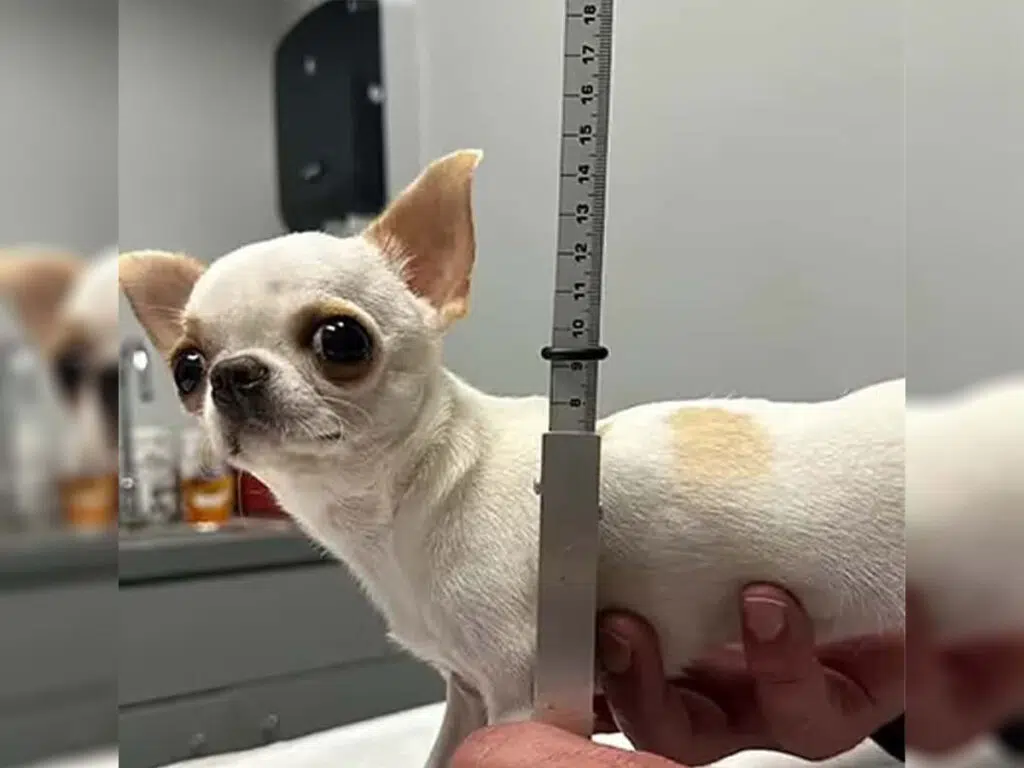


When volunteers from Wee Ones Dog Rescue Society drove out to a stretch of freight track near Enfield, Nova Scotia, in late October 2022, they expected to find a body. They found Matilda, a four-pound rescue chihuahua, alive.
The dog had been struck by a train two days into a missing-dog search. Her right front leg was crushed. Her left front leg had lost most of its skin. She was alert.
"It was a complete shock to find her alive," said Cindy Harrison, president of Wee Ones Dog Rescue Society, the Truro-based nonprofit that had imported Matilda from a Texas shelter five days earlier. "She was alert, but her feet were in rough shape."
How she got loose

Matilda was one of 10 dogs Wee Ones transported from Texas. The shipment arrived in Nova Scotia on October 20, 2022. It was the rescue group's first cross-border transport, according to Harrison, a Truro resident who has spent more than a decade in Atlantic Canada rescue work, including a board role at Atlantic Canada Dachshund Rescue.
Matilda had been thrown over a fence at a Texas home along with five other chihuahuas, Harrison said. The local rescue took her in. She was nervous. She had eaten little.
She was in her foster home in Enfield, about 35 kilometers north of Halifax, for two days. Then she slipped out a back door. Wee Ones called Nova Scotia Lost Dog Network. The group posted sightings on community Facebook groups. The dog was spotted multiple times over the next 48 hours. She would not let anyone approach.
"She wasn't socialized, and she was afraid of everyone," Harrison said. "There were sightings of Matilda, but she ran from everyone."
The train strike
Matilda had been loose for two days when a freight train conductor called the rescue. He had struck a small dog on the tracks. He thought it had not survived.
Her foster and two volunteers drove out to recover the body. They found her alive. They drove her to an emergency veterinary hospital. From there she was transported to the Atlantic Veterinary College in Charlottetown, on Prince Edward Island. The college is the regional referral center for the most complex small-animal cases in Atlantic Canada.
The surgery at the college
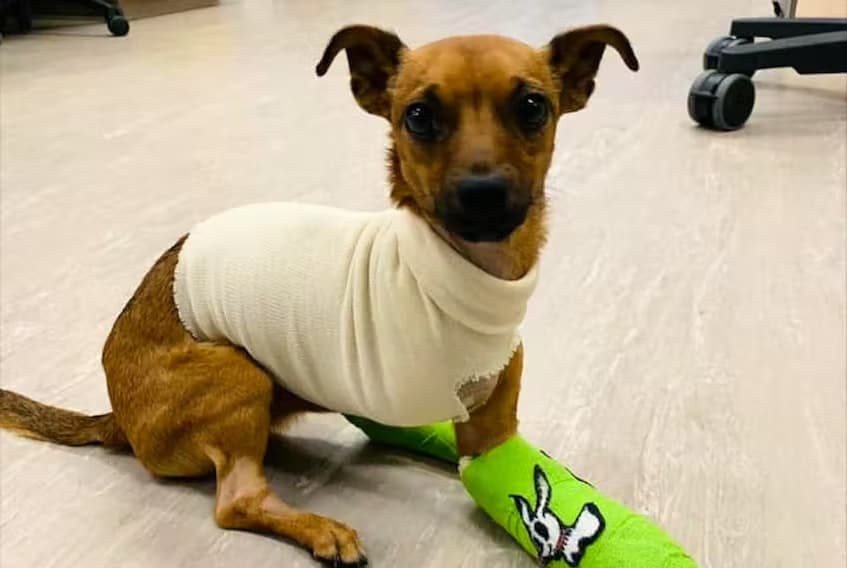
The surgical team amputated Matilda's right front leg on October 27, 2022, according to Harrison. They reconstructed the left leg. They left the wound open because there was not enough healthy skin to close it.
"They were able to reconstruct the left leg," Harrison said. "There wasn't enough healthy skin tissue to close the wound, so it's being treated as an open wound. If it doesn't heal on its own, they'll do a skin graft. It will take months to heal, but they're pleased with how she's doing."
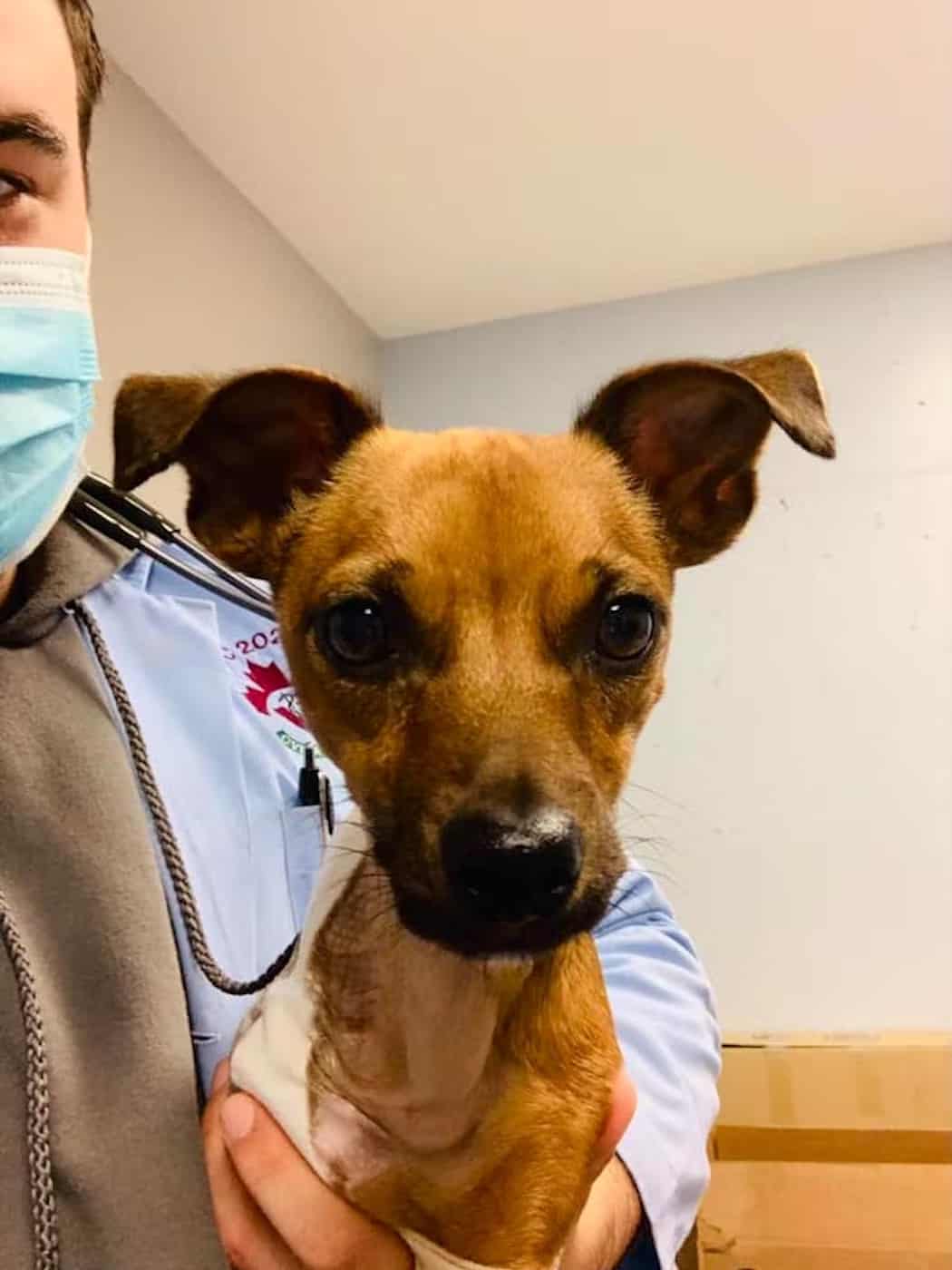
Matilda had no internal injuries. She had no fractures beyond the amputated leg. Veterinary students rotated through her recovery suite. The dog who had run from everyone in Enfield became affectionate within days. The surgical team flagged the behavioral change as a positive sign.
How the bills got paid
The cross-border transport from Texas to Nova Scotia had cost Wee Ones about 5,000 Canadian dollars, Harrison said. Matilda's veterinary care was projected to add several thousand more. The rescue set up a GoFundMe campaign and an online auction.
"This is huge for us," Harrison said. "We've been fundraising all along, and it cost $5,000 to bring the dogs up. To date, we've raised about $6,000 for Matilda's care, but we will still need about $5,000 more to have everything covered."
The campaign closed past its target before the end of November 2022. Wee Ones has continued to transport small dogs from high-intake Texas shelters into Atlantic Canada foster homes.
How readers can help
Readers who want to help Wee Ones Dog Rescue Society can:
- Donate through the rescue's website.
- Contribute to active GoFundMe campaigns for dogs in specialty care.
- Foster a small dog through the group's Atlantic Canada network.
- Send in-kind donations of baby gates and exercise pens.
For readers preparing a foster home or a new adoption, Atlantic Canada foster coordinators recommend a perimeter audit before the dog arrives. Check every gate. Check every fence panel. Check every door used by anyone besides the primary caregiver. An earlier piece on a separate small-dog escape covers the same audit, applied after the fact.
Where Matilda is now
The Atlantic Veterinary College discharged Matilda in December 2022. She went into a long-term recovery foster home in the Halifax area. The left leg healed without a skin graft. She was adopted into a permanent home in early 2023. Per the rescue's last public update, she walks on three legs without difficulty.
"If anybody survives being hit by a train, they deserve help," Harrison said.
Original reporting on Matilda's case was published by SaltWire in October 2022.
Sources & Further Reading menu_book
Canine Health Outcomes Institute (2025)
Canine Longevity Study Full Report
View Report arrow_forwardFrequently Asked Questions help
help_outline How do you source your news pieces? expand_more
Every piece names its sources by title and affiliation on first reference. We confirm by phone or email before publication when a story turns on a single account.
help_outline How current is your reporting? expand_more
News pieces are dated and corrected on a rolling basis. The publish date and any updated date appear at the top of the article.
help_outline Can I send you a story tip? expand_more
Tag @ChihuahuaCorner or use the contact form. We follow up on every named lead we can verify.
Stay in the loop Follow the story. We update on the record as new information arrives.
favorite