
I have judged enough Toy classes to know the look that crosses an owner's face when their Chihuahua weighs in. They wanted smaller. Everybody wants smaller. The whole appeal of the breed, for a lot of people, is that a dog can fit in a coat pocket and still bark at a Rottweiler like it owns the building. So the market did what markets do, and somebody started selling "micro," "mini," and "teacup" Chihuahuas at a premium. Read on as we sort out what those words actually mean, which is: not much.
What "Teacup" Actually Means
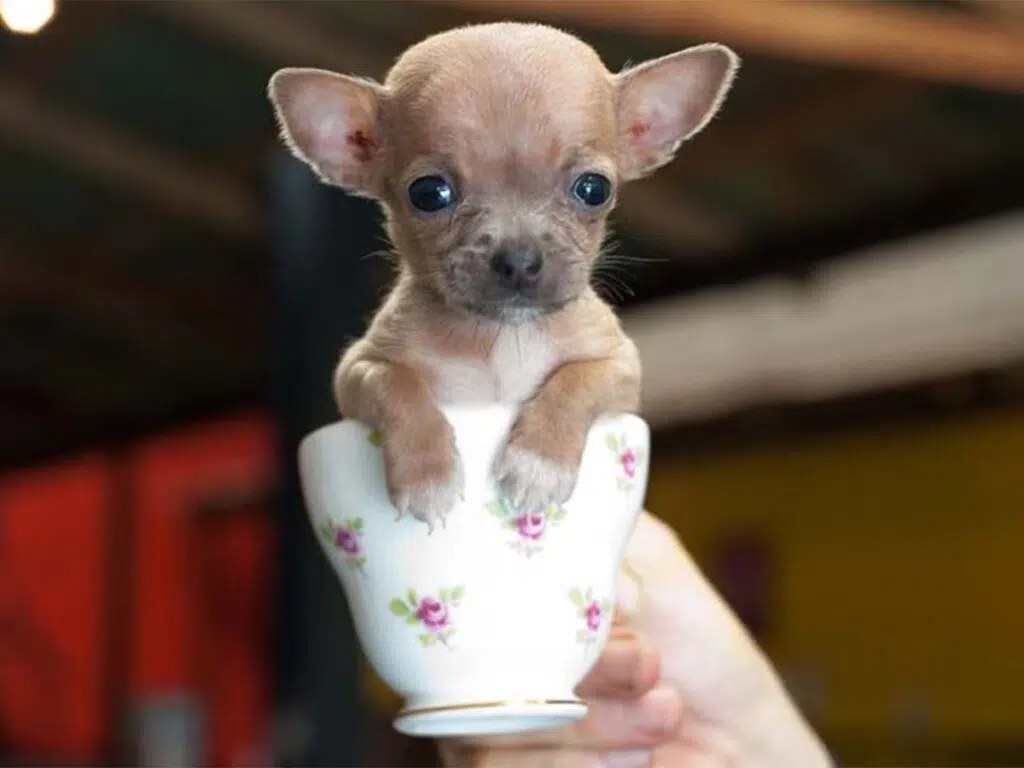
Here is the part nobody selling a teacup wants you to hear. There is no teacup Chihuahua. There is no micro Chihuahua, no mini Chihuahua, no pocket Chihuahua. The American Kennel Club recognizes exactly one Chihuahua, and the breed standard sets a single ceiling: not to exceed 6 pounds. It says nothing about a floor, nothing about "teacup," and nothing about classes within the breed. The Chihuahua Club of America, the AKC parent club, says the same. "Teacup" is a marketing word. It is a size adjective dressed up as a variety, and it usually means one of two things: a dog at the very small end of normal, or a dog that was bred small on purpose, which is the part that should give you pause.
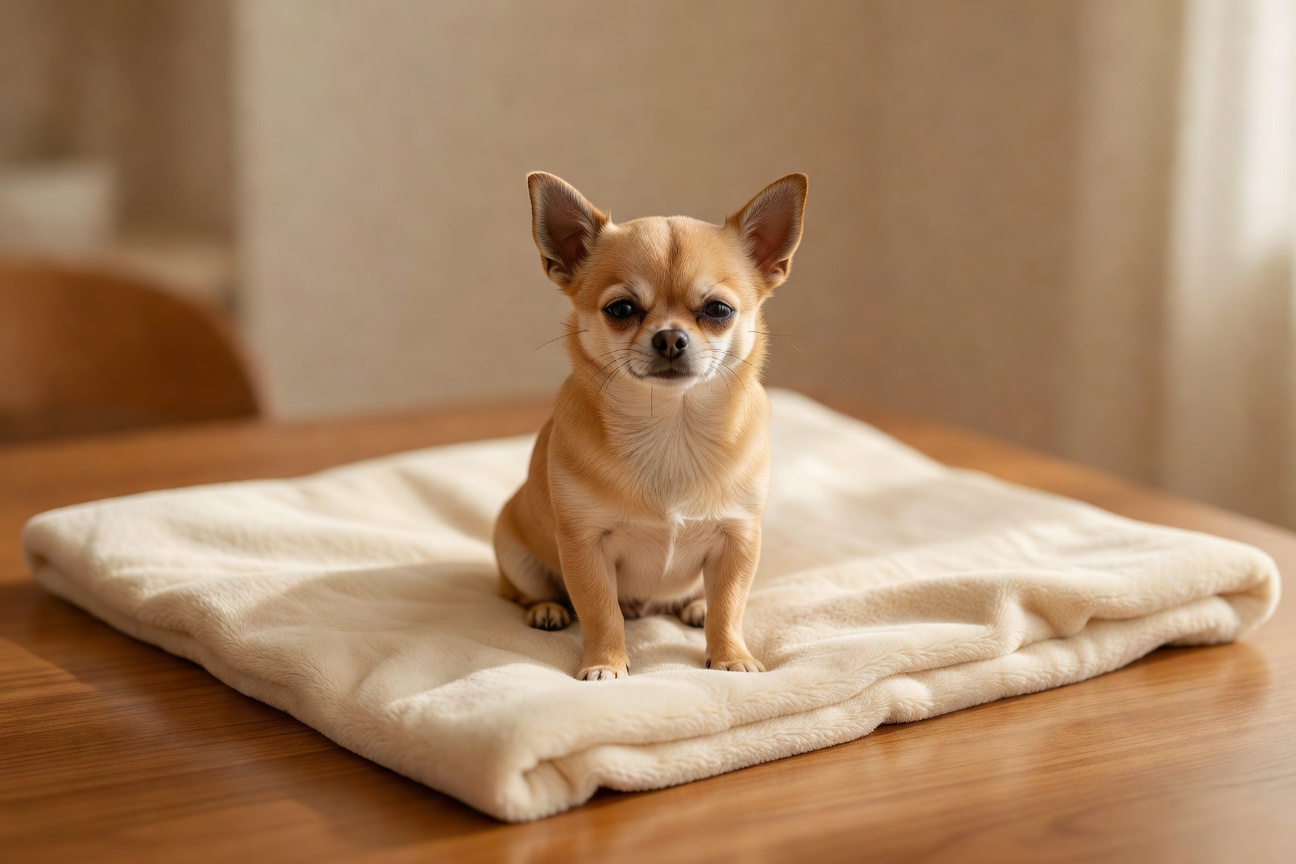
So why does everyone use the word? Because it works. A 3-pound dog with apple-head eyes the size of buttons is, objectively, one of the most charming things on four legs, and "teacup" sells that charm in a single syllable. The dogs are portable, they suit an apartment, they are devoted to the point of jealousy, and they pack the famous oversized Chihuahua temperament into a frame you can hold in one hand. None of that is a lie. The lie is the suggestion that "teacup" is a breed you can shop for, or a size you can safely engineer.
The Cost of Breeding for Tiny
Let's face it: you do not get a reliably 2-pound dog by accident. To produce extreme smallness on demand, breeders lean on tricks that the responsible ones won't touch. Breeding runt to runt. Selecting for the smallest pup in every litter, generation after generation. In the worst cases, introducing dwarfism. The result is not a smaller healthy dog. It is, very often, a dog whose body was scaled down past the point where the parts work properly.
The problems track the size. A tiny Chihuahua has a tiny liver and very little fat reserve, which makes hypoglycemia, a sudden crash in blood sugar, a genuine emergency. Toy-breed puppies can go from playing to limp in a couple of hours if they miss meals, get chilled, or simply burn through their reserves. Bones come next. A Chihuahua at the bottom of the weight range has legs about the diameter of a pencil, and a jump off the couch that a Beagle would shrug off can snap a radius. Then the head. The breed's open fontanelle, the molera, is normal in Chihuahuas and usually harmless, but the more extreme the miniaturization, the more you stack the odds toward hydrocephalus and other skull and brain complications.
It does not stop there. These dogs are over-represented for collapsing trachea (the honking cough), patellar luxation (slipping kneecaps), and a mitral valve heart disease that toy breeds carry more than their share of. Dental crowding is almost a given when you fit a full set of teeth into a jaw that small. And the most extreme dogs simply don't last. A well-bred Chihuahua is a famously long-lived dog, fourteen to sixteen years is ordinary, some reach the high teens. A dog bred to dangerous smallness often does not get the same number of birthdays, not because Chihuahuas are fragile by nature, but because that particular dog was built past its margins.
The History Is Quieter Than the Sales Pitch
You will read, in more than one place, a tidy origin story crediting a single breeder with inventing the teacup line in the 1970s. Treat that the way you'd treat any too-clean breed legend. The Chihuahua's documented history runs through the Mexican state it is named for, where Americans first noted the little dogs in the 1850s, and back, debatably, to the Techichi of pre-Columbian Mexico. The breed has simply always had small individuals. People did not invent the teacup. They renamed the runt and raised the price. It's complicated, and the marketing prefers it simple.
How To Choose One Responsibly
None of this means you shouldn't want a very small Chihuahua. It means you should want a healthy one first and a small one second, in that order, and refuse to flip them. Here is what that looks like in practice.
Buy the dog, not the adjective. A good breeder will sell you a Chihuahua and let the scale fall where it falls. If a listing leads with "teacup," "micro," or "we specialize in the tiniest," read it as a warning label, not a feature. Ask to see the parents, both of them, and ask their weights; a responsible breeder is not chasing 2-pound parents. Ask what health testing they do, and listen for specifics: cardiac evaluations, patella checks, eyes. Ask about hypoglycemia and how they raise pups through the vulnerable early weeks, and be wary of anyone selling a puppy that is too young or that they want gone before twelve weeks. A reputable breeder will also hand you, unprompted, the unglamorous side: the small-dog rules about supervised stairs, no second-story jumps, and frequent meals.
And know that the smallest dogs cost more in every sense. The premium price is the least of it. The vet bills, the heartbreak math on a dog with half the lifespan it should have had, the 2 a.m. drive when a 3-pound puppy crashes, those are the real invoice. A Chihuahua does not need to be extreme to be tiny, devoted, and yours for a decade and a half.
I have stood ringside next to a 4-pound Chihuahua who carried herself like she was forty pounds of mastiff, and I'd take that dog over a fragile "teacup" any day of the week. The charm was never in the ounces. It was always in the dog.
For the breed standard and what the breed actually is, see the American Kennel Club Chihuahua page and the Chihuahua Club of America.
Is this Chihuahua right for you? auto_awesome
Want to learn more about your Chihuahua? Compare breeds, check the standard, and find the chihuahua that matches your home.
favorite