


I want to walk through three real chihuahua emergencies that occurred in a single household, what the owner did right, what she did wrong, and the protocol that emerged. The owner has given permission for the cases to be discussed, with details adjusted slightly for privacy. The dog is fine; she is, as I write this, eight years old and on her usual sun spot at the household I am writing about. The emergencies occurred over five years and span three different categories that, taken together, cover most of what a chihuahua household encounters.
I am writing this column from the clinic side, because the patterns the owner described in retrospect line up with what I see across the chihuahua patient population, and the lessons are generalizable.
Emergency one: the foreign body, missed for thirty hours
The first emergency happened at month seven of the dog's life, during a Sunday afternoon. The dog ate a small piece of what turned out to be a sock corner, swallowed in pieces over several minutes during what the owner described as a "playful" session. The owner did not, at the time, realize what had been swallowed.

By Monday morning, the dog was vomiting and refusing food. By Monday evening, the dog was lethargic. By Tuesday morning at 9 a.m., the owner brought the dog in. We performed imaging, identified the partial obstruction, and proceeded to surgery. The dog recovered fully but spent five days in hospital and the household spent approximately $4,200 on the surgical care.
What the owner did right: recognized that the lethargy on Tuesday morning warranted clinic attention; brought the dog in promptly once the decision was made; followed post-op care instructions carefully.
What the owner did wrong: attributed Sunday afternoon's brief vomiting to "she ate too fast" rather than considering ingestion; waited through Monday despite the dog's escalating signs; did not call the after-hours emergency line on Sunday or Monday evening when the signs were already abnormal.
The lesson: any acute change in a chihuahua's appetite or energy that does not resolve within a few hours is worth a phone call to the clinic. The cost of a same-evening call that turns out to be nothing is small; the cost of a thirty-hour delay on a foreign body is, on the surgical math, substantial. A separate piece on home-manageable issues covers the triage; the lesson here is that this case was past the home-management threshold from the outset.
Emergency two: the toxin exposure, caught in time
The second emergency happened at month twenty-one. The owner found her dog standing in the kitchen with a piece of dark chocolate cake in her mouth and a clearly substantial amount missing from a serving plate that had been on the counter. The owner immediately called the ASPCA Animal Poison Control number (888-426-4435), provided the dog's weight, the type of chocolate (dark, approximately 70% cacao), and the amount estimated to have been consumed. The poison control veterinarian determined the dose was potentially toxic and recommended immediate clinic care.
The owner brought the dog in within forty minutes. We induced vomiting, administered activated charcoal, and monitored the dog overnight. The dog was, on the available bloodwork, fine; the early intervention prevented the toxic dose from being absorbed in clinically significant amounts.
What the owner did right: recognized the situation immediately; called poison control before the clinic, which produced specific dose-based guidance; brought the dog in promptly; followed all instructions.
What the owner did wrong: the chocolate cake had been left on a counter that the dog could reach by jumping onto a chair. The household had not, until that point, been chocolate-secure. The lesson learned was upstream: the household environment had to be reviewed for toxin exposure pathways.
The lesson: the ASPCA Animal Poison Control number should be in every chihuahua household's phone contacts. The 24/7 service is the standard reference for toxin questions; the small consultation fee is well worth it. A separate piece on emergency planning covers the broader frame.
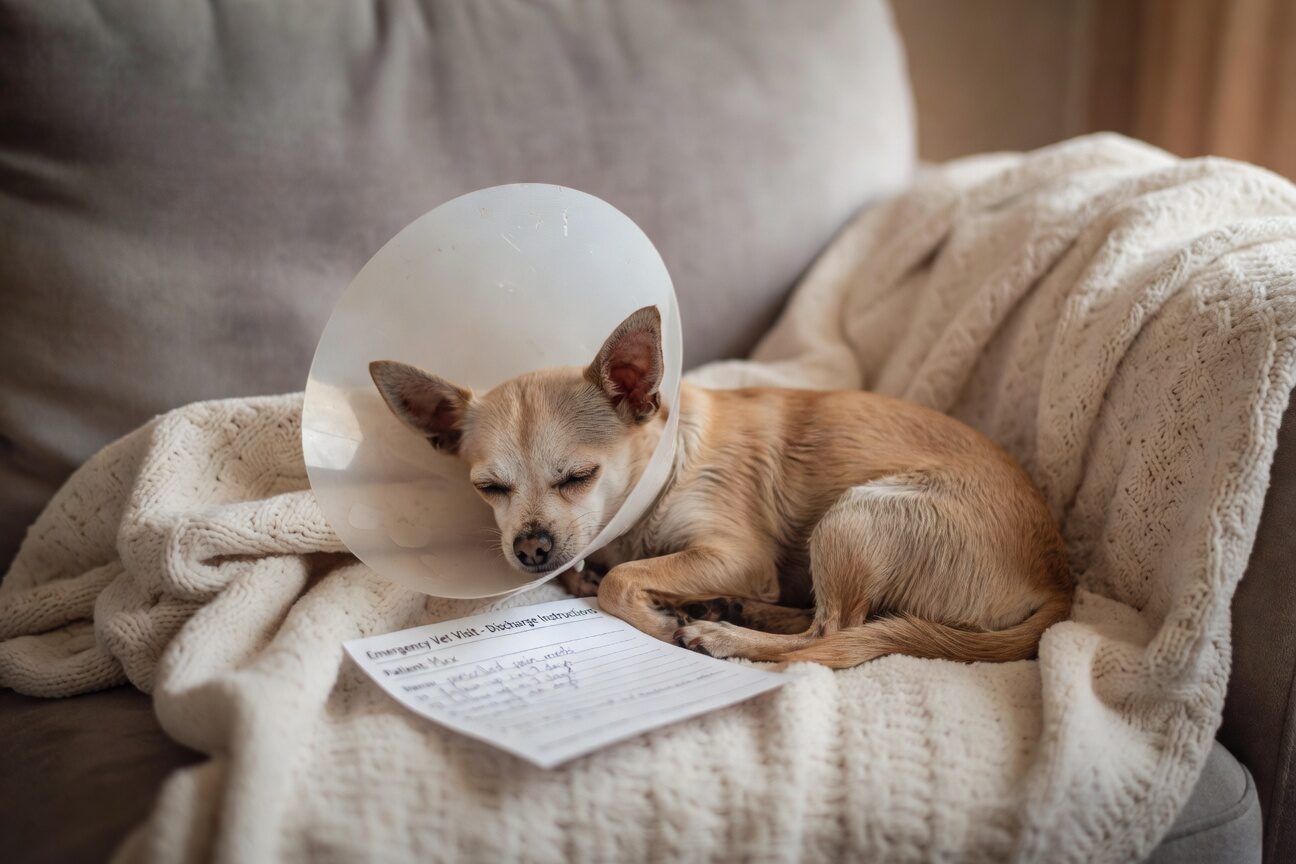
Emergency three: the trauma event, handled efficiently
The third emergency happened at month thirty-eight. The dog was on a backyard deck on a summer evening when she slipped between two railings and fell approximately four feet to the ground below. The owner heard the impact and reached the dog within ten seconds. The dog was conscious, breathing, and responsive but visibly uncomfortable on her left rear leg.
The owner did not, in the moment, attempt to manipulate the leg. She placed the dog gently in a small carrier, drove to the emergency clinic (eight minutes away), and presented at intake with a clear concise account: fall, four feet, conscious, holding the left rear leg. We imaged the leg, identified a hairline fracture, splinted, and referred to a board-certified surgeon for evaluation. The dog recovered fully with conservative management.
What the owner did right: did not panic; did not manipulate the injured limb; transported in a carrier rather than carrying loose; presented at intake with a clear summary; followed all care instructions.
What the owner did wrong: the deck railings had a gap that the dog could fit through. The household had not, until that point, deck-secured against a four-pound dog. Like the chocolate situation, the lesson was upstream: the environment review.
The lesson: chihuahua-proofing the household environment is a household-level project that pays off in avoided emergencies. The deck railings, the chocolate-on-counter situation, the laundry-basket sock, and several other household features were all addressed in the same six-month period after the third emergency.
The protocol that emerged, briefly
By the end of the three-emergency sequence, the household had developed a working protocol that I think is worth sharing:
- The emergency clinic phone number, the regular clinic phone number, and the ASPCA Poison Control number are all in the household phone contacts and posted on the refrigerator.
- A small carrier lives by the front door, ready for transport.
- A printed sheet with the dog's medical history is in a folder near the carrier.
- The household has been audited for chihuahua-specific environmental hazards: deck and railing gaps, counter heights, laundry baskets, houseplants, electrical cords, small swallowable objects.
- Any acute change in the dog's behavior that does not resolve within a few hours triggers a phone call to the clinic, not a wait-and-see approach.
A separate piece on the go-bag covers the related preparedness work. The combination of go-bag, emergency plan, and household environmental audit covers most of the upstream variables.
The honest bottom of the question
Chihuahua households will, statistically, encounter at least one emergency over the dog's lifespan. The variable that matters most in outcomes is the time-to-action. The household that calls the clinic at the first sign of unusual behavior catches problems in the home-management or low-acuity category; the household that waits to "see if it resolves" sometimes catches the same problem in the surgical or critical-care category.
Talk to your veterinarian about establishing the relationship before any emergency arrives. A clinic that knows you and your dog will triage faster on a phone call. The annual wellness visit is the right time to ask about the after-hours protocol and to confirm the emergency clinic referral. A separate piece on the emergency vet visit covers what to expect during the actual clinic experience.
The bottom line, with the usual caveat
The three emergencies in this household span foreign body, toxin exposure, and trauma; together they cover most of the chihuahua-relevant emergency categories. The lessons (call early, audit the environment, prepare in advance) generalize. The dog, in the household I have described, is now eight and has had no further emergencies in the four years since the third one. The system, on the available evidence, runs.
Health at a Glance: What to Watch monitor_heart
| Condition | Key Signs | Prevention Tips |
|---|---|---|
| Dental Disease | Bad breath, tartar, red gums | Daily brushing, dental treats |
| Patellar Luxation | Limping, skipping, leg lifting | Weight control, avoid high jumps |
| Tracheal Collapse | Dry cough, gagging | Harness walking, avoid smoke |
| Heart Disease | Coughing, fatigue, fainting | Regular check-ups, heart-healthy diet |
| Hypoglycemia | Shaking, weakness, lethargy | Small, frequent meals |
Community Insights – FAQ help
help_outline When should I call my vet about a behavior change? expand_more
Sooner than feels reasonable. A change in appetite, energy, or routine that lasts more than 48 hours is worth a phone call, not a wait-and-see.
help_outline How often should a healthy adult chihuahua see the vet? expand_more
Once a year through age seven. Twice a year from eight on. Dental checks are part of every visit.
help_outline Do chihuahuas need different care than larger breeds? expand_more
Yes. Smaller medication dosing, more frequent dental work, and closer monitoring for tracheal and patellar issues are standard in toy-breed care.
Have a health question? Ask your question in the comments. We will bring it up with the vet team.
favorite