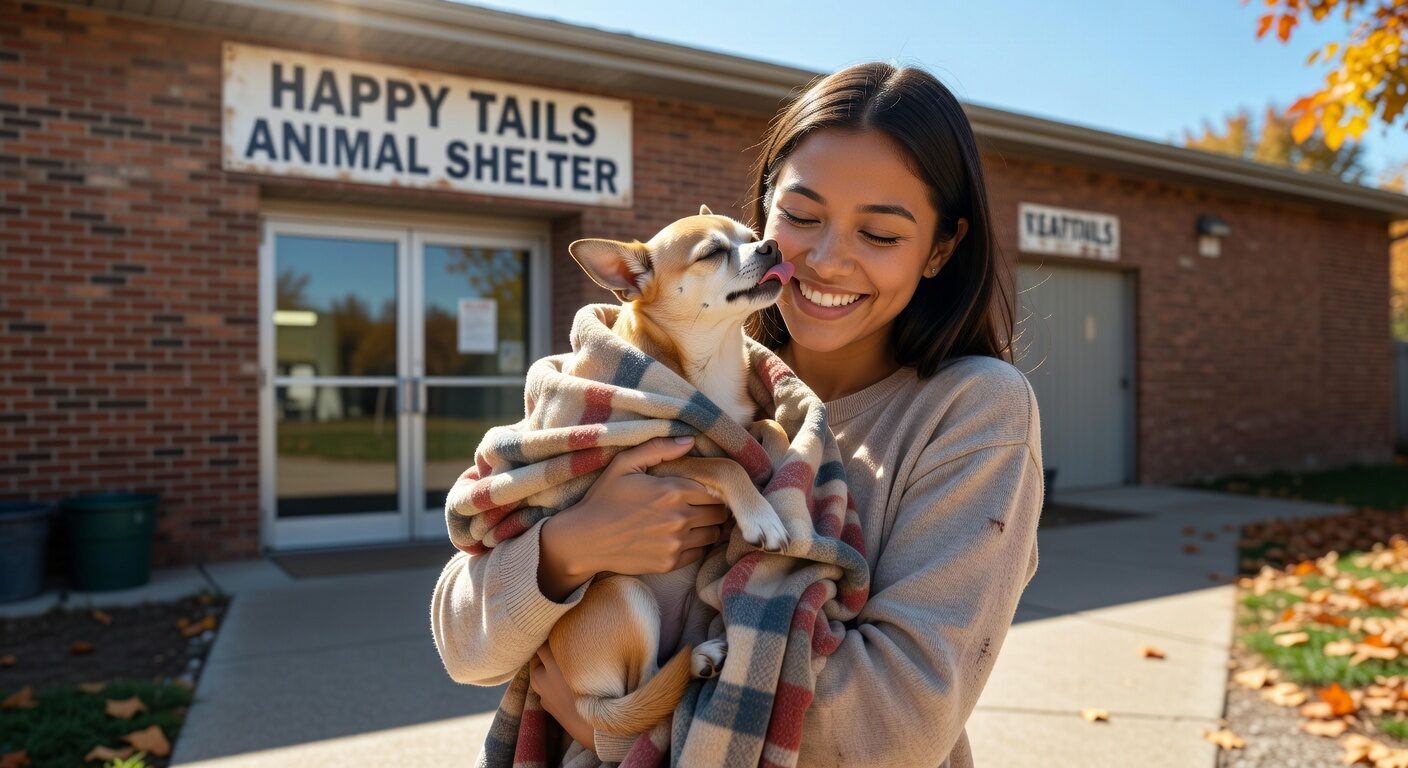

On a Tuesday morning in March, a jogger running the perimeter of a small city park stopped at the edge of a shallow pond. He saw something in the water that did not belong there. He pulled out his phone and called the police, and within fifteen minutes two officers and an animal control officer were standing on the bank with him, looking at the same scene. Two small dogs, tied together at the collar with a length of thin wire, were standing on a shallow ledge near the bank, their heads barely above the surface. They were chihuahuas, both of them; a tan female and a black-and-white male, a combined weight of about eleven pounds.
Know a Chihuahua who needs a second chance? Share their story—and help them find a forever home.
favoriteI have spent a fair amount of time in the last decade writing about rescue, and I will say plainly that I do not believe in writing the inspirational summary of these cases. They are difficult cases, and the people involved deserve their dignity. What I am going to do is walk through the rescue itself, the medical course that followed, and the question these stories quietly put to the rest of us, which is what the people nearby are supposed to do.
The pond
An officer waded in. The water was cold and roughly chest-high at the dogs’ position. The dogs did not struggle when he reached them; they were past struggling. He carried both of them out together, still tied, and laid them on the towel a neighbor had brought down from a house across the street. The wire had cut into the fur and skin at both collars. The animal control officer cut it carefully, with a pair of small bolt cutters, and the dogs were wrapped in two beach towels and driven, by the neighbor, to an emergency veterinary clinic eight miles away.
article_in_feed
A handpicked find for your tiny companion.
The veterinarian on duty was a Dr. Lucia Marquez. She and her two technicians worked on both dogs at once, in the manner of a small clinic that has done this kind of intake before. Body temperatures were 95.8 and 96.2 degrees Fahrenheit; normal canine range is roughly 100 to 102.5. Both dogs were warmed slowly with circulating-water blankets. Both were started on intravenous fluids. The wounds at both collars were cleaned and dressed. By 4 p.m. that afternoon, both dogs were out of immediate danger. By the next morning, both were eating soft food.

The investigation, and the law
The case has been turned over to the local police department’s investigation unit, and as of this writing, no charges have been filed; I am not going to speculate on a case in progress. What is publicly known is that the dogs were thin and matted before the pond incident, suggesting a pattern of neglect that predated Tuesday morning. The ASPCA’s state-by-state animal cruelty law tracker documents the legal frameworks in play; in most U.S. jurisdictions, a case like this falls under aggravated cruelty statutes carrying felony penalties.
The state veterinary forensic team did examine both dogs and produced a report that will, in time, be part of the investigative record. I have read the press release. I am not going to quote from it; the dogs deserve the privacy that a press release cannot quite provide.
What the people nearby actually did
I keep coming back to the four people in the first hour of this story. The jogger, who did not run past. The two officers, one of whom went into the water in his uniform. The neighbor with the towels. None of them is the protagonist of the story. Each of them did one ordinary thing at the moment it was needed.
The Humane Society’s guide to reporting animal cruelty is short. You call the police non-emergency line, or 911 if a life is in immediate danger; you do not enter a stranger’s property; you describe what you see in factual terms and let the trained responders take it from there. The jogger had read something like this, or had not read it and was simply paying attention. The officer in the pond had not read it; he had been a small-town officer for fourteen years and had pulled three dogs out of three different bodies of water across his career.
I am writing about this case because the rescue worked. The investigation continues. The dogs are alive. Pepito’s adoption story, which I wrote last fall, ended a similar sentence; the chihuahua who got his first bed at nine years old ended another. The line between the dogs in those stories and the dogs in this one is the people who happened to be nearby and the small actions they took.
Where the dogs are now
Both dogs are in foster care with a regional small-breed rescue group, in a private home with a quiet retired couple who have fostered fourteen chihuahuas over the last seven years. The female has gained 1.4 pounds in three weeks. The male has begun, tentatively, to play with a small rope toy. They are sleeping on a single donated orthopedic bed, even though the foster home has two beds; this is something they decided themselves and the foster has not interfered.
Both dogs will be available for adoption together once the medical course is complete and the investigation has stabilized. The rescue has asked that I not publish the city, and I have agreed; I will write the follow-up when there is one.
The quiet ask
If you have read this far, the ask is small and specific. Save the non-emergency number for your local police department in your phone. Save the number for your nearest animal control. The next time you pass a yard or a park or a pond and see something that does not look right, you will have what the jogger had, which is a number to call and the willingness to call it.
The dogs in this story are alive because four people, on a Tuesday in March, did not look away. That is, in my experience, almost always the entire story. There is rarely an inspirational summary; there is usually a phone call, a pair of towels, and a Dr. Marquez at the other end of an eight-mile drive.
How You Can Help volunteer_activism
Every action creates a ripple. Here's how you can make a difference.
Adopt
Open your heart and home to a Chihuahua in need.
Foster
Provide a safe place for healing and recovery.
Donate
Support medical care, food, and emergency rescues.
Volunteer
Offer your time and skills to local rescues.
Share
Spread stories that help save more lives.
Frequently Asked Questions help
help_outline What should every Chihuahua owner know about Rescue? expand_more
Stay observant — small changes in routine, energy, or appetite are usually the first signal something needs attention.
help_outline Is a tailored approach really necessary for Chihuahuas? expand_more
Yes. Their tiny size means smaller portions, gentler activity, and more frequent check-ins than larger breeds.
help_outline How often should we revisit our routine? expand_more
At least quarterly, and any time you notice a change. Small dogs, small adjustments — early and often.
Share Hope’s Story Your share could be the reason another dog gets found.
favorite