


Why does a chihuahua bark at the doorbell, the mail carrier, the wind, and occasionally the toaster? In one sentence: the breed is alert, people-focused, and small enough to feel exposed in many situations, and barking is the dog's most efficient tool for managing distance from things she finds notable. The fix is not "stop barking"; it is to figure out which kind of barking you are dealing with and to teach a replacement behavior.
I am going to walk through the four most common barking patterns, how to tell them apart, and the force-free protocol for each.
Why the breed barks more than a Labrador
A few structural reasons. The chihuahua is alert by breed temperament; the breed has historically been a watch dog as much as a companion. The breed is small, which means the dog is, in many environments, looking up at potential threats; barking is a distance-creating tool. The breed is people-focused, which means the dog often has a strong sense of what belongs and what does not in her household.

None of this is "wrong." A chihuahua who notices things is a chihuahua doing her job. The training work is to channel the noticing into useful signals rather than constant alarm.
The four common patterns
Drawn from the behavioral literature and from caseload experience.
- Alert barking. The doorbell, a person passing the window, an unfamiliar sound. Short bursts, alert posture, often with a quick check-in look at you. The dog is reporting.
- Demand barking. The dog wants something specific; food, attention, a toy, the door open. Often directed at you, sometimes accompanied by pawing.
- Frustration barking. The dog is restrained from approaching something she wants to investigate; common on leash, common at the window with a passing dog. Higher pitch, often a longer string.
- Anxiety barking. Sustained, often when alone, without a clear trigger. Different from alert barking and worth distinguishing because the protocol is different. A separate piece on canine anxiety covers the broader picture.
The first step in any barking-modification plan is to figure out which pattern you have. Many households have two or three running at once.
Alert barking, the protocol
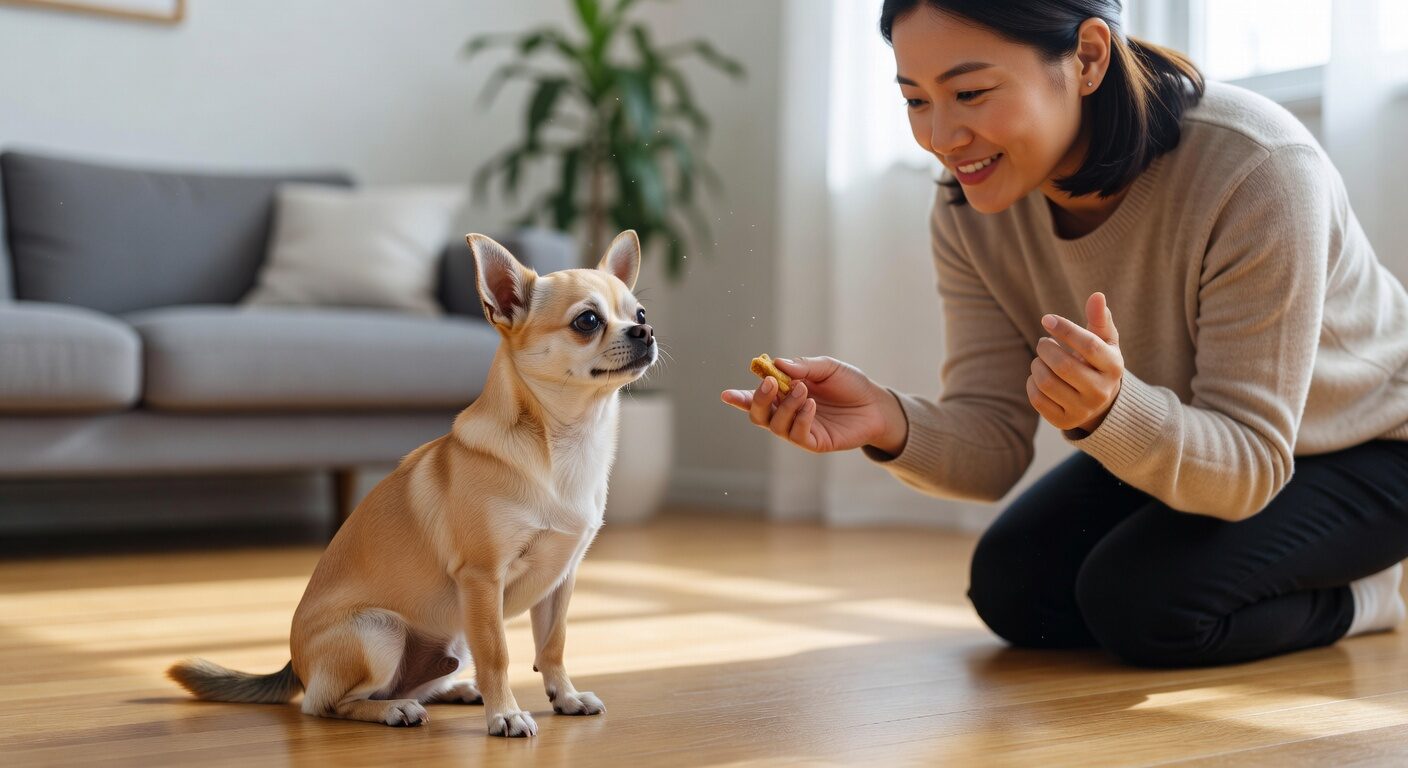
For alert barking, the protocol is to acknowledge the report, then redirect to a quiet position.
- When the bark starts, calmly say "thank you" once. Walk to the source, glance at it, return.
- Cue the dog to a mat or bed. Reward heavily for going.
- Repeat consistently. The bark becomes the cue to go to the mat.
The "thank you" is a specific framing borrowed from Patricia McConnell's work; it acknowledges the dog's report rather than punishing it, which preserves the underlying watchdog function while channeling the response.
Demand barking, the protocol
Demand barking is reinforced by the response. The dog barks, the owner gives the thing, the bark is reinforced. The fix is to make barking unreliable as a tool and a quiet alternative reliable.
- Identify the demand (food, attention, door).
- When the bark starts, do nothing visibly. Do not look, do not talk, do not move.
- Wait for any quiet pause, however brief. Mark it. Deliver the thing.
- Within a few sessions, the dog learns that quiet works and barking does not.
This protocol is unglamorous and requires consistency from every household member. One person who responds to demand-barking undoes the whole household's work.
Frustration barking, the protocol
Frustration barking is a sub-threshold problem; the dog is over-aroused and cannot disengage. The protocol is to manage distance and reduce arousal.
- Identify the trigger and the working distance.
- Block visual access where possible. A film on the bottom half of the front window stops the patrol; a baby gate at the entryway prevents the door rush.
- Counterconditioning at sub-threshold distance, paired with high-value food. The dog notices the trigger; the dog gets a treat. Build over weeks.
- The general stress-reduction protocols sit in the same toolkit.
Anxiety barking, the protocol
Anxiety barking, especially when the dog is alone, is its own conversation. The protocol involves a graduated absence plan, environmental management, and (in some cases) veterinary consultation about medication. This is not a "training the bark" problem; it is an "addressing the underlying state" problem. The ASPCA's separation anxiety reference is the right starting document.
What not to do
A few interventions that do not work and sometimes hurt.
- Yelling. The dog hears barking back. The bark increases.
- Bark collars. Aversive correction without addressing the underlying state. In small breeds, often increases anxiety, which can worsen the bark.
- Punishment after the fact. The dog cannot connect the punishment to earlier barking.
- Ignoring all barking equally. Demand barking benefits from being ignored; alert barking does not, because alert barking is doing a job.
When the pattern is mixed, which it usually is
Most households I work with have two or more barking patterns running at once. A chihuahua who barks at the doorbell (alert), at dinner time (demand), and at the cat through the window (frustration) is normal, not exceptional. The protocol in this case is to address one pattern at a time, starting with the most disruptive, rather than trying to "fix the barking" as a single project.
A reasonable order, drawn from caseload, is to start with the demand barking (because it is the most reinforced and the easiest to extinguish), then the frustration barking (because it tends to escalate fastest), then the alert barking (because some level of alert is breed-appropriate and worth keeping). Anxiety barking, when it shows up, often needs to move to the front of the queue and may require veterinary support.
One thing to do this week
For five days, keep a small log on your phone. When does the dog bark? At what? For how long? By Friday, you have a pattern. The pattern tells you which of the four protocols to start with. Without the pattern, every plan is guessing; with the pattern, the plan is targeted.
The work is small. The compounding, over six weeks, is real. A chihuahua who barks meaningfully (at actual events, briefly, then settles) is the dog you are aiming for, not a silent dog. Silent is not the goal; useful is.
Gear That Works backpack
Harness (Not Collar)
A step-in harness is safer and more comfortable.
Lightweight Leash
4–6 feet gives freedom without losing control.
Treat Pouch
Keep rewards accessible and distraction-free.
ID Tag & Microchip
Always be prepared in case of separation.
Trainer Tip: Success on walks starts with reading your Chihuahua's signals and respecting their pace.
Was this guide helpful?
Was this guide helpful? Save the guide. Share it with one other chihuahua owner this week.
favorite