
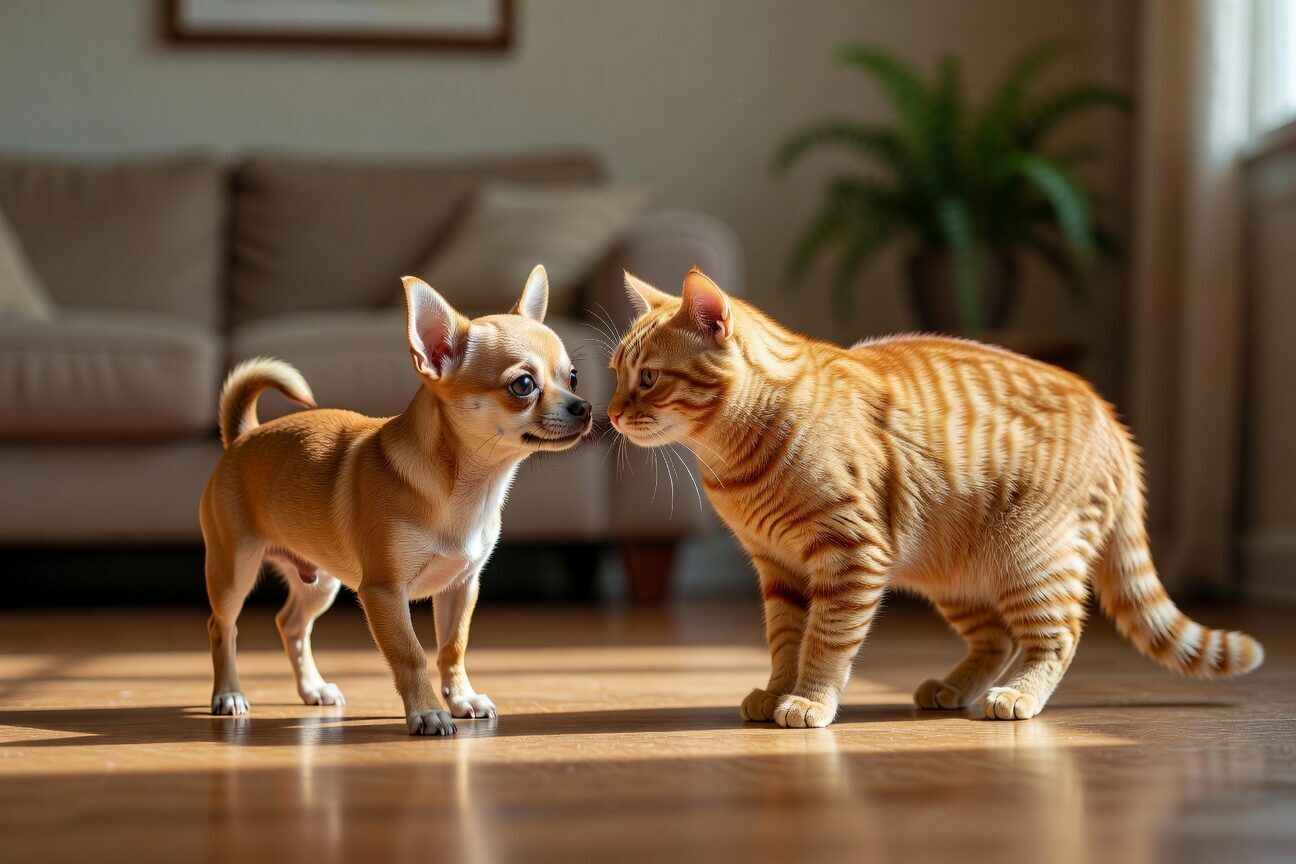

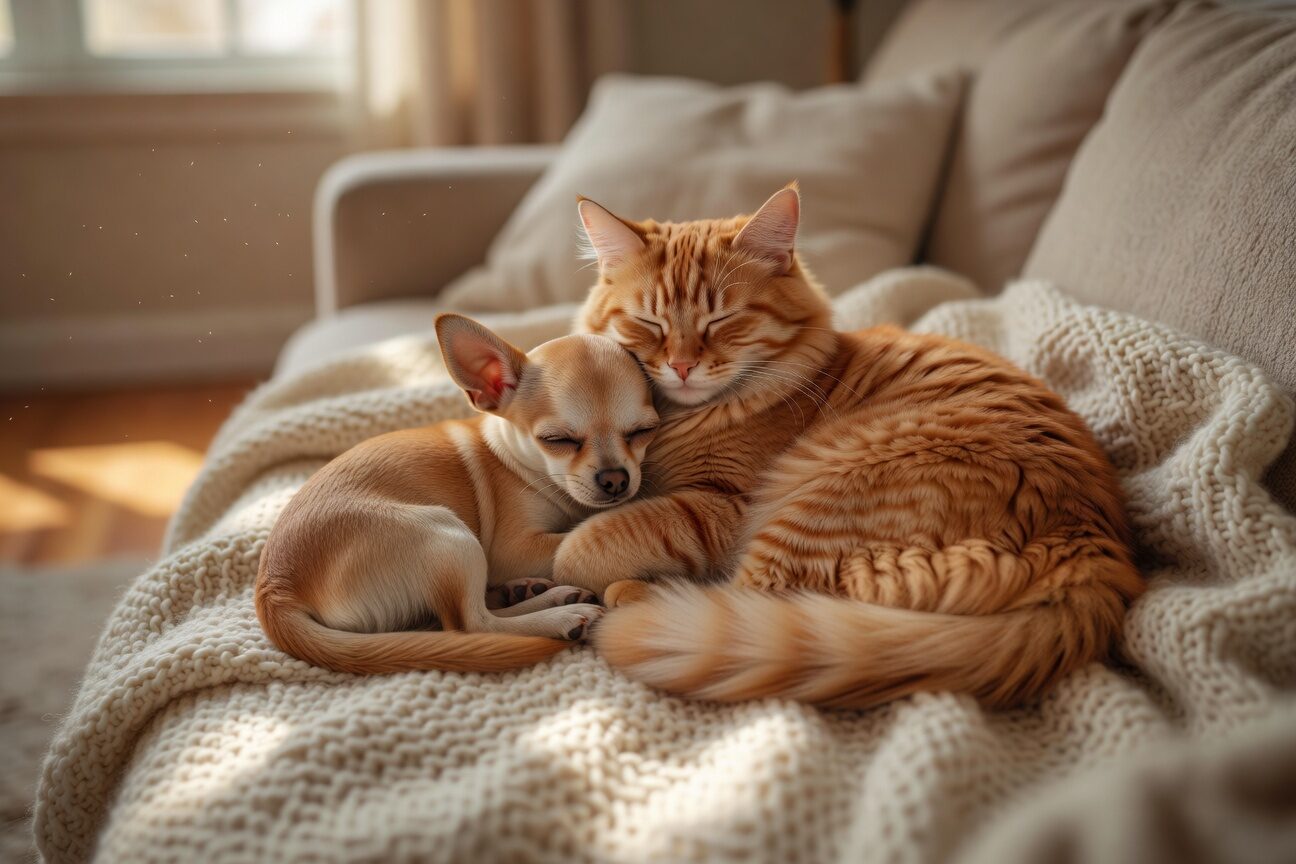
I brought home a seven-week-old tabby kitten named Mango fully expecting my chihuahua Oliver to lose his mind. Oliver is territorial about his water bowl, his blanket, his spot on the couch, and the specific patch of sunlight that hits the living room floor at 2 PM. Introducing a new animal into his kingdom seemed like a recipe for disaster. But here is what actually happened — within three weeks, Oliver and Mango were sleeping in the same bed, grooming each other’s ears, and generally behaving like they had been roommates for years. So are chihuahuas good with cats? The answer is more complicated and more hopeful than most people expect.
The relationship between chihuahuas and cats depends almost entirely on the individual animals, the quality of the introduction, and the owner’s willingness to manage the transition period properly. I have seen chihuahuas who adore cats and chihuahuas who cannot share a room with one. The breed is not the determining factor — personality, socialization history, and your approach to the introduction make all the difference.
Why Chihuahuas and Cats Often Get Along Better Than Expected
There is a reason so many chihuahua owners report successful cat-chihuahua households, and it comes down to size and temperament similarities. Chihuahuas are closer in size to a cat than to most other dogs, which removes the size-based fear response that cats often have with larger breeds. A cat can hold their own against a five-pound chihuahua in a way they cannot against a seventy-pound Labrador, and that power balance makes the cat feel less threatened from the start.
Chihuahuas also share certain personality traits with cats that create unexpected compatibility. They are independent. They have strong preferences about where they sit, when they eat, and who touches them. They are capable of deep affection but on their own terms. The AKC breed profile describes chihuahuas as having “terrier-like” confidence, and that confidence translates into a dog who is more likely to view a cat as an equal than as prey.
When Size Works in Your Favor
Oliver weighs four pounds. Mango weighs nine. The cat is literally twice the size of the dog, and both of them seem aware of this. Oliver never chases Mango because Mango is not small enough to trigger a chase response, and Mango never feels genuinely threatened by Oliver because one swat from a tabby paw sends Oliver scrambling. This natural power balance is something you do not get when pairing cats with larger, high-prey-drive breeds. It is one of the biggest reasons chihuahuas good with cats is more than just a hopeful question — it is a frequently observed reality.
The Introduction Process That Worked for Oliver and Mango
I followed a slow introduction protocol that took about two weeks and it made all the difference. The first three days, Mango stayed in the guest bedroom with the door closed while Oliver sniffed the gap underneath it approximately four hundred times per day. We swapped blankets so each animal could get used to the other’s scent without direct contact. By day four, Oliver was lying next to the guest room door with a bored expression, which I took as a good sign.
Days four through seven, I used a baby gate to create visual access without physical contact. Oliver would sit on one side staring at Mango with an expression that alternated between fascinated and offended. Mango would sit on the other side washing herself with theatrical indifference. No hissing, no lunging, no aggression from either side. The ASPCA introduction guidelines recommend exactly this kind of gradual exposure, and I can confirm from experience that rushing this phase is the fastest way to create a multi-pet household where everyone is miserable.
The First Unsupervised Moment
Week two, I removed the gate during supervised sessions. Both animals investigated each other, there was one warning hiss from Mango when Oliver got too close to her food, and Oliver respected it immediately. That hiss was the last conflict they ever had. By the end of week two, they were sharing the couch. By week three, they were sharing a bed. Are chihuahuas good with cats when the introduction is done right? In my household, the answer is an emphatic yes.
Warning Signs That a Chihuahua and Cat Pairing Is Not Working
Not every combination works, and recognizing early failure signs prevents injuries and chronic stress for both animals. If your chihuahua fixates on the cat with rigid body language, stalking posture, and intense staring that does not break when you call their name, that is prey drive activation and it means supervised separation needs to continue. If your cat is hiding constantly, refusing to eat, or urinating outside the litter box after the introduction, the stress is too high and you need to slow down.
Physical aggression beyond a single warning swat or a single warning growl means the animals are not just adjusting — they are actively in conflict. A chihuahua who lunges at a cat or a cat who attacks a chihuahua with claws out needs immediate separation and a reassessment of whether the pairing can work. Our guide on chihuahua aggression explains the body language to watch for.
How Chihuahuas and Cats Build a Bond Over Time
Oliver and Mango went from cautious tolerance to genuine affection over about six weeks. The progression was fascinating to watch. First came the parallel existence phase — both in the same room but ignoring each other. Then came the curiosity phase — cautious sniffing, tentative nose touches, the occasional play bow from Oliver that Mango responded to with a slow blink. Then came the grooming phase, which is when I knew they had truly bonded. Oliver started licking Mango’s head, and Mango started kneading the blanket next to Oliver.
The VCA multi-pet guide describes this progression as typical for successful introductions, and they note that small dog breeds generally adapt faster than large breeds because the cat perceives less threat. Chihuahuas good with cats is not just possible — in many households, chihuahuas and cats become the closest companions in the home.
Managing Resources to Prevent Conflict
The single biggest source of chihuahua-cat tension in multi-pet households is not personality — it is resources. Food bowls, water dishes, sleeping spots, and owner attention are all things both species care about deeply, and both species are perfectly willing to get snippy about perceived unfairness. Oliver does not care that Mango exists until Mango walks past his food bowl at dinner time. Then Oliver cares very much.
I feed them in separate rooms with the door closed. Each has their own water source. The cat has elevated spaces the dog cannot reach, and the dog has his crate where the cat is not allowed. This resource separation prevents the low-level tension that can erode an otherwise good relationship over time. Our chihuahuas love article discusses resource preferences that keep your chihuahua content in a multi-pet home.
Breed-Specific Considerations That Affect the Cat Relationship
Chihuahuas who have been well socialized during their critical period between 3 and 14 weeks are dramatically more likely to accept a cat than chihuahuas who were not exposed to other species during that window. If your chihuahua came from a home with cats, or a breeder who raised puppies around cats, your odds of a smooth introduction go way up. If your chihuahua has never seen a cat before age two, the process may take longer and require more patience, but it is still very much possible.
Age matters too. Puppies and kittens introduced together almost always bond because neither has established territorial patterns yet. Adult chihuahuas can absolutely learn to live with cats, but the introduction needs to be slower and more carefully managed. Senior chihuahuas, honestly, often do best with cats because they have mellowed enough to find a quiet cat companion more appealing than threatening. Learn more about chihuahua personality across life stages in our calming down guide.
Most chihuahua-cat introductions take between two and six weeks to progress from cautious tolerance to comfortable coexistence. Full bonding, where the animals actively seek each other out, can take two to three months. Rushing the process is the most common mistake. Let both animals set the pace and focus on positive associations during every interaction.
Both scenarios are possible but uncommon with proper management. A chihuahua can nip a cat, and a cat can scratch a chihuahua’s prominent eyes, which is one of the biggest risks in this pairing. Supervise all interactions until you are confident both animals have established a respectful dynamic. Trim your cat’s claws during the introduction period as an extra precaution.
Kittens generally integrate more easily because they have not developed set territorial patterns and their smaller size is less intimidating to a chihuahua. However, kittens are also more fragile and more likely to trigger chase behavior with their quick movements. Adult cats with known dog-friendly temperaments can be equally successful and are often calmer during introductions.
Resource guarding around food is common and does not necessarily mean the relationship is failing. Feed the animals in separate rooms with closed doors to eliminate the trigger entirely. Food-related tension between chihuahuas and cats is a management issue, not a compatibility issue, and it resolves completely when you remove the opportunity for conflict.
Yes, once both animals have established trust and comfort with each other. Many chihuahua-cat pairs become enthusiastic co-sleepers because both species seek warmth and physical contact. If your chihuahua and cat choose to sleep together, it is one of the strongest indicators that they have formed a genuine bond rather than simply tolerating each other.
How long does it take for a chihuahua to accept a new cat?
Most chihuahua-cat introductions take between two and six weeks to progress from cautious tolerance to comfortable coexistence. Full bonding, where the animals actively seek each other out, can take two to three months. Rushing the process is the most common mistake. Let both animals set the pace and focus on positive associations during every interaction.
Will my chihuahua hurt my cat or will my cat hurt my chihuahua?
Both scenarios are possible but uncommon with proper management. A chihuahua can nip a cat, and a cat can scratch a chihuahua’s prominent eyes, which is one of the biggest risks in this pairing. Supervise all interactions until you are confident both animals have established a respectful dynamic. Trim your cat’s claws during the introduction period as an extra precaution.
Should I get a kitten or an adult cat to pair with my chihuahua?
Kittens generally integrate more easily because they have not developed set territorial patterns and their smaller size is less intimidating to a chihuahua. However, kittens are also more fragile and more likely to trigger chase behavior with their quick movements. Adult cats with known dog-friendly temperaments can be equally successful and are often calmer during introductions.
My chihuahua growls at the cat during feeding time. Is that normal?
Resource guarding around food is common and does not necessarily mean the relationship is failing. Feed the animals in separate rooms with closed doors to eliminate the trigger entirely. Food-related tension between chihuahuas and cats is a management issue, not a compatibility issue, and it resolves completely when you remove the opportunity for conflict.
Can chihuahuas and cats share a bed safely?
Yes, once both animals have established trust and comfort with each other. Many chihuahua-cat pairs become enthusiastic co-sleepers because both species seek warmth and physical contact. If your chihuahua and cat choose to sleep together, it is one of the strongest indicators that they have formed a genuine bond rather than simply tolerating each other.