

Confession to start. I have been working with this breed since 2007 and I still missed the warning signs the first time my own chihuahua was about to bite. He was four pounds, the toddler was reaching toward him, and the snap missed by an inch. I had been calling him "cranky" for months when the more accurate word was "terrified," and the body language had been telling me so for at least six weeks before the patio incident.
Fear-based aggression is the most common behavioral problem in this breed, by a wide margin, in every shelter and trainer survey I have looked at. It does not appear from nowhere. It climbs a ladder, and the ladder has seven rungs. Every owner of a small dog should know them.
The Stress Ladder, in Order
1. Whole-body trembling that is not a temperature signal
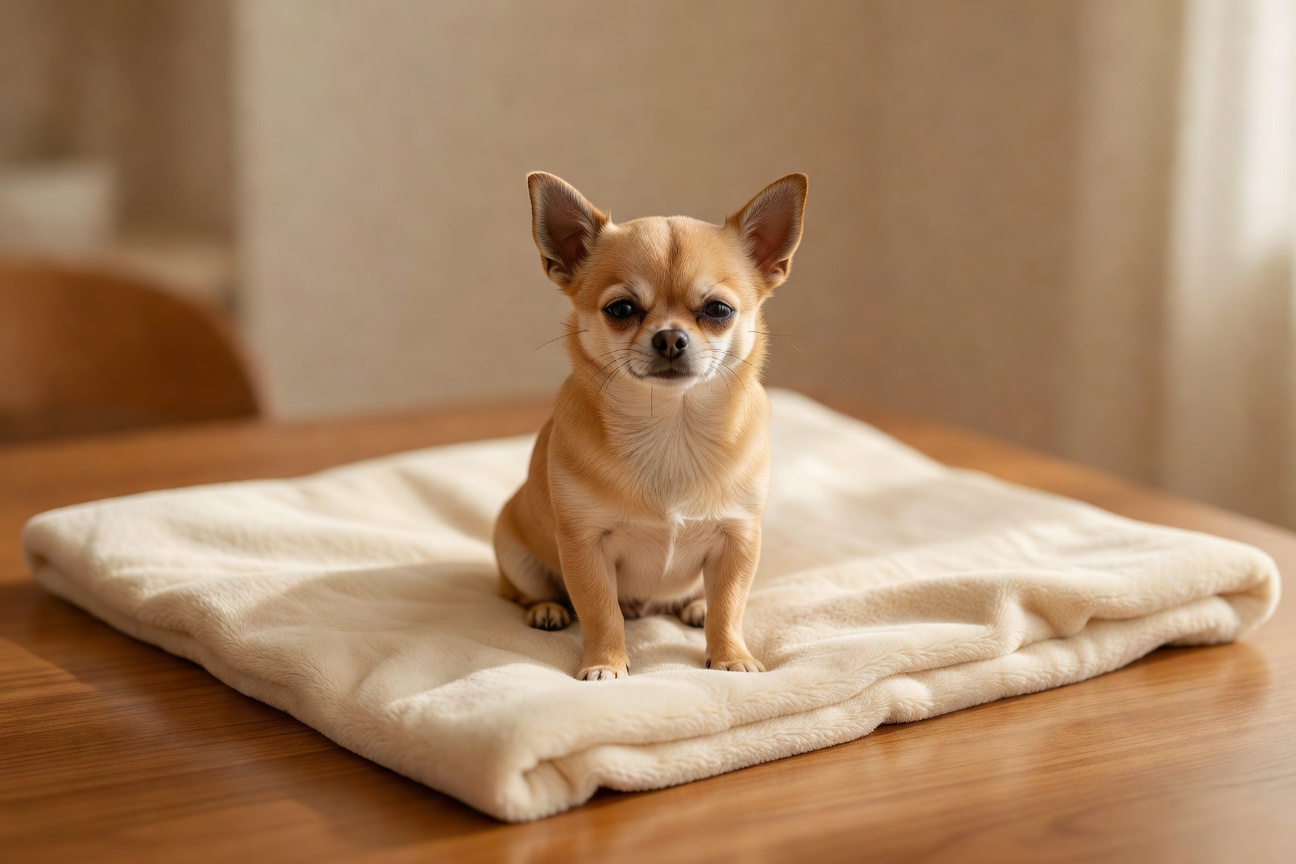
Every chihuahua trembles. Distinguishing the cold tremble from the stress tremble is the first skill. The cold tremble holds neutral ears, neutral tail, neutral pupils. The stress tremble brings pinned-back ears, a tucked tail, dilated pupils, and a body that has gone slightly rigid. (My own dog used to begin shaking the moment the car turned into the veterinarian's parking lot. I told the receptionist, for years, that he was "just dramatic." He was not dramatic. He was telling me, in plain breed-language, that he had been here before and he remembered.)
The AKC canine body-language guide treats trembling-with-postural-shift as an early stress indicator across breeds, and it is reliable.
2. Whale eye and head turn
The dog turns the head away from the trigger but keeps the eyes locked on it; the white of the sclera shows in a half-moon crescent. (It looks faintly comic. It is not comic.) Whale eye is the breed's polite way of saying "I see what is approaching and I am preparing for it." It almost always co-occurs with distance-increasing behavior: ducking behind your legs, leaning away, attempting to walk in the opposite direction.
Most owners miss whale eye because they are looking at the strange person petting their cute small dog, not at the cute small dog's face. Train yourself to watch the dog.
3. Stress yawning and lip licking outside mealtimes
A long, wide yawn unrelated to sleep, sometimes with a high whine on release. Lip-licking when no food is present. These are calming signals; the dog is performing them automatically to de-escalate a situation she finds overwhelming. The 2008 AVSAB position statement on socialization treats both behaviors as early-ladder distress signals; they appear well before a growl. (Why? Because evolution selected for warnings that are cheap. Yawning is cheap. Biting is expensive.)
4. The freeze
A stressed dog stops moving entirely. Not relaxed stillness; rigid stillness. The eyes get larger, the body goes stiff, the ears cool slightly to the touch as blood is shunted to core musculature. The freeze is dangerous because it sits one rung below the bite. A dog who is lip-licking still has emotional bandwidth. A dog who has frozen has stopped trying to manage the situation and is calculating.
If your chihuahua freezes, do not wait. Pick the dog up calmly. Create distance. Decompress. Our companion piece on the three things every chihuahua owner must know covers the safety side; the relevant rung here is the freeze.
5. Growling
Growling is communication. A dog who growls is doing the polite thing. (Why? Because the alternative is biting without warning.) The single most damaging mistake an owner can make is to punish a growl, because what you eliminate is not the underlying fear but the warning. A dog whose growl has been punished moves directly from freeze to teeth, which is the worst of all possible worlds.
The ASPCA aggression page treats growling as a critical communicative signal that should be acknowledged and worked with, not silenced. My own trainer once put it more sharply: "That growl just saved that child from a bite. If you punish it, the next time there will be no growl."
6. Frantic, escalating barking
Patrol-bark is rhythmic, sharp, and stops when the trigger leaves. Anxiety-bark is higher-pitched, frantic, and escalates rather than steadies. It is often paired with pacing or spinning. The transition you watch for is from frantic bark to silence: a dog who has been barking and abruptly goes quiet has not calmed; she has climbed past barking into the freeze, and teeth may follow.
7. Air-snap or contact bite
This is the top of the ladder. By the time you see it, every prior rung has been climbed, in most cases more than once. If you have arrived at this stage, the rest of this article is a retrospective; the work is now to manage the dog, find a certified behavior professional, and rewind the ladder rung by rung. The breed responds well to careful desensitization. It does not respond well to flooding, alpha-correction, or any approach that punishes communication.
What I Did, in Plain Sequence
I worked with a credentialed trainer for four months. We did graduated desensitization to the specific triggers, with the threshold set well below the freeze. We established a safe-zone protocol: the dog has a crate, the crate is sacred, no one follows him into it, and the family enforces this without exception. I stopped scolding the growl; I started reading the ladder a rung earlier than the growl.
The dog is not a different dog. He is still anxious, still suspicious of overhead reaches, still personally offended by the vacuum cleaner. He has not snapped at a human in over a year. The change is in the reader, not the breed. For the wider context on what "this breed" actually means, the twenty-five chihuahua facts piece is the field guide.
If you want more from this beat, explore more chihuahua breed dispatches or subscribe to get the next one in your inbox.
Is this Chihuahua right for you? auto_awesome
Want to learn more about your Chihuahua? Compare breeds, check the standard, and find the chihuahua that matches your home.
favorite