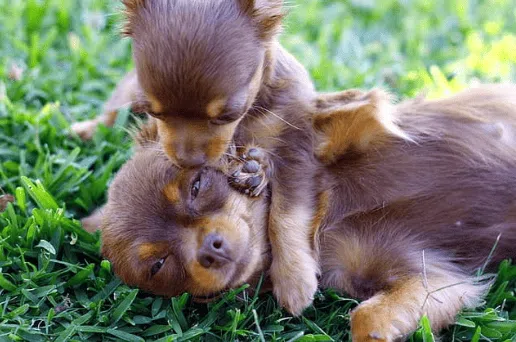


Picture a Chihuahua. Go ahead. Whatever showed up behind your eyes, that round little domed skull, the big set-apart eyes, the abrupt step down to a short muzzle, you just pictured an apple head. The breed standard pictured it too. When the American Kennel Club describes the Chihuahua's head as a "well rounded 'apple dome' skull, with or without a molera," it is describing the dog most of us already carry around in our heads as the default. That is not an accident. The apple head is the Chihuahua as the breed clubs decided it should look.
So let's start with the obvious question and answer it fast: an apple head is not a separate breed, a rare variety, or a premium product. It is a Chihuahua built to the conformation standard. Everything else on this page is the reason that one sentence is true.
What the apple-dome skull actually is
The "apple" comparison is doing real anatomical work, not just sounding cute. Two things create the shape. First, the cranium is broad and rounded while the muzzle is short and comparatively narrow, so the head reads wider up top and tapers below, like the silhouette of a cooking apple sitting stem-down. Second, there is the stop. The Chihuahua Club of America, the AKC parent club for the breed, describes a well-defined stop, the transition from forehead to muzzle, that approaches a near-90-degree angle in profile. Stand a good apple head sideways and you see it: forehead rises, then drops almost straight to the nose. A breeder will call that "good stop" without a trace of irony.
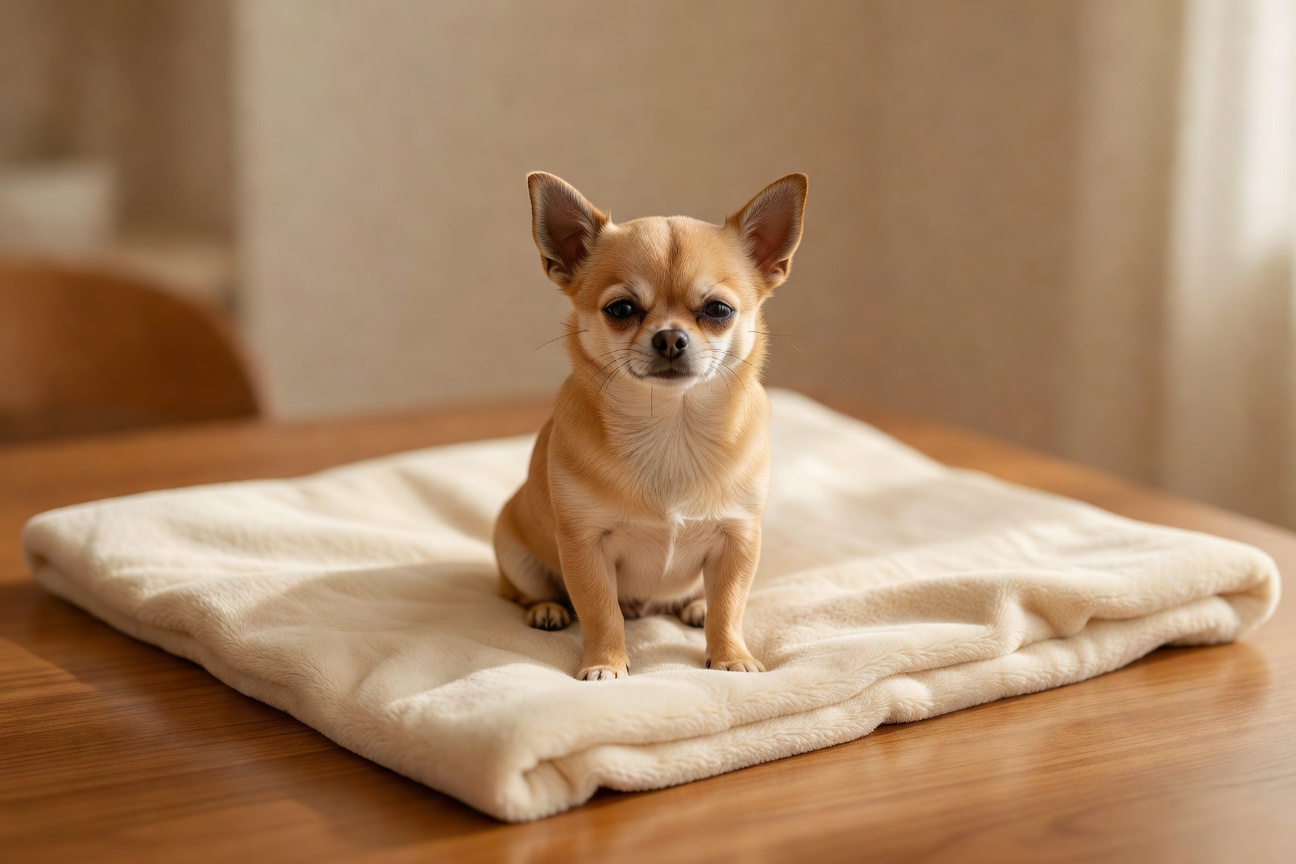
This is also where the standard sets the rest of the frame. Chihuahuas are not to exceed six pounds for show, and the body is meant to be slightly off-square, a touch longer than the dog is tall, with that saucy "terrier-like" expression the standard actually names. The apple head is the keystone of all of it. Get the skull wrong and the whole picture drifts.
The molera, and why "with or without" matters
Read that AKC phrase again: "with or without a molera." That clause is one of the more humane sentences in the dog-fancy literature, and it is worth understanding.
A molera is a soft spot on the top of the skull, an opening where the cranial bones have not fully knit. It is the canine equivalent of the fontanelle on a human newborn's head, the same soft give under your fingertip. Most Chihuahua puppies are born with one. Many close, fully or partially, as the dog matures. Some never close at all, and a normal adult Chihuahua can carry a small molera for life with no ill effect whatsoever.
Here is why the wording earns its keep. For decades a molera was treated, by some breeders and even some veterinarians, as a defect or a marker of a sickly dog, and pups were sometimes culled or steered away from breeding programs over it. The standard's "with or without" language is the breed club saying, plainly, that a molera by itself is normal Chihuahua anatomy and not a disqualifying fault. The Chihuahua Club of America has gone out of its way over the years to push back on the molera-as-disease myth.
None of which means you ignore it. A large molera, or one paired with a visibly domed, fluid-swollen head, lethargy, or a wobbly gait, can signal hydrocephalus, which is a genuine and serious problem in toy breeds. The distinction is one a veterinarian makes, not a breeder's reassurance and not a website. A pea-sized soft spot on a bright, normal puppy is one thing. A bulging skull on a dull one is another. Know the difference, and have a vet confirm it.
Apple head versus deer head
If the apple head is the Chihuahua bred to standard, what is everyone calling the other one? That would be the deer head, and the name is descriptive: a longer, more refined muzzle, a flatter and more sloping stop instead of that near-vertical drop, larger ears, and a body that often runs taller on longer legs. Put one in profile and the slope gives it a foxy, fawn-like look, hence the deer.
The deer head is not a breed, not a variety the AKC recognizes, and not a mixed dog. It is a purebred Chihuahua whose head simply does not match the conformation standard. There was a stretch, roughly the 1950s into the 1960s, when that longer-muzzled look was far more common in the American population, before the parent club's preference for the rounded apple-dome head consolidated in the show ring and pulled the breeding gene pool with it. The most famous Chihuahua of the modern era proves the point: Gidget, the dog behind the Taco Bell ad campaign, was a deer head, and nobody watching ever filed a complaint.
There is a quiet health footnote responsible owners should hear. The deer head's longer muzzle and more moderate skull tend to mean fewer of the dental-crowding and respiratory headaches that can come with an extremely short face, and easier whelping, because the broad apple-dome skull is exactly the part that makes a Chihuahua delivery hard. Cesarean sections are not rare in this breed for that reason. The standard rewards the apple dome; biology charges a small toll for it. Both things are true at once.
Temperament and what living with one is actually like
The head is the show-ring story. The temperament is the living-room one, and it is the same regardless of skull shape. Chihuahuas are bold out of all proportion to their size, fiercely bonded to one or two people, alert to the point of being a doorbell with legs, and far more dog than their packaging suggests. The standard calls for self-importance, and it is not exaggerating. This is a dog that will challenge a Rottweiler and mean it.
That boldness has a flip side worth naming before you bring one home. Under-socialized Chihuahuas can tip into sharpness and chronic wariness, and a tiny dog that has learned biting works is a hard habit to undo. Early, patient socialization is not optional for this breed; it is the whole ballgame. They also feel the cold genuinely, hence the sweaters that get mocked and are in fact justified, and their fine dentition means dental care is a lifelong line item, not an afterthought.
The compensation for all that is one of the longest lifespans in dogdom. A healthy Chihuahua commonly reaches fifteen, and a sixteen-year-old is no miracle. You are not adopting a dog. You are signing up for the better part of two decades of opinionated company.
What a prospective owner should actually do
So you want one. Good. Here is the part that protects you and the dog both.
First, refuse to pay a "rare apple head" premium. Neither head type is rare, and any breeder leaning on that line is telling you something about their honesty, not their dogs. Apple heads are simply Chihuahuas bred correctly; that is the standard, not an upgrade. Second, ask to see the dam, ask about molera and patella history in the line, and ask whether the breeder health-tests, the patella luxation, the heart, and the eyes are the ones that matter most here. A breeder who knows the AKC breed standard cold and talks openly about its trade-offs is worth ten who promise you a flawless miniature. Third, and I say this as the unglamorous truth, plenty of the best Chihuahuas in the world are sitting in rescues right now, deer heads and apple heads alike, asking for far less than $800 and offering exactly the same fifteen years.
The apple dome is a beautiful piece of engineering and a genuine breed signature. It is also just the top of the dog. The rest of it, the nerve, the loyalty, the absurd two-decade staying power, comes free with either skull.
Keep reading: Chiweenie: What a Chihuahua-Dachshund Mix Actually Is
Is this Chihuahua right for you? auto_awesome
Want to learn more about your Chihuahua? Compare breeds, check the standard, and find the chihuahua that matches your home.
favorite