
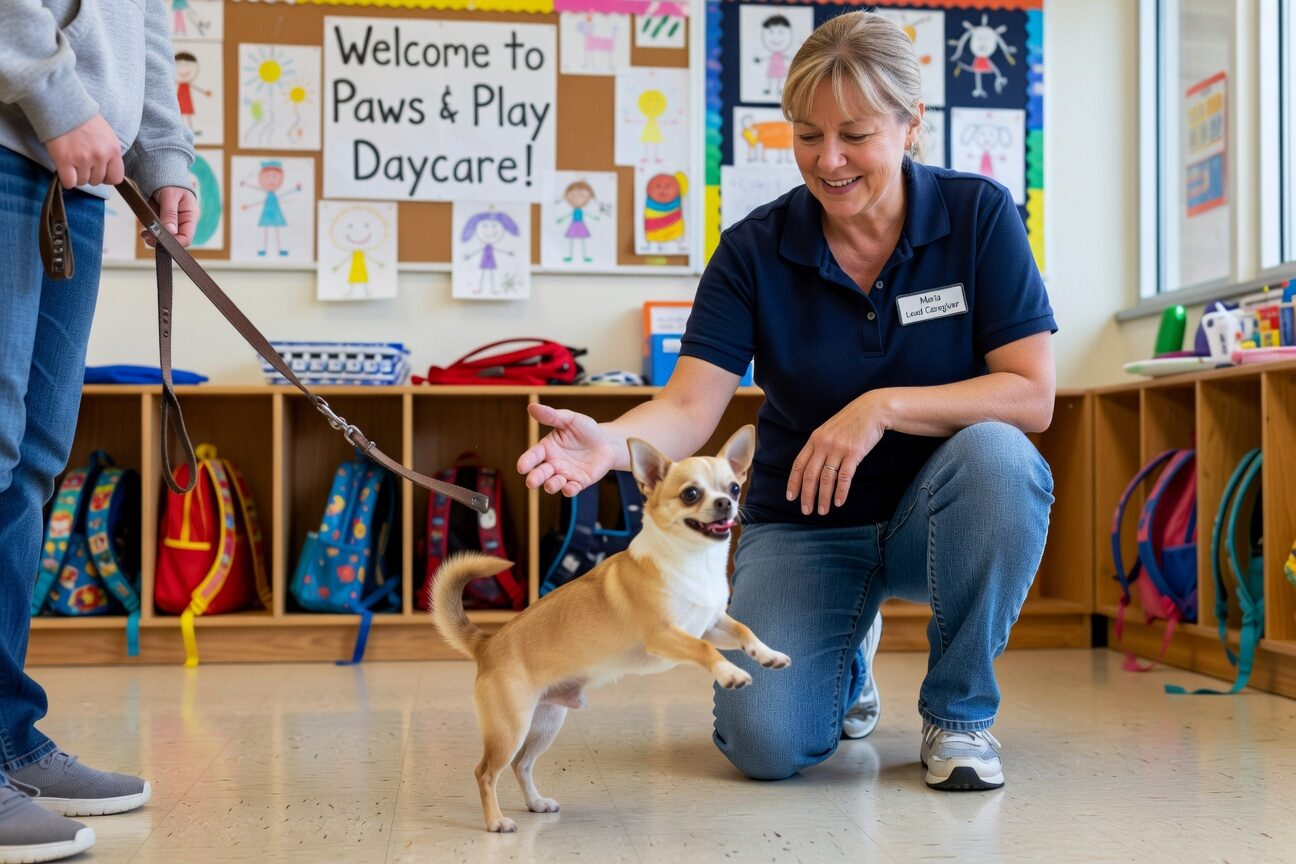
Doggie daycare seems, in concept, like the perfect solution for a household with long workdays and an attentive small dog. The brochure shows dogs playing happily in an open room: fetch, tug-of-war, group nap time on colorful mats. The reality, when I tried it with my chihuahua Pickles, was that she lasted exactly three hours before the daycare called me to come pick her up. She had not played with anyone. She had retreated to a corner. She had, on the staff's account, been distinctly not having a good time. The honest version of the chihuahua-and-daycare question is that the model works for some chihuahuas in some setups and does not work for others, and the screening for which is which matters more than the marketing suggests.
I am writing this with the full benefit of having tried the wrong daycare with the wrong dog, and with the additional benefit of having figured out, in the years since, what the right setup looks like and which chihuahuas it suits.
Why most general-population daycare does not suit chihuahuas
The standard daycare model is calibrated for medium-to-large dogs in mixed-size groups. A few specific issues for chihuahuas in this setup:
article_in_feed
A handpicked find for your tiny companion.
- Size differential. A 50-pound dog playing at normal speed can produce injury to a 5-pound chihuahua without aggressive intent. The physics are unforgiving. A separate piece on dog parks covers the same issue from a different angle.
- Sensory overload. A daycare room with twenty dogs is loud, busy, and full of unpredictable movement. Most chihuahuas, even social ones, find this overwhelming.
- Group nap dynamics. The shared rest space works for many dogs and not for chihuahuas, who often need a small enclosed retreat to settle.
- Staff-to-dog ratios. A 1:10 ratio is standard but means a chihuahua showing distress signals is harder to spot in real time. A 1:5 ratio or smaller, with attentive staff, is meaningfully better.
The model fails not because daycare is inherently bad but because the standard daycare is calibrated for a different population.
What the right setup looks like
The daycare model that does work for many chihuahuas:
Small-breed-only or small-dog-area daycare. The dogs in the room are all under 25 pounds. The play dynamics scale appropriately; the injury risk drops substantially.
Low capacity. Six to eight dogs maximum, with adequate physical space. The ratio of staff to dogs is more like 1:4 or 1:6.
Quiet retreat options. Individual crates, beds, or small enclosed areas where the dog can rest separately when needed.
Trained staff who recognize toy-breed body language. The staff should be able to read stress signals and intervene before the dog escalates into shutdown or reactive behavior. A separate piece on body language covers the underlying reading skill.
Trial day before booking. A non-negotiable. The first day is a half-day (three to four hours) at a discounted rate; the staff observes the dog and provides honest feedback about whether the model fits.
Signs the daycare is not working, briefly
A few specific signals that warrant a different solution:
- The dog refuses to enter the daycare on subsequent visits.
- The dog is exhausted but not in a settled-after-good-day way; the exhaustion is the kind that follows sustained stress.
- The dog shows new behavioral changes (reactivity, sleep disruption, appetite change) on daycare days that do not appear on non-daycare days.
- The daycare staff describes the dog as "shy" or "doing fine in her own corner" rather than engaging with the group. Some chihuahuas do well at the edges of group play; some are signaling that the model is not working.
- Recurring small injuries or skin issues from rough play.
When these signs appear, the right answer is usually a different model rather than a different daycare.
The alternatives, plainly
A few setups that work for chihuahuas who are not daycare-suited:
Pet sitter at home. The dog stays in her familiar environment with a sitter visiting two or three times a day, or staying overnight. The pet-sitter primer covers the screening.
Trusted neighbor or friend. An informal arrangement where the dog goes to a familiar person's house during the workday. Works well when the relationship is established.
Two-or-three-dog playdates. A neighbor's calm small dog visits during the workday or the chihuahua visits there. The structured small-group play is, in many cases, more useful than daycare for the breed.
Mid-day dog walker. The dog stays home; a walker visits for thirty minutes mid-day for a walk and a brief play session. Works well for households where the dog is otherwise comfortable being alone for long stretches.
Bringing the dog to work. Where the workplace allows it. Many chihuahuas are good office dogs; the size and calm baseline suit the setting.
The honest bottom of the question
Doggie daycare is one solution among several for chihuahua households with long workdays. It works for some chihuahuas in the right setup and does not work for many others. The screening (small-breed-only, low capacity, trained staff, trial day) is the most reliable variable; the dog's individual temperament is the next most important. A separate piece on socialization covers the broader frame within which group-play comfort develops.
The household considering daycare should plan for the possibility that the model does not suit the dog and should have one of the alternatives ready as a fallback. The cost of trying daycare with a chihuahua and finding it does not work is, on the dog's accounting, real; the prep that prevents an unhappy six-month enrollment is small.
The bottom line, with the usual caveat
Doggie daycare is right for some chihuahuas, in the right setup, with attentive staff and small-breed-only group dynamics. It is not right for many others. Talk to your veterinarian about your specific dog's temperament if you are considering it; the wellness exam is the right place to discuss any specific medical or behavioral considerations. The ASPCA's general daycare guidance covers the broader category; the chihuahua-specific math is what this column has been about. Pickles, post-daycare-experiment, lives a calm at-home life with a mid-day walker. The system, on the available evidence, runs.
Health at a Glance: What to Watch monitor_heart
| Condition | Key Signs | Prevention Tips |
|---|---|---|
| Dental Disease | Bad breath, tartar, red gums | Daily brushing, dental treats |
| Patellar Luxation | Limping, skipping, leg lifting | Weight control, avoid high jumps |
| Tracheal Collapse | Dry cough, gagging | Harness walking, avoid smoke |
| Heart Disease | Coughing, fatigue, fainting | Regular check-ups, heart-healthy diet |
| Hypoglycemia | Shaking, weakness, lethargy | Small, frequent meals |
Community Insights – FAQ help
help_outline What should every Chihuahua owner know about Health? expand_more
Stay observant — small changes in routine, energy, or appetite are usually the first signal something needs attention.
help_outline Is a tailored approach really necessary for Chihuahuas? expand_more
Yes. Their tiny size means smaller portions, gentler activity, and more frequent check-ins than larger breeds.
help_outline How often should we revisit our routine? expand_more
At least quarterly, and any time you notice a change. Small dogs, small adjustments — early and often.
Have a health question? Ask in the comments and we’ll bring it up with our vet team.
favorite