Blog

  • 5 Reasons Why Chihuahuas Lick Your Face

    5 Reasons Why Chihuahuas Lick Your Face

    If you have one of these precious pups, you’ve probably asked yourself “Why do Chihuahuas lick me so much?” at least once in your life. It’s cute until your Chihuahua licks you often and drenches you with saliva. Here are the top five reasons why Chihuahuas lick your face.

    Why Does My Dog Lick My Face Aggressively?

    Is a dog licking your face a sign of affection? Why do Chihuahuas lick their paws after licking our faces? Continue reading to discover the answers to these questions and explore the top five reasons why Chihuahuas lick your face so much.

    1. They Want to Show Affection

    Chihuahuas aren’t called a man’s best friend by accident. They are affectionate animals that love to bond and provide companionship within their pack.

    According to Stephanie Borns-Weil, a clinical instructor in animal behavior, Chihuahua licking could be a way for them to show affection to their owners. It could also be a way for Chihuahuas to appease others. Just think of licking as a form of kissing for Chihuahuas. But, why do Chihuahuas lick your face, exactly?

    2. Your Puppy is Hungry

    One interesting behavior observed among wild canines is when puppies lick their mother’s face to get her to vomit out some food. When your Chihuahua puppy is licking you, it could potentially be a sign that he is hungry and is asking you for some kind of snack. There are different levels to how much a Chihuahua should eat, so make sure to keep your pup within the norm.

    3. Licking is a Sign of Submission

    According to Dr. Susan Nelson, licking could be a sign of submission. Chihuahuas may lick other Chihuahuas that have a more dominant pack status in order to show their respect. People are no exception to this behavior. A Chihuahua’s protective behavior may exhibit through licking, and you may be on the other end of it.

    Why does your Chihuahua lick your face so much?
    The reasons why Chihuahuas lick your face so much explained through real-life examples

    4. They Enjoy the Taste of Your Skin

    This is a strange one but your Chihuahua could be licking you excessively because they like the taste of your skin, specifically the mineral and salt in the body’s sweat. Dr. David Dilmore states that Chihuahuas have the taste receptors to respond to the sodium/acidic content of body sweat, which is why they lick your face so much.

    5. Your Chihuahua is Bored or Stressed

    Licking could be a sign of Chihuahua boredom or stress, especially if you have shown a lot of positive reactions (e.g. petting, speaking in a positive tone) every time your Chihuahua has licked you in the past. Licking could be a form of communication for attention-deprived Chihuahuas.

    A Chihuahua’s licking behavior shouldn’t be examined in isolation. You will need to take into account the whole situation to answer why Chihuahuas lick your face so much.

    It could be as simple as showing affection or it could be a way for the Chihuahua to de-stress (because he is left alone at home for a long period of time).

    Is it Unhygienic to Let a Dog Lick Your Face?

    The bacteria and germs in your Chihuahua’s saliva may make you sick, and in extremely rare cases, may cause death as well. According to the CDC, Capnocytophaga is a germ common among Chihuahuas and cats. Unfortunately, this particular germ led to the death of one Chihuahua owner in June 2018.

    Healthy Chihuahua owners aren’t all that likely to be affected by the occasional lick but you should still take precautions and discourage your Chihuahua from licking your face, especially due to the fact that it’s much easier for germ-carrying Chihuahua saliva to be absorbed via your mouth, eyes, and nose.

    If your Chihuahua is licking you as a form of affection then you want to make sure you aren’t re-buffing his positive behavior by encouraging him to display the same level of affection in a different way. For example, every time your Chihuahua licks, you may want to teach the Chihuahua that it’s better for him to sit and be petted instead.

    Here's why Chihuahuas lick your face, even if you're a tiny baby
    Here’s why Chihuahuas lick your face, even if you’re a tiny baby

    Is it Okay for Chihuahuas to Lick Babies?

    The reason for the Chihuahua’s behavior could be different when the pup licks a baby’s face. Instead of a sign of submission, a Chihuahua that licks a baby’s face could be viewed as a sign of dominance.

    Your Chihuahua shouldn’t be allowed to display such behavior over your baby as there’s no way of knowing how your baby or the Chihuahua will react. In worst-case scenarios, your Chihuahua (if female) may exhibit maternal behaviors and do things as if the baby is her puppy. You may also experience the occasional Chihuahua ankle bite, so be wary of your pup’s behavior at all times.

    There’s also the health issue. Babies are much more vulnerable to the bacteria in the Chihuahua saliva because their immune system is less developed. If you have a baby at home then don’t take any risks. Keep your pup at a safe distance from your baby, especially if your Chihuahua has health problems you’re aware of.

    With that in mind, we hope that we have explained the lifelong question of why your Chihuahua licks your face so much.

  • 5 Reasons Why Chihuahuas May Bark at Night for No Reason

    5 Reasons Why Chihuahuas May Bark at Night for No Reason

    It may seem like your Chihuahua is barking for
    no reason, but chances are, there is something that is bothering him or
    something that has caught his attention. Here are some things that may get your
    Chihuahua to bark at night, and things you can do to reduce his need to bark.

    1. The Chihuahua Feels Lonely

    As pack animals, Chihuahuas require a certain amount of companionship. Some Chihuahuas may suffer from separation anxiety more than others. Chihuahuas, especially puppies, with a high level of separation anxiety may bark excessively as soon as they are alone. Barking is a way for them to get someone’s attention.

    One way to resolve this is by letting your Chihuahua
    sleep in your bedroom. However, you should only do this if you are comfortable
    with your Chihuahua sleeping in the bedroom for the long-term. While it’s not
    easy to treat, separation anxiety is something you should also take a closer
    look at.

    2. The Chihuahua has Nighttime Anxiety

    Chihuahuas aren’t nocturnal animals so they can fear the dark just as much as anyone else. The slightest of sound or a hint of unfamiliar smell may get your Chihuahua barking like crazy. They may bark either to warn us or to scare away the unknown.

    Unfortunately, it’s not easy for us to identify
    what caused the Chihuahua’s fearful reaction, especially when a Chihuahua’s
    sense of smell and hearing is so much stronger than ours. If you live in a
    house with a yard then it may help to set up outdoor cameras to see if there’s
    any wildlife that’s causing your Chihuahua to get all worked up.

    3. The Chihuahua is Bored and Restless

    Does your Chihuahua spend the day snoozing away while you are at work? There’s always the chance that they are barking at night because they are restless and looking for something fun to do.

    If you aren’t already doing so, getting your Chihuahua
    some exercise in after work could be a good way to reduce their barking at
    night. Getting some light exercise, such as a long walk, in may also promote
    better-quality sleep for you so it’s a win-win situation.

    4. The Chihuahua has a Medical Condition

    Certain health conditions may cause your Chihuahua to bark at night. For example, senior Chihuahuas can suffer from dementia, which may cause them to bark randomly at night because they are confused or they feel lost. Your Chihuahua may also be feeling some form of pain or discomfort.

    If the nighttime barking has come out from
    nowhere then a visit to the vet may be worthwhile in case your Chihuahua is
    feeling some sort of pain. Certain types of pain can feel worse at night.

    5. The Chihuahua Needs to Pee

    Your Chihuahua may have had a sudden urge to pee and wants you to let him outside so he can do his business. This may happen for Chihuahuas that are trained to pee outside. Puppies, in particular, have weaker bladder control so this may be a more common occurrence for younger Chihuahuas.


  • 7 Signs that a Chihuahua is Nervous to the Point of Aggression

    7 Signs that a Chihuahua is Nervous to the Point of Aggression

    Is your dog acting nervous to the point of becoming aggressive or is he just being playful? It’s never easy to interpret what Chihuahuas are trying to communicate. Here are seven signs that could indicate that your Chihuahua is reaching the point of aggression.

    Types of Chihuahua Aggression

    Before we reveal these signs, it’s important to understand the different types of Chihuahua aggression and the root cause for each. Here are the most common types of aggression that Chihuahua owners may encounter.

    • Fear Aggression – the most common type of Chihuahua aggression. This could occur when the Chihuahua is confronted by a scary object (could be humans, other Chihuahuas, or even inanimate objects). The Chihuahua may take an offensive posture when they are confronting fear.
    • Territorial Aggression – this could occur when a stranger or intruder enters the Chihuahua’s territory (e.g. owner’s home or the area surrounding the property). The Chihuahua may attack the stranger.
    • Possessive Aggression – this could occur when someone, including the Chihuahua owner, tries to take away the Chihuahua’s prized possession (e.g. Chihuahua toy, snacks).
    • Pain-induced Aggression – this could occur when the Chihuahua is in physical pain. For example, one study suggests that hip dysplasia is a factor in the risk of large-sized Chihuahuas becoming aggressive.

    Signs of Chihuahuas Becoming Aggressive

    Here are some signs to watch out for when it comes to Chihuahua aggression. Knowing these signs will help you better handle a situation when a Chihuahua becomes aggressive against other humans or Chihuahuas.

    • Chihuahua suddenly becomes still or rigid.
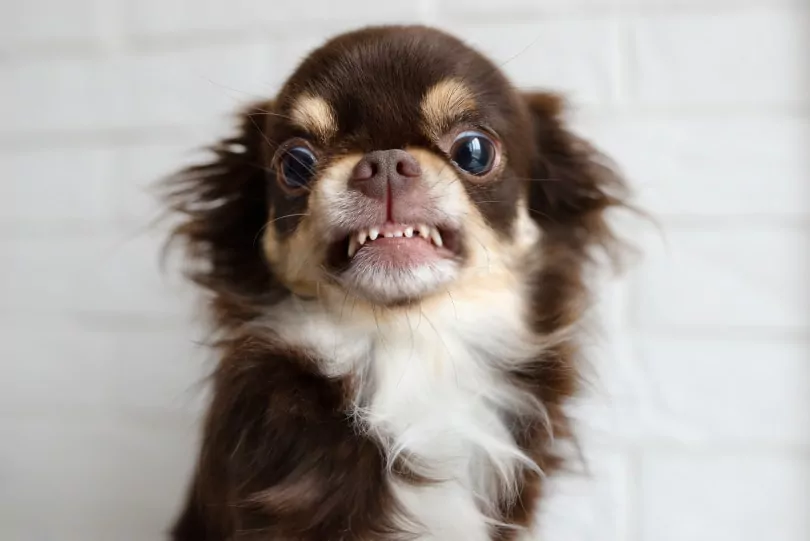
    • Chihuahua curls his lips to reveal his teeth at the “threat”. Chihuahua may also wrinkle his nose.
    • Chihuahua’s ears are pointed backward – this may, however, also be a sign of a Chihuahua showing his friendliness or showing submissiveness to other Chihuahuas and humans.
    • Chihuahua lowers his body with all of his feet firmly planted on the ground. This could be a sign that a Chihuahua is ready to lunge forward at his threat.
    • Chihuahua’s tail moves from a neutral position to a stiff, vertical position. The higher the tail, the greater the potential threat.
    • Chihuahua raises his back or has raised hackles (hair along the Chihuahua’s back).
    • Chihuahua’s eyes are large, dilated and stares directly at the threat.

    Stop a Nervous Chihuahua from Becoming Aggressive

    So how should you act when your affectionate Chihuahua suddenly becomes aggressive to other Chihuahuas and humans (including yourself)? Here are some quick tips.

    • Stay Firm but Relaxed – take a deep breath. Your Chihuahua feeds off your energy so you may make your Chihuahua feel more nervous if you start to stress out over the situation.
    • Show You Aren’t a Threat – if the Chihuahua is starting to show aggression to you or to another human then show him that you aren’t a threat. Reduce the tension by lowering your gaze, turning your head slightly, backing off etc. Do not make direct eye contact.
    • Create a Distraction – if you feel an aggressive behavior is imminent then try and distract your Chihuahua with his favorite treat or toy. This could work well for Chihuahuas that are fearful aggressive.
    • Don’t Raise Your Voice – stick to a low, calm voice. A sudden change in tone or movement may stress out your Chihuahua even more.

    If your Chihuahua continues to remain aggressive then we highly recommend that you see a professional Chihuahua trainer or Chihuahua behaviorist to help figure out your Chihuahua’s aggression.


  • Why Do Dogs Eat Grass & Throw Up?

    Why Do Dogs Eat Grass & Throw Up?

    Our lovable dogs are full of wonderful and strange behaviors, one of which is to eat grass and weeds. This act can be of concern for dog owners, especially if the dog throws up soon after.

    So why exactly would a dog decide to graze on grass, especially if they are well-fed? Well, apparently it’s just everyday behavior for dogs, although some may graze more than others. A 2009 study by researchers in Australia found that dogs with a normal diet spent more time eating grass than dogs with a diet that induced a mild gastrointestinal disturbance.

    Another study by researchers at UC Davis didn’t identify a strong relationship between grass ingestion and clinical illness. Many articles on the internet will present the theory that dogs eat grass in order to “self-medicate” gastrointestinal illnesses but that doesn’t appear to be the case based on these studies.

    Ultimately, you don’t have to worry about the behavior itself and the fact that your dog likes to become a part-time cow every once in a while. The thing you do have to worry about are some of the potential dangers associated with the grass they consume.

    Is Grass Harmful to Dogs?

    For example, the grass the dog consumes may have been exposed to lawn pesticides. The unfortunate reality is that pesticide is very much a big part of the lawn and gardening scene. In 2014, pesticides accounted for 32% of lawn and garden supplies sale in the US.

    The consequences of consuming pesticides will vary based on the type of pesticide and the volume the dog gets exposed to. Certain pesticides may cause vomiting and mild stomach problems, while others may potentially lead to poisoning and death.

    Some dogs may also be unfortunate enough to be allergic to grass and pollen. Dogs that are allergic to grass may exhibit symptoms such as itchy skin and scratchy throats.

    While you may not want to discourage your dogs from going about their normal grass-eating behavior, you also don’t want to leave anything to chance in case the grass your dog consumes contains toxins and other dangerous chemicals.

    Grass-eating may also lead to other worrying symptoms such as vomiting. The UC Davis study found that vomiting was more commonly observed among dogs that didn’t have access to grass on a regular basis. This may suggest that vomiting has more to do with a dog’s inability to digest unfamiliar material.

    Regular grass-eating may also cause your dog to poop green stools. This can occur if the green pigment in the grass (chlorophyll) passes through the dog’s gastrointestinal tract.

    How to Stop Your Dog from Eating Grass

    There are certain steps you can take to discourage your dog from eating grass aside from keeping him away from the grassy areas.

    Offer a Healthy Alternative

    In some cases, the dogs will continue to eat grass no matter how much you train them because it’s part of their natural instinct. If you find yourself in this situation then you might as well offer an alternative option that you know is safe for your dog.

    For example, you can grow your own wheatgrass and give it to your dog. Wheatgrass offers many health benefits, such as aiding digestion and improving bad breath. Wheatgrass is also an excellent source of minerals and vitamins.

    Examine Your Dog’s Diet

    Consult with your vet and identify potential deficiencies in your dog’s diet. Some dogs may start to nibble on grass due to nutritional deficiencies. For example, the grass is high in fiber so switching to a high-fiber diet may reduce your dog’s need to graze on grass.

    Keep Your Dog Engaged

    Some dogs may eat grass because they are bored or nervous. Take a step back and determine if you are giving your dog enough entertainment. Giving your dog a chew toy or natural bone could be a simple way of keeping them engaged.


  • How Many Puppies Can a Chihuahua Give Birth to?

    How Many Puppies Can a Chihuahua Give Birth to?

    Taking care of a chihuahua can be the best joy within the world. This breed is small and usually weighs beneath six pounds. It’s similar to having a toy dog going for walks around the house. But, being this type of small canine, is it viable for a Chihuahua to get pregnant safely? And, how many litters can a chihuahua have?

    What to Remember When Breeding a Chihuahua

    Breeding for chihuahuas is a serious choice. Being pregnant can result in complications particularly in case you just “wing it” and don’t understand whatever approximately breeding a tiny dog. First off, you should know that breeding a chihuahua can be costly because, the maximum of the time, a C-phase could be needed. Of course, there are other medical remedies that might be vital for her to present birth safely.

    If you don’t need her to get pregnant, you want to keep a watchful eye on her if she’s in warmness and round different puppies. The trouble is it’s hard to tell if a Chihuahua is in heat because they’re pretty severe about cleansing themselves. So, aside from a bloody discharge from her reproductive organ, you can also watch out for other signs and symptoms like a trade-in her mood (she might be crankier than usual), swollen nipples or genital, frequent urination, and immoderate licking of the genital.

    Signs of Pregnancy in Chihuahuas

    One of the satisfactory ways to recognize if your Chihuahua is pregnant is to get an X-ray on the nearest animal health center. As mentioned, it could be luxurious so don’t choose this just yet. If you watched that your lovable little pooch is pregnant, then you definitely will virtually spot signs like lethargy, mild vomiting, enlarged nipples (recessed knockers will emerge), and her stomach will grow larger quickly.

    How Many Puppies Can a Chihuahua Have in Her First Litter?

    When it comes to how many litters a chihuahua can have, the maximum range is generally four per pregnancy. Sometimes, it’ll be simply one pup or two. As a count number of fact, in case your chihuahua gave start to 3 or 4 pups, then that’s already considered to be a massive litter.

    Now, how many litters can chihuahuas have in their lifetime? It may be numerous, however, always consider that your small canine can get quite a few headaches with every being pregnant so it’s first-class to check with your vet in case you are planning to breed your chihuahua.

    Can Birthing Be Done at Home?

    Is it possible to have your chihuahua provide beginning at home? Yes, it’s far. Some puppy owners opt for this birthing method. If your vet says that it is alright so that you can just allow your pet to go through a herbal birthing process, then move ahead.

    However, in case you are inexperienced or if it’s far your canine’s first time to offer to begin, your vet may advocate a C-section which should be done inside the health center or puppy clinic. This ought to be the equal vet that closely monitored her throughout her entire being pregnant.

    Interesting Facts About A Chihuahua Pregnancy

    Did you recognize that a chihuahua can get pregnant with the aid of two puppies? Of course, the range of litters your can a chihuahua have will no longer alternate no matter the multiple-sire being pregnant. It’s possible because girl puppies have multiple ova remain available for some days after one has been fertilized.

    And, simply if you had been wondering, yes a tiny chihuahua can get pregnant by using a far larger dog. In this case, being pregnant will become even more complicated because the pup can be too huge for your dog’s womb. This is one of the motives why it’s so vital to keep an eye on your chihuahua while she is in warmness.


  • Why You Shouldn’t Bother Chihuahua When They Eat or Sleep

    Why You Shouldn’t Bother Chihuahua When They Eat or Sleep

    You’ve heard the old phrase, “Let snoozing chihuahuas lie,” but is there any truth in that?

    In this article, we check why you shouldn’t bother a chihuahua even as he’s slumbering. We also examine why you shouldn’t take a canine’s meals away from him when he’s ingesting. Both these problems are particularly vital if you have youngsters for your household.

    Sleeping domestic chihuahuas can get startled while woken, and it could make them just as worrying as while there are different loud noises like noisy holidays. Let’s find out greater.

    Sleep Cycles

    To understand why you shouldn’t trouble your chihuahua even as he’s asleep, we want to learn greater approximately chihuahua’s sleep patterns.

    Your average own family pet canine desires load extra sleep than you do. In fact, chihuahuas sleep for between 14 and 16 hours each day. Despite that, your chihuahua has identical sleep cycles as you do. Those sleep cycles are:

    • REM (fast eye movement)
    • SWS (short-wave sleep)

    So, does your canine dream?

    On average, it takes your canine around 20 minutes to go into the REM sleep cycle. That’s whilst your chihuahua starts offevolved dreaming, and you’ll see your slumbering puppy reputedly chasing something, twitching, yapping, or maybe barking.

    So, yes, puppies virtually do dream.

    Research also suggests that chihuahuas dream greater as children and seniors. It’s also thought that the sounds and moves that your canine makes while he’s dreaming correlate directly to the sports he’s enjoyed throughout his waking hours. For example, in case your canine likes to chase a ball or pursue squirrels, you’ll frequently see him “running” in his sleep, and he may even yip in exhilaration too.

    Waking a Sleeping chihuahua

    The phrase, “Let slumbering puppies lie,” became coined with the aid of the extraordinary author and poet, Geoffrey Chaucer in the 1300s. The cutting-edge interpretation of this usually used expression means that you should forget about trouble, rather than address it and hazard causing greater troubles. However, in case you take the word literally, you ought to wonder why Chaucer chose that specific analogy.

    Well, there are good reasons why you have to now not wake a napping chihuahua.

    Waking a canine from a deep sleep may want to startle him if he wakes. That should purpose the canine to react aggressively by way of biting the hand that shook him awake. Even the most placid, good-tempered canine can turn on you if he’s startled.

    If it’s essential which will wake your canine, use the handiest a mild voice to wake him. Keep your fingers and face nicely away from your canine, just in case he reacts badly to being disturbed.

    When your chihuahua wakes, give him masses of affection and cuddles, particularly if he had a bad dream.

    Waking them from Bad Dreams

    Although it might be slightly scary to observe your chihuahua whilst he has a bad dream, maximum vets assume that having a nightmare is a regular manner that needs to be allowed to come back to a natural conclusion. Dreams can allow your canine to explicit and work via his mind and feelings, permitting your pet’s subconscious mind to sort thru his latest studies and repair equilibrium.

    So, if possible, you must let your dreaming canine lie!

    However, in case your canine has recurrent night time terrors while he appears to end up extraordinarily distressed, you ought to have a chat with a chihuahua behaviorist who can be able to indicate a solution.

    Seizures vs. Normal Rest

    The enormous majority of the twitching, spasms, and involuntary moves that you study while your canine is dreaming are pure because of your puppy’s dreams. However, if your chihuahua suddenly goes rigid and stiff whilst he’s asleep, he could be having a seizure.

    Signs of a seizure in a sound asleep canine include:

    • Labored breathing
    • Problems taking a breath
    • Rigid limbs
    • Stiff, prolonged neck
    • Seizures can be indicative of an underlying health problem that you can no longer be aware of, inclusive of epilepsy.

    If you suspect that your canine is having a seizure while he’s asleep, don’t try to wake your pet. Instead, touch your vet right away.

    Bothering chihuahuas While Eating is a Bad Idea

    Wild puppies and wolves defend their possessions, particularly their food, territory, and mates. That’s necessary survival conduct that domestic puppies regularly mimic in a domestic scenario.

    What does your chihuahua do if you attempt to do away with a fave toy? Some chihuahuas will clutch the toy and run away with it. Others will growl and flatten their ears. In extreme cases, the canine can also chunk you or even chase you away! Many chihuahuas most effective show resource guarding conduct closer to strangers or specific own family participants.

    chihuahuas protect something that they keep in mind to be of value, inclusive of toys, chunk bones, objects of your clothing, even stolen meal wrappers out of your kitchen trash can. However, by far, the maximum usually guarded thing is meals.

    Chihuahuas that Food Guard

    If you get your canine when he’s a puppy, you must teach him to just accept having his possessions, such as his meals, taken far from him. You need to educate your puppy which you are the alpha inside the family. That means that you may get rid of any of your pet’s possessions each time you need to without fear of reprisals.

    However, if you have a grownup canine who thinks he’s in charge, you’ll want to use the following suggestions to address the trouble of meal guarding. If you have children to your family, it’s specifically vital which you educate them NOT to hassle the circle of relatives chihuahua whilst he’s consuming.

    Always go away your chihuahua alone while he’s consuming.

    • To permit your canine overall privacy even as he’s consuming, recollect feeding him in a separate room, in a canine crate, or at the back of a physical barrier which includes a chihuahua gate. That strategy can assist to save you guarding behavior against turning into exaggerated and doubtlessly risky.
    • Make sure that your canine has lots of meals. A chihuahua that’s constantly hungry can be extra inspired to defend his meals than one who is nicely fed.
    • If your chihuahua guards meals on counters and your dinner table, or in case your pet scrounges leftover meals on dishes on your dishwasher, you’ll need to control these conditions carefully. Shut your chihuahua out of the room during the circle of relatives’ meals, be sure to easy up spills, don’t depart food out for your kitchen countertops, and hold your dishwasher door shut.
    • Preventing Food Guarding
    • If you undertake a chihuahua from a shelter, there are some sports you may do to prevent your new pet from developing undesirable guarding conduct.

    Start by feeding your chihuahua by hand a few times. Sit along with your chihuahua and feed him his kibble one morsel at a time. As you feed your chihuahua, stroke him, and communicate gently on your pet. If the canine is cautious or appears uncomfortable, stop feeding him.

    If your canine is satisfied and calm with hand feeding, positioned a few kibbles into his bowl and keep the dish for your lap while he eats. Repeat the technique some times, and then area your canine’s bowl on the ground. As he eats, attain down from time to time to drop a morsel of something tasty into the bowl. Repeat the exercise over the first few months of your new chihuahua’s time with you. Your canine ought to stay comfortable and calm for the duration of this method because he won’t feel threatened.

    Eventually, you should have the ability to cast off the chihuahua’s bowl of meals from him without protest. However, be sure to go back the meals in your chihuahua proper away, ideally after you’ve delivered a small deal with to his dish.

    Exercises to Break Food Guarding

    So, what do you do when you have a chihuahua who guards his food?

    The remedy that animal behaviorists use to cure puppies who showcase meals guarding conduct includes counterconditioning and desensitization. The following sporting events should be achieved in stages. Only pass on to the following step when your chihuahua is relaxed and shows no signs of turning into aggressive.

    Before you begin, cut some tasty treats which include chicken, cheese, or hotdog into small chunk-length pieces. The idea is to show your chihuahua that you have something especially tasty for him that’s much greater interesting than the contents of the bowl.

    Stage #1

    Allow your chihuahua to consume some dry kibble from a bowl on the ground. Stand away from the chihuahua and don’t flow towards him.

    Talk on your chihuahua in a friendly, conversational tone, and at the equal time, throw a unique deal with in the direction of your puppy’s dish. Continue to do this till the canine has eaten all of the kibbles.

    Repeat the exercising every time you feed your chihuahua for at least ten food in a row till he’s totally comfortable.

    If your chihuahua procedures you for extra treats, ignore him. Wait on your pet to head back to ingesting his kibble earlier than you throw him extra tasty treats.

    Stage #2

    Repeat the Stage #1 exercise however this time, take a step closer to your chihuahua and throw a deal with close to the bowl. Immediately take a step back. Keep repeating this exercise until your canine has completed his bowl of meals.

    Every day, take a step in the direction of your canine earlier than you throw your puppy a special deal with. Keep that up until you’re inside a couple of ft of your canine’s bowl.

    Keep repeating the workout for at least ten meals until your chihuahua stays completely comfortable.

    Stage #3

    This time, you’re going to walk right up to your canine’s bowl, drop a treat proper into it, and then right away stroll away.

    Continue repeating this workout until your canine has finished his meal. Once your canine stays comfortable for at the least ten meals in a row, move onto the next stage.

    Stage #4

    As in the previous stages, method your chihuahua even as he’s eating a bowl of kibble. This time, stand proper subsequent for your chihuahua and bend down slightly to provide him a unique deal with from your hand. Encourage your chihuahua to prevent eating and take the deal with you.

    Once your canine has taken the treat out of your hand, stroll away. Keep repeating this exercise until your chihuahua has finished ingesting the bowl of kibble.

    Every day, bend down a little more to provide your chihuahua a treat, moving your hand an inch or two toward the bowl of kibble. Repeat this procedure until you could keep a deal with right next to the dish of meals.

    Once your canine has eaten his meals and stayed comfortable for ten food in a row, flow onto the next stage.

    Stage #5

    Approach your chihuahua at the same time as he’s eating from the bowl of kibble. Bend down and touch the bowl, presenting your puppy a treat together with your different hand.
    Repeat this technique until the canine has eaten all the meals inside the bowl.
    After your chihuahua has eaten ten meals in a row without displaying no signs of aggression or tension, circulate onto the next stage.

    Stage #6

    Approach your canine, protecting a unique deal within a single hand. Standing subsequent for your chihuahua, choose up the bowl of food, raising the dish only a few inches off the floor. Drop a special deal with into the bowl. Immediately update the meals dish on the floor so that your canine can consume his meals.

    Repeat the exercise, elevating the bowl a little higher off the ground each time until you could lift it right up on your waist and stand upright.
    Repeat the exercising, but this time, take the bowl to a counter and location a special treat into the dish.
    Return for your canine and placed the bowl down in the same region on the ground.

    Stage #7

    Finally, you want to have all the contributors of your family work via stages #1 via #6.

    Don’t make the error of assuming that your canine might be happy for absolutely everyone to eliminate his food bowl from him. Your puppy desires to study that these rules work inside an identical manner for each member of his human “pack.”

    Troubleshooting Tips

    Here are three critical pointers to bear in mind while working to discourage food guarding behavior.

    • Never leave bowls of meals out to your canine. If your pet exhibits meals guarding conduct, you ought to not allow your chihuahua free to get entry to food. Only feed your chihuahua at ordinary times every day.
    • Do no longer try and scold or punish your canine if he guards meals. chihuahuas defend meals due to the fact, inside the wild, they would clearly compete for this valuable resource. If you attempt to dominate your chihuahua, you may purpose the meals guarding to get worse, and the situation ought to come to be dangerous.
    • Change your canine’s behavior via using systematic, affected person desensitization, and conditioning sporting events as we’ve outlined in advance in this article.
    • If your canine persists in guarding his meals, you have to are trying to find the advice of a professional chihuahua behaviorist.

    Final Thoughts

    Waking a chihuahua whilst he’s sleeping and seeking to take his food faraway from him may be risky and every now and then leads to human beings being bitten.

    Be positive to educate your youngsters and different participants of your family about the importance of letting a sleeping chihuahua lie. Also, if your canine displays guarding conduct round meals or different possessions, undertake a software of desensitization and counterconditioning to help address the issue.

    If you hold to enjoy issues with your canine’s behavior, refer him to a specialist chihuahua behaviorist.


  • Chihuahua’s Lifespan: How Long Do Chihuahuas Live?

    Chihuahua’s Lifespan: How Long Do Chihuahuas Live?

    The Chihuahua’s lifespan is arguably the longest in the dog kingdom. These pups have some of the most exciting personalities, and that pairs well with having one of the longest life expectancies of modern dog breeds. But, just how long do Chihuahuas live?

    How Long Do Chihuahuas Live For?

    The average Chihuahua’s lifespan is about 12-20 years, while the Teacup Chihuahua’s lifespan is 15-20 years, granted they receive the proper care.

    Female Chihuahuas typically live around 1 to 2 years longer than males, and this is probably due to their slow aging boom, delaying the onset of age-related diseases.

    Medium and huge dogs live significantly shorter lives. Medium pups live for an average of 10 to 13 years, while large dogs tend to live from 8 to 10 years.

    As furry companions go, that’s quite a long while to spend with your favorite lapdog! Small dog breeds tend to live longer than medium and large dogs, but that highly depends on the quality of life they have.

    Chihuahua’s Age In Human Years

    You’ve probably heard that one human year equals seven dog years. However, different dog breeds age at their own pace, so that calculation won’t always be accurate.

    Chihuahuas and other little dogs don’t age as quickly as larger dogs, and they also tend to age faster in their first year of life as they move through puppyhood into adulthood.

    Here’s a handy chart that’ll help you measure a Chihuahua’s age more accurately:

    Age in Human YearsAge in Dog Years
    115
    221
    325
    429
    533
    637
    741
    845
    949
    1053
    1157
    1261
    1365
    1469
    1573
    1677
    1781
    1885
    1989
    2093
    2197
    22101
    23105
    24109
    25113
    Chihuahua years versus human years
    Chihuahuas life expectancy illustrated by a vet holding a Chi
    Chihuahuas life expectancy illustrated by a vet holding a Chi

    Chihuahua Health Problems

    Even though a Chihuahua’s life expectancy is high, they are prone to several lifestyle factors and health conditions that affect it. In this guide, we’ll lay out some factors that affect a Chihuauha’s life and provide you with some advice to help your pup.

    1. Brain Trauma

    Chihuahuas are famous (or possibly infamous) for their cocky, “big dog” attitude. While that is endearing, it does make them prone to some dangers, given their dimensions.

    Because of this “by no means say die” attitude, Chihuahuas frequently show off a genetic situation known as “moleras”. Moleras are smooth spots inside the Chihuauha’s cranium wherein bone did not develop.

    Because of moleras, a high percentage of Chihuahuas die from trauma, whether they stem from dog fights or accidents like being dropped or stepped on.

    2. Cardiovascular Disease

    A twenty-month study into canine mortality discovered that 18.5% of Chihuahua mortality can be attributed to coronary heart-related disease. This sets the breed among the top five of those maximum susceptible.

    The onset of heart disease happens extraordinarily overdue in a Chihuahua’s life, typically around 14 years. Still, heart disease remains the finest contributor to reduced Chihuahua’s life expectancy.

    The good news is that up to 70% of reported coronary heart disease cases in small breed puppies are degeneration of the mitral valve, a circumstance that can be prevented via a good diet and exercise.

    3. Hypoglycemia

    Hypoglycemia in Chihuahuas is a condition that causes blood sugar levels to stay at lower than healthful levels.

    While the bodily effects are not straight away obvious, through the years, hypoglycemia causes a sluggish decline in physical attributes.

    If your Chihuahua is sluggish, drowsing excessively, or liable to shaking, you may want to schedule an emergency vet visit and check them out.

    Early treatment can arrest the onset of hypoglycemia. If you don’t get your pup treated in time, this condition will extensively reduce your Chihuahua’s lifespan.

    Other Factors Affecting a Chi’s Lifespan

    Other conditions that may reduce your Chihuahua’s lifespan include patellar luxation, Von Willebrand’s Disease, hydrocephalus, and retinal disease.

    Patellar luxation in Chihuahuas essentially means a dislocated kneecap. This condition can lead to discomfort, pain, and in severe cases, the inability to walk. It’s more prevalent in small breeds like the Chihuahua. 

    Chihuahuas are also susceptible to Von Willebrand’s Disease. This is a blood clotting disorder, similar to hemophilia in humans. Dogs with Von Willebrand’s Disease may experience excessive bleeding after a minor injury or surgery. It’s a genetically inherited disease, so it’s crucial breeders test for it. 

    Another alarming condition that can affect Chihuahuas is hydrocephalus or ‘water on the brain’. Chihuahuas with hydrocephalus have an abnormal accumulation of cerebrospinal fluid within their skull, causing pressure on the brain. Symptoms can range from subtle to severe and can significantly impact a Chihuahua’s lifespan. 

    Lastly, retinal disease is the final and most challenging Chihuahua health issue, which can lead to partial or complete vision loss. Although it’s more common in older dogs, certain breeds like Chihuahuas are predisposed to early onset. If you start to notice watery eyes, regular checkups can help in early detection and management.

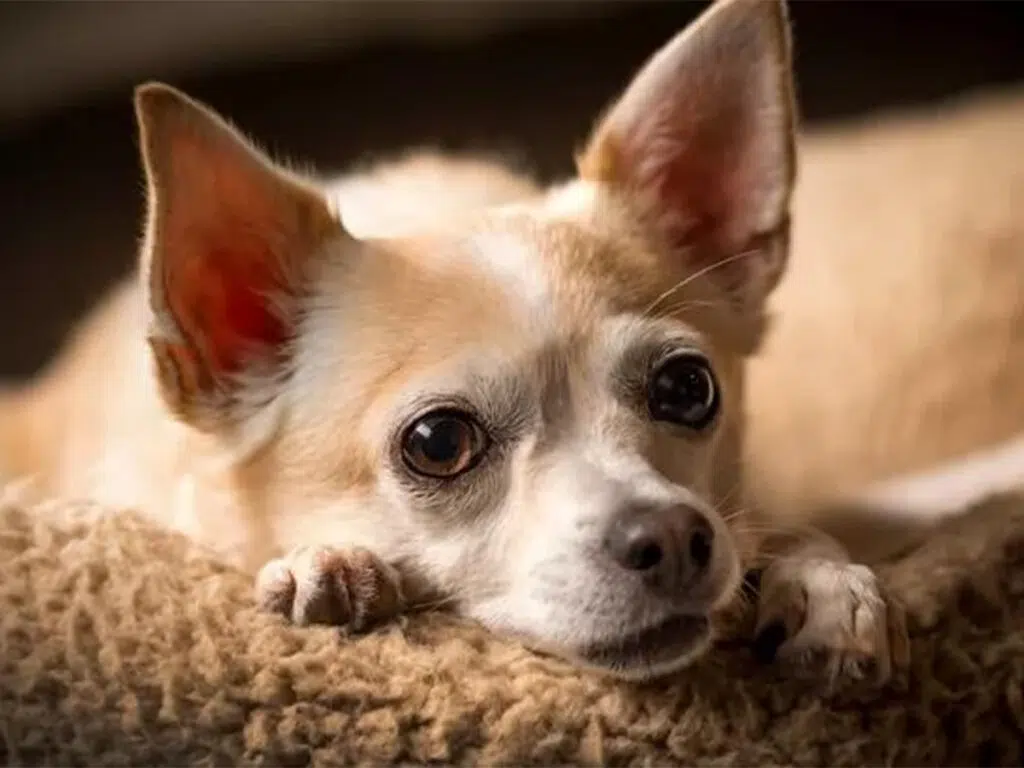
    How long do Chihuahuas live? Illustrated by a beige pup lying down
    How long do Chihuahuas live? Illustrated by a beige pup lying down

    Some practical things you could do to target these challenges and improve your Chihuahua’s lifespan are:

    1. Maintain a Healthy Diet

    A healthy food regimen is your primary weapon in stopping Chihuahuas’ cardiovascular degeneration.

    Chihuahuas are regularly choosy eaters, and it’s common for them to beg for that delicious “human food.” However tempting this is, you must be firm on refusing that.

    Make sure your small pal gets nutritious and well-balanced canine food, preserving treats from your table to a bare minimum.

    2. Have Regular Exercise

    Chihuahuas generally love to play and go for walks in their neighborhood. Keeping your Chihuahua in shape and wasting their energy levels is usually easy to do.

    While Chihuahuas want everyday walks, the walking distance and intensity are far less than required for larger dogs. A little bit of exercise goes a long way!

    As you walk your pup, remember that Chihuahuas are huge puppies trapped in tiny bodies. They’ll frequently face significantly larger dogs believing themselves to be invincible. So, keep a close eye on their natural outgoing exuberance.

    3. Invest in Preventive Care

    As with all things, prevention is much better than a cure. Make sure your furry companion receives regular check-ups, at least every 12 months.

    Make sure your Chihuahua gets all their vaccinations, especially their leptospirosis, parvovirus, and dog influenza shots.

    You’ll also want to make sure your pups receive regular oral care. Chihuahuas are very much at risk of dental problems. Persistent problems with Chihuahuas’ oral fitness can introduce contamination and boost the probability of coronary heart disease.

    Finally, keep in mind that spaying and neutering brings many benefits. Spaying and neutering your Chihuahua reduces the threat of cancer, lowers their aggression, and reduces the probability of them walking away.

    So, with proper care, the average Chihuahua lifespan is excellent! As long as you take care of your pup, you can help your Chihuahua live a long life, filled with love, joy, and lots of cuddles!