Nail day has a reputation in chihuahua households, and it is earned. Owners describe dogs that start screaming before the clippers touch anything, neighbors who assume the worst, and a chore that ends with everyone shaking. If that sounds like your house, this is how to change it: what's actually inside the nail, why the panic happens, and a slower method that veterinary behavior experts say works better than any amount of holding on tighter.
Quick answer: Trim every three to four weeks, or sooner if the nails touch the floor while your chihuahua is standing. The screaming is usually anticipation from a nail quicked once before, so the fix is pace rather than restraint: pay the dog at every step, take one-second passes with clippers or a grinder, and stop at the first hint of the pink quick. If you do hit it, press styptic powder or cornstarch into the tip, hold pressure, give a treat, and end the session.
Why such a small dog makes such a big scene
The screaming isn't drama for its own sake. It's anticipation. A dog that has been "quicked" once, nicked in the sensitive core of the nail, remembers it, and starts protesting at the sight of the clippers rather than the touch of them.
There's science behind taking that fear seriously. Fear Free, the veterinary education program founded in 2016 by Dr. Marty Becker, trains veterinary teams and groomers to measure and reduce what it calls FAS (fear, anxiety, and stress) during exactly this kind of handling. And the American Veterinary Society of Animal Behavior's 2021 position statement on humane dog training backs reward-based methods over force across the board. In plain terms: pinning a frightened chihuahua down harder teaches it that nail day is worth panicking about. Behavior professionals stopped doing that, and it's worth following their lead at home.
One more pattern owners report constantly, and it stings a little: the dog reads your nerves. Plenty of chihuahuas hold still for a veterinary technician after fighting their own person for years. If you dread nail day, your dog knows. Part of the fix is making the job less scary for both of you.
Know the nail before you cut it
Inside every nail is the quick, a core of blood vessel and nerve. Cut into it and the nail bleeds and hurts, which is how most nail-day fear gets started in the first place.
Two facts about the quick shape the whole job. First, it grows out with the nail, so in a dog whose nails have been left long, the quick can reach nearly to the tip. Second, according to the American Kennel Club, regular trimming causes the quick to recede, which means frequent tiny trims are safer than occasional big ones.
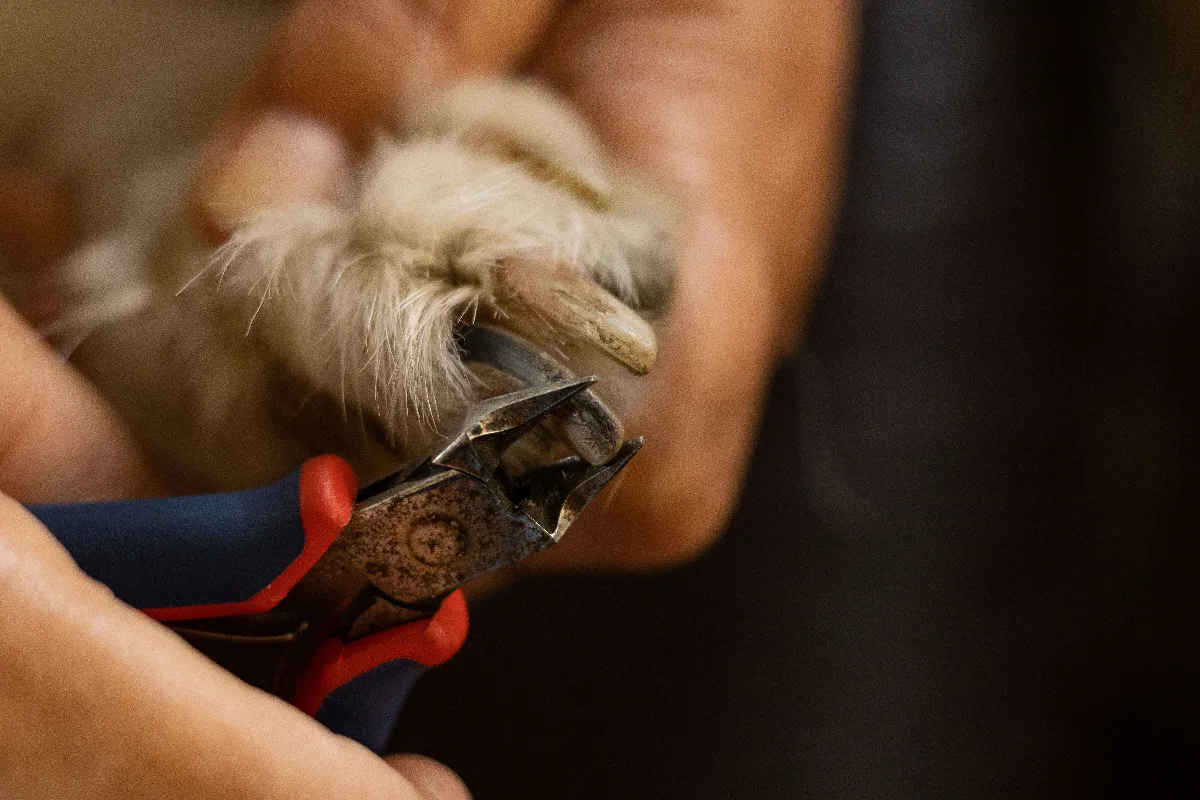
On white nails, the quick shows as a pink core you can see and avoid. Black nails, common in this breed, hide it completely. The AKC's guidance is to take thin slivers off the tip and watch the cut surface: a chalky white ring appears as you approach the quick, and that's the signal to stop. Owners of tiny dogs add a practical note: cat-size or rabbit-size clippers fit a chihuahua nail far better than standard dog clippers, and give you finer control over how much comes off.
Why bother at all? Because overgrown nails are not a cosmetic problem. Dr. Jerry Klein, the AKC's chief veterinary officer, warns that long nails can splay a sound paw, reduce traction, and over time deform feet and strain tendons. The same AKC guidance notes that a long nail striking the ground sends that force back up the foot and leg.
VCA Animal Hospitals offers a simple test: if the nails touch the floor while the dog is standing, they're too long. And don't forget the dewclaws, the thumb-like nails partway up the leg. They never touch the ground, never wear down, and left alone can curl all the way around into the paw pad.
The slow way is the fast way
The method that works is desensitization and counter-conditioning, the standard behavior-science pairing: break the scary thing into tiny steps, and pair every step with something the dog loves.
VCA's veterinary behaviorists publish a handling protocol that looks like this in practice. Handle the paws every day, briefly and pleasantly, with a treat after each touch. Once that's boring, bring out the clippers and just let them sit near the dog while the treats flow. Then hold the clippers to a nail without cutting. Then, one session later, shave a tiny flake from the tip of a single nail, treat generously, and stop for the day.
Yes, stop. One nail a session is a legitimate pace, not a failure. Most chihuahuas have eighteen nails, counting the two front dewclaws, and no rule says they're due the same afternoon. Owners who rebuilt trust with a screamer almost always describe the same arc: weeks of one-nail days, then two, then a full paw, with the dog opting in because every clip predicts chicken.
Owners who have cracked this share the same logistics. Work at a counter or tabletop with a non-slip mat rather than crouching over the dog on the floor. Smear something lickable on a lick mat at the dog's head height, so the dog stays busy while both your hands stay free; the community favorite is peanut butter without xylitol.
Trim after a walk or a bath, when the dog is tired and, owners swear, the nails are softer. And end every session before the panic starts, not after. The goal is a dog that walks away thinking nail day is mildly profitable.
If you're starting with a puppy, you're starting rich. Daily paw handling from the first week home is the same cooperative-care habit we flagged in what owners wish they knew before getting a chihuahua, and it's the cheapest nail-day insurance there is.
Clippers, grinders, and the scratch board
The AKC's advice on tools is refreshingly unfussy: scissor-type, guillotine-type, or grinder, use what you're comfortable with. Each has a real trade-off. Clippers are fast and silent but can crush or split a nail, and one squeeze can take too much.
A rotary grinder files the nail gradually, leaves smooth edges, and makes it much harder to hit the quick, but the noise and vibration need their own gentle introduction, and long facial or leg hair must be kept clear of the spinning head. Some dogs that hate clippers tolerate a grinder happily. Some feel exactly the opposite. Let the dog vote.
Then there's the scratch board, the lowest-stress option of all. It's a plank covered in sandpaper; you teach the dog to drag its front nails down the board for treats, and it files its own nails, no restraint involved. Fear Free Happy Homes, the program's owner-facing site, has published a how-to, and owners often report dogs learning the game within a session or two. The honest catch: it mainly files the front nails, so the rear feet, which often wear more on their own, still need an occasional trim.
If it bleeds, and when to hand the job off
Accidents happen, so set up for one before you start. Keep styptic powder within reach, or plain cornstarch in a pinch, and press it into the nail tip with a moment of firm pressure. The bleeding usually stops quickly and the dog forgives faster than you will. PetMD's threshold is simple: if a nail keeps bleeding despite prolonged pressure, or has split down into the quick, that's a call to your veterinarian.
Outsourcing is not a defeat, either. Groomers and veterinary clinics do inexpensive walk-in nail trims, and owners of fearful dogs consistently favor a quiet salon on a slow morning over a busy chain on a Saturday. If your chihuahua's panic runs past trembling to snapping or worse, tell your veterinarian what nail day actually looks like. Clinics that practice Fear Free methods can help, sometimes with a pre-visit anti-anxiety medication such as gabapentin or trazodone, prescribed and dosed by the veterinarian only. That's a mainstream option now, not a last resort.
How often does all this happen? Every three to four weeks for most dogs, per the AKC; VCA puts it at roughly monthly and notes that regular pavement walks can stretch the interval. A featherweight chihuahua on short outings rarely earns that much wear. Fold the checks into the weekly once-over from our chihuahua daily care routine, and remember that for seniors, short nails are part of keeping grip on slick floors, something that matters more each year, as we covered in measuring a senior chihuahua's quality of life.
Frequently asked questions
How do you grind a dog's nails safely?
Introduce the dog nail grinder in stages: off, then running nearby, then touching one nail, with payment at every step. Hold the paw firmly, grind in one second touches, round the edges, and stop at the first hint of the pink quick. Short weekly passes beat occasional marathons, and a grinder with a guard helps beginners hold the angle.
How often should I trim my chihuahua's nails?
Every three to four weeks is the standard guidance, though it varies dog to dog. Use VCA's test rather than the calendar: if the nails touch the floor when your chihuahua is standing, they're due. Frequent small trims also make the quick recede, so the job gets safer the more regularly you do it.
What do I do if I cut the quick?
Stay calm, press styptic powder or cornstarch into the nail tip, and hold firm pressure for a moment or two; most bleeding stops quickly. Give a treat, end the session, and let the dog reset for a few days. If bleeding continues despite prolonged pressure or the nail has split deeply, call your veterinarian.
Do daily walks wear the nails down enough to skip trimming?
Usually not. Pavement does file nails a little, and very active dogs may stretch the schedule, but the wear is uneven, a light chihuahua on short walks barely files anything, and dewclaws never touch the ground at all. Walks help; they don't replace the trim.
How do I find the quick in black nails?
You can't see it from outside, so you work in thin slivers. Trim a few millimeters at a time and watch the cut surface after each pass: when a chalky white ring appears in the center, you're near the quick, and it's time to stop. Good light and small clippers make the ring much easier to spot.
Small nails, long game
A stress-free nail trim isn't a technique so much as a reputation you rebuild one clip at a time. Go slower than feels necessary, pay in real food, quit while you're ahead, and let a professional take a turn when you need one. Eighteen tiny nails will come around. And if the fear ever looks bigger than a grooming problem, bring it to your veterinarian; that's what the fear-free playbook was written for.
