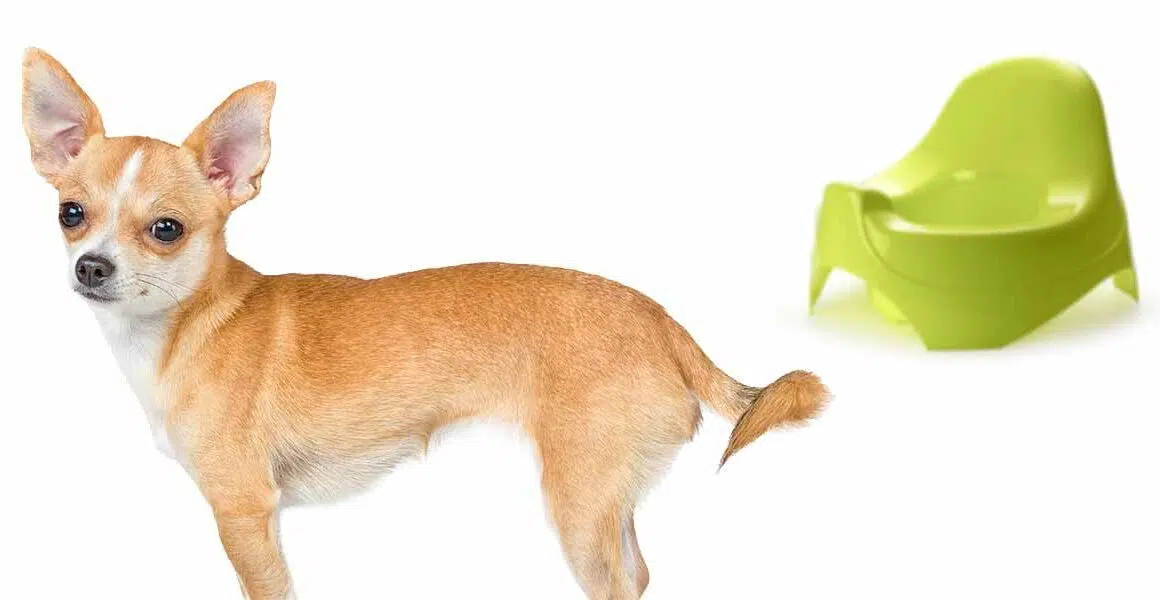


Why is housebreaking a chihuahua harder than the general puppy housebreaking literature suggests, and what is the protocol that actually accounts for the small-dog specifics? In short: the chihuahua's small bladder capacity, fast metabolism, and tendency to be carried rather than walked produce three structural complications that the general advice does not address. The protocol that works in our practice is a three-week pattern with specific small-dog adjustments, run consistently across the household.
I want to start with the framing that matters. Housebreaking a chihuahua is not, mostly, a training problem. It is a logistics problem, with training as one component. The dog wants to go outside and do her business in the right place; the household has to arrange enough opportunities and clear enough cues for the dog to succeed. Below is the working framework.
The three small-dog complications, plainly
Small bladder, frequent need. A chihuahua puppy at ten to sixteen weeks can hold her bladder for roughly her age in months plus one hour. A 12-week puppy is, on the math, a four-hour bladder. An 8-week puppy is closer to a three-hour bladder. The schedule has to accommodate this; expecting any longer is a setup for accidents.
Fast metabolism, fast trigger. Chihuahuas typically need to relieve themselves within ten to twenty minutes after eating, ten to thirty minutes after waking from a nap, and within five minutes of vigorous play. The trigger window is shorter than for larger breeds. The household's response time has to be inside that window.
Carrying tendency. Many chihuahua households inadvertently carry the puppy through transitions (from couch to door, from car to entryway, from one room to another). The puppy who is carried does not have the chance to take herself to the door, which is the cue she would otherwise be developing.
The three-week protocol, by week
Week 1: Frequency and supervision. The puppy goes outside every two hours during the day, plus immediately after eating, drinking, sleeping, or vigorous play. The household supervises every minute the puppy is loose indoors; the puppy is in a crate, pen, or on-leash with a household member at all other times.
The supervision is the part most households underdo. A chihuahua puppy with the run of the house is, in housebreaking terms, a puppy who is having unsupervised opportunities to relieve herself indoors. The success rate is meaningfully higher when the puppy is, for several weeks, never out of sight when not contained.
Week 2: Pattern recognition. The household begins to notice the puppy's pre-elimination cues. Most chihuahua puppies show one or two of: circling, sniffing the floor in a focused way, walking toward a previously-used spot, briefly leaving the human's vicinity. When any of these appears, the human takes the puppy outside immediately. The cue-to-outside window should be under thirty seconds.
The puppy also begins to associate a specific outdoor spot with the elimination behavior, particularly if the household uses the same spot consistently and rewards heavily within two seconds of completion.
Week 3: Generalization. The frequency of accidents drops substantially. The puppy begins, in many households, to take herself to the door. The supervision can begin to relax slightly, particularly during predictable lower-risk periods (right after a successful outdoor trip).
The reward timing matters more than the reward
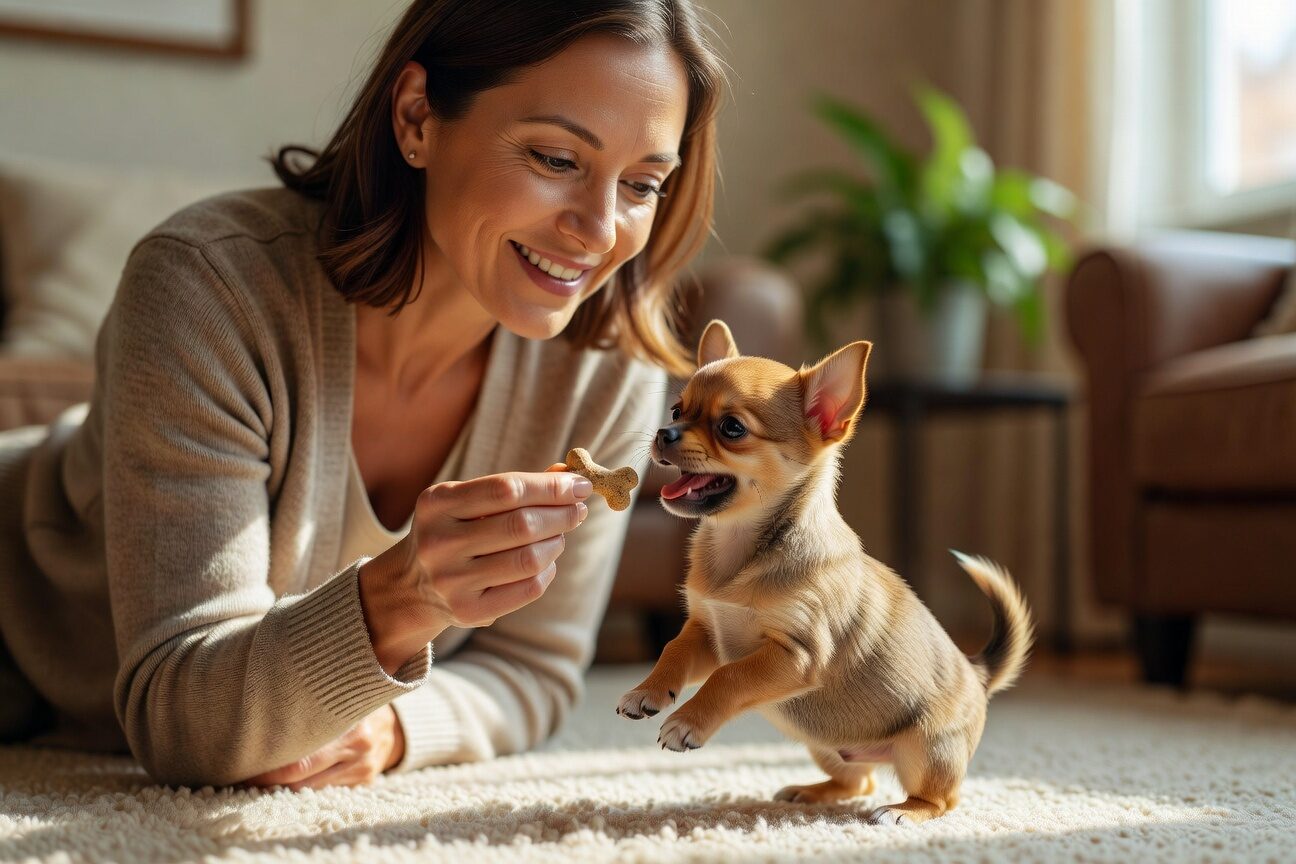
A common owner mistake is to reward the puppy after she comes back inside. The reward is then attached to "I came inside," not to "I eliminated outside." The reward should arrive within two seconds of the puppy finishing, while she is still in the spot. A small high-value treat from a treat pouch worn on the belt is the practical setup.
Verbal praise alone, in my training experience, is meaningfully less effective than a paired food reward during the housebreaking phase. After the pattern is established, verbal praise is sufficient.
Accidents, the calm response
Accidents will happen. The household response that supports housebreaking:
- If you catch her mid-accident, calmly say "ah-ah" and take her outside. Reward heavily if she finishes there. Do not scold; the puppy associates scolding with the act of elimination, not with the location.
- If you find an accident after the fact, clean it up calmly. Do not show the puppy the accident. The "rub her nose in it" advice is, on the modern training literature, counterproductive and produces an anxious puppy without changing the underlying location pattern.
- Use an enzymatic cleaner, not a general-purpose cleaner. The enzymatic cleaner breaks down the proteins that signal "this is the bathroom" to the puppy.
The night, briefly
A chihuahua puppy at 8 to 12 weeks typically cannot make it through a full night without a bathroom break. The schedule:
- Weeks 8 to 10: One middle-of-the-night break, typically around 3 a.m. The puppy goes out briefly, eliminates, returns to the crate.
- Weeks 10 to 14: Often no overnight break needed if the household runs the day's schedule consistently. The puppy can hold for six to seven hours overnight by this point.
- 14 weeks onward: The puppy should be able to make it through a full night.
The crate-training piece covers the overnight crate setup; the housebreaking and crate-training protocols reinforce each other.
The rain question, briefly
A specific small-dog complication: many chihuahuas refuse to eliminate outside in rain. The dog walks to the door, looks at the rain, looks back at you, and returns to the couch. The bladder, however, is unchanged.
The practical solutions:
- A small fleece-lined raincoat for the dog; many chihuahuas tolerate rain in a coat that they would not tolerate in their bare coat.
- A covered area in the yard, if possible, where the dog can eliminate without getting wet.
- Indoor pee pads or a grass-mat tray as a backup for severe weather. The puppy supplies piece covers the equipment.
If the dog is past puppyhood, briefly
For an adult chihuahua adopted from a rescue or foster who has not been reliably housebroken, the same protocol applies, often compressed into one or two weeks. The adult dog typically learns faster because of the longer attention span and the better established household routine. The rescue-adjustment piece covers the broader transition.
When to escalate, briefly
Most chihuahuas are reliably housebroken by 16 to 20 weeks. If your puppy is past 20 weeks and not making progress, talk to your veterinarian about a urinary tract infection or other medical cause; a UTI in a small dog can produce frequent small-volume accidents that look like housebreaking failure.
For adult dogs with sudden-onset accidents, the medical workup comes first; behavioral causes are addressed only after medical causes are ruled out. The Merck Veterinary Manual covers the medical differential; the general warning-signs piece covers the broader watch-list.
The bottom line, with the usual caveat
Chihuahua housebreaking is mostly logistics with training as one component, and the small-dog specifics matter. Frequency, supervision, reward timing, and a calm response to accidents are the four variables. Talk to your veterinarian if your dog is past the expected window without progress; a medical cause is more common than the training literature suggests.
Gear That Works backpack
Harness (Not Collar)
A step-in harness is safer and more comfortable.
Lightweight Leash
4–6 feet gives freedom without losing control.
Treat Pouch
Keep rewards accessible and distraction-free.
ID Tag & Microchip
Always be prepared in case of separation.
Trainer Tip: Success on walks starts with reading your Chihuahua's signals and respecting their pace.
Was this guide helpful?
Was this guide helpful? Save the guide. Share it with one other chihuahua owner this week.
favorite