
What does it mean for a chihuahua to be "polite" with guests? In one sentence: a polite chihuahua is one whose default response to the doorbell, a stranger entering, or a calm visit is something other than continuous barking, frantic jumping, or a panicked retreat to the bedroom. The training is unglamorous and works on most dogs in six to eight weeks of consistent practice.
I am going to walk through what polite actually means in dog terms, the four cues that do most of the work, and the protocol I use with chihuahuas in my caseload.
What polite actually means, in dog terms
The "polite" behavior most owners want is a small set of trained replacements for the loud default. A reliable dog who hears the doorbell can:
article_in_feed
A handpicked find for your tiny companion.
- Move calmly to a designated mat or bed.
- Stay there while the door opens and closes.
- Greet the guest, when invited, with four feet on the floor.
- Settle near the conversation rather than escalating with it.
Each of those is a discrete trained behavior. The reason most chihuahuas are not polite at the door is not that they are untrainable; it is that nobody has trained the replacement, and so the default behavior (barking, jumping, escalation) is what the dog has practiced thousands of times. A note on the difference between excitement and threat-display is a useful pre-read; the protocol below is for excited or alert greeting, not for fear-aggression at the door.
The four cues that do most of the work
If you train these four cues to a reasonable standard at home, the door behavior follows.
- "Mat" or "bed." Send the dog to a designated spot. Reward the dog for going. Build duration, then distance, then distraction. Two minutes a day, four days a week.
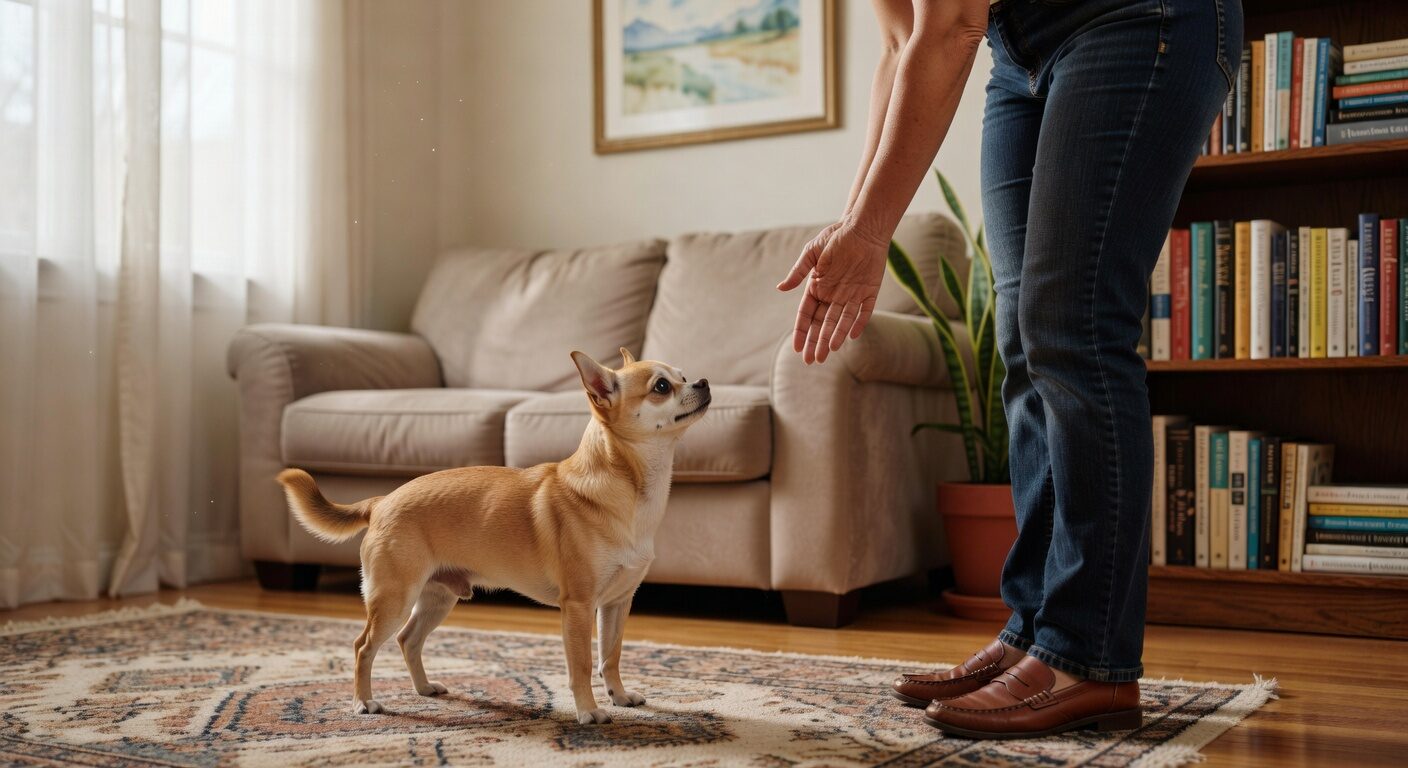
- "Look at me." The dog’s name produces a turn-and-eye-contact. This is the cue you use when the doorbell rings to redirect the first wave of attention.
- "Settle." A trained calm on a mat. Different from "stay"; the dog is actively relaxing, not holding a position. The stress-reduction protocols include a settle protocol.
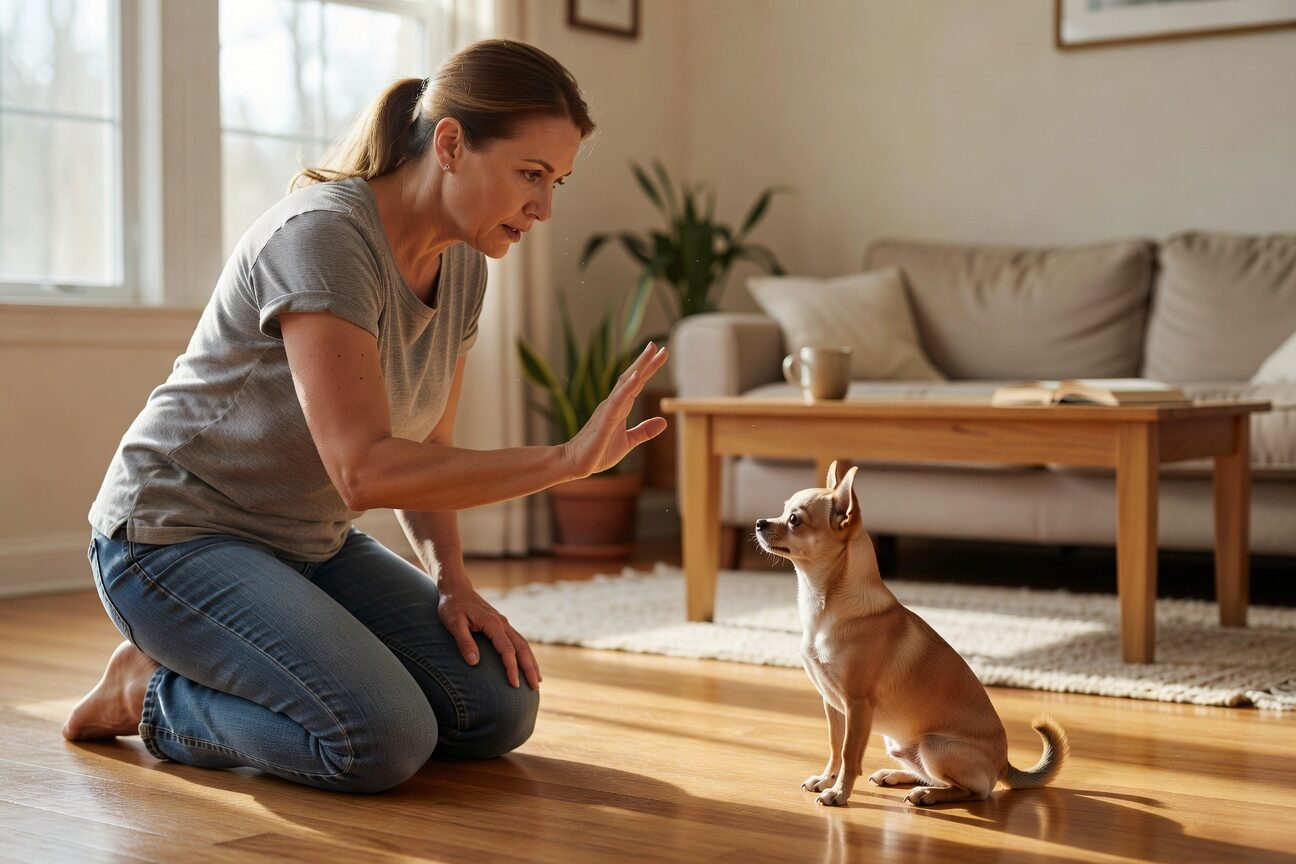
- "Off." Four feet on the floor. Used at the moment of greeting, paired with reinforcement for keeping all four feet down when the guest is interesting.
These four are not specific to greeting; they are the building blocks of a calmer dog in many contexts. Train them in low-distraction sessions first, and the door behavior is a recombination of skills the dog already has.
The protocol, week by week
I run this on a six-week timeline with most clients; some dogs are faster, a few are slower.
- Week 1 to 2: train the mat without the door. Twice a day, two minutes each session, send the dog to the mat, reward, release. Build to one minute on the mat.
- Week 2 to 3: pair the doorbell with the mat. Have a household member ring the bell while you cue the mat. Reward heavily. The doorbell is now becoming the cue to go to the mat, not the cue to bark.
- Week 3 to 4: door opens, no guest. The doorbell rings, the dog goes to the mat, you open the door, you close the door. The dog stays. Reward.
- Week 4 to 5: a calm guest enters and sits down. The dog stays on the mat. Once the guest is seated, you release the dog to a calm greeting on four feet. Reward four-on-the-floor.
- Week 5 to 6: real guests, with a leash for safety the first few times. The dog runs the same protocol with novel humans. The leash is there to prevent rehearsal of the old behavior; it is not a correction tool.
The most common mistakes
The single most common mistake I see is pushing the protocol too fast. The dog who is calm at the mat with a quiet doorbell is not, automatically, the dog who is calm with the actual mailman, the actual neighbor, and the actual three-year-old. Each step up in difficulty is a separate teaching moment; if you skip the gradient, the protocol breaks.
The second most common mistake is reinforcing the old behavior at the moment of greeting. A guest who pets the jumping dog rewards the jumping. A guest who waits for four-on-the-floor rewards the polite version. Brief your guests before they walk in. A simple "please ignore her until she has all four feet down" is sufficient.
A third, more subtle mistake is teaching "quiet" without first teaching "what to do." A dog who is told "no bark" without being given a replacement behavior often escalates somewhere else. The mat is the replacement; the cue chain is the structure. The AVSAB position on humane training is the document I would refer back to here; aversive corrections do not reliably produce calmer dogs, on the available evidence.
One thing to do this week
Pick the mat or bed. Set it five feet from the door, in a spot the dog can see the front entryway from. Twice a day, for two minutes, lure the dog to the mat with a treat, reward, release. By Friday, the mat is associated with food and the dog is volunteering to walk to it.
The doorbell, the guests, and the actual greeting come later. The mat first. The mat is most of the protocol; the rest is just plumbing the cue to a real-world trigger.
Gear That Works backpack
Harness (Not Collar)
A step-in harness is safer and more comfortable.
Lightweight Leash
4–6 feet gives freedom without losing control.
Treat Pouch
Keep rewards accessible and distraction-free.
ID Tag & Microchip
Always be prepared in case of separation.
Trainer Tip: Success on walks starts with reading your Chihuahua's signals and respecting their pace.
Was this guide helpful?
Was this guide helpful? Save it for later or share with a fellow Chi parent.
favorite