
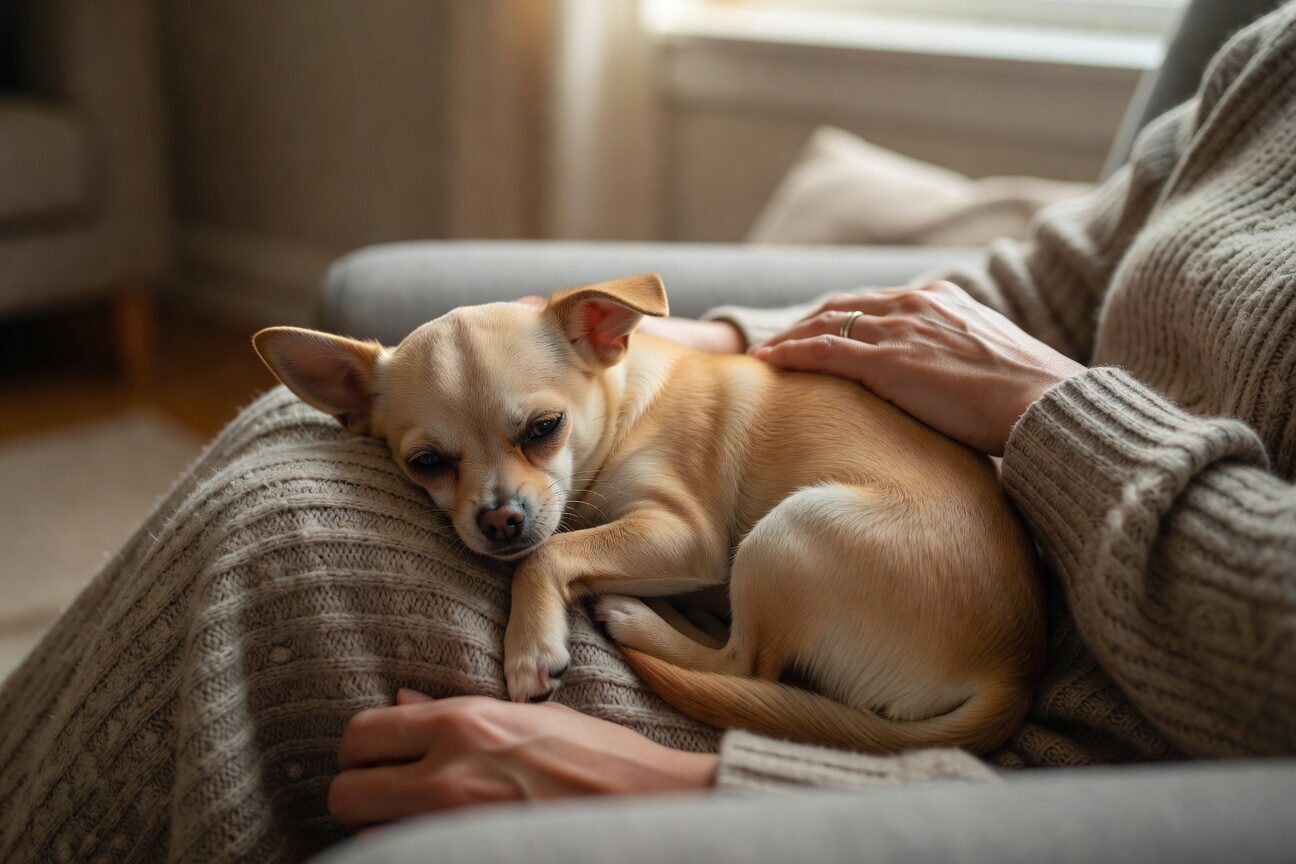

My chihuahua follows me into the bathroom. Every single time. She sits outside the shower door and cries if I take too long. She presses her body against my leg while I cook dinner and stares up at me like I might vanish if she looks away for even a second. If you have ever wondered why your chihuahua is so attached to you, I have spent a lot of time thinking about this exact question.
Why Your Chihuahua Is Attached to You on a Level That Feels Excessive
Chihuahuas are genetically predisposed to intense, single-person bonds. This is not a behavior problem. It is a breed trait that has been selected for over thousands of years. The Techichi, the chihuahua’s ancient ancestor, was a companion animal kept close to their human for warmth, companionship, and spiritual significance. The dogs that bonded most intensely with their people were the ones that survived and reproduced. Your chihuahua is attached to you because her entire genetic lineage was built on attachment.
The AKC’s chihuahua breed profile describes them as graceful, charming, and sassy, but I think they left out obsessively devoted. My chihuahua does not just love me. She has oriented her entire existence around my presence. I am her sun and she is in permanent orbit. That level of attachment is flattering, but it also comes with responsibilities that we need to take seriously.
The Science Behind Why Your Chihuahua Is So Attached to You
When your chihuahua is near you, their brain releases oxytocin, the same bonding hormone that flows between mothers and infants. Studies have shown that dogs and their owners experience mutual oxytocin spikes during eye contact and physical touch. For chihuahuas, who are in near-constant physical contact with their person, this hormonal loop runs continuously throughout the day.
Your chihuahua is not just emotionally attached to you. They are chemically attached to you. Your presence literally makes them feel good at a neurological level, and your absence triggers a stress response that can include whining, pacing, destructive behavior, and refusal to eat. According to PetMD’s explanation of following behavior, small breeds like chihuahuas are especially prone to this because their physical vulnerability makes proximity to a trusted person feel essential for survival.
This is also why your chihuahua is attached to you specifically and may be indifferent or even hostile toward other family members. They imprint on one primary person and invest their emotional resources accordingly. It is not that they dislike other people. It is that their bond with you runs so deep that other relationships feel less essential. For tips on helping them bond with the whole family, check our owner training guide.

When Attachment Becomes Separation Anxiety
There is a line between healthy attachment and separation anxiety, and many chihuahuas cross it. If your chihuahua is attached to you to the point where they cannot function when you leave the room, that is not endearing. That is a welfare issue that needs addressing.
Signs of separation anxiety include destructive behavior when left alone, excessive barking or howling, house soiling despite being trained, refusal to eat when you are gone, and physical symptoms like trembling or panting. If your chihuahua shows these signs, start with short practice separations, leave the room for thirty seconds, return calmly, and gradually increase the duration. Never make departures or arrivals dramatic. Walk out like it is nothing and walk back in the same way. com/the-chihuahua-who-chased-a-coyote-out-of-a-backyard-and-became-a-neighborhood-legend/” title=”The Chihuahua Who Chased a Coyote Out of a Backyard”>The Chihuahua Who Chased a Coyote Out of a Backyard.
Building independence is not about breaking the bond. It is about teaching your chihuahua that your absence is temporary and survivable. A chihuahua who trusts that you will always come back is a chihuahua who can relax when you leave. That trust is built through repetition, not reassurance. For a deeper look at this topic, read our separation anxiety guide.
How to Enjoy the Bond Without Enabling Anxiety
I love that my chihuahua is attached to me. I love the way she settles into my lap like I was specifically designed to be her furniture. I love that she chooses me over every other human on the planet. But I have also learned to set boundaries that protect her emotional health.
She has her own bed that she sleeps in for at least part of the night. She has toys she plays with independently. She stays home alone for short periods while I run errands, and she has learned that alone time ends and that I always return. These boundaries do not weaken our bond. They strengthen it because they give her confidence and resilience alongside the devotion.
Your chihuahua is attached to you because you are everything to them. Honor that by being the kind of owner who prepares them for the moments when you cannot be there. Teach them that they are safe even in your absence. That is the deepest form of love you can offer a dog this devoted.
What Being Loved by a Chihuahua Really Means
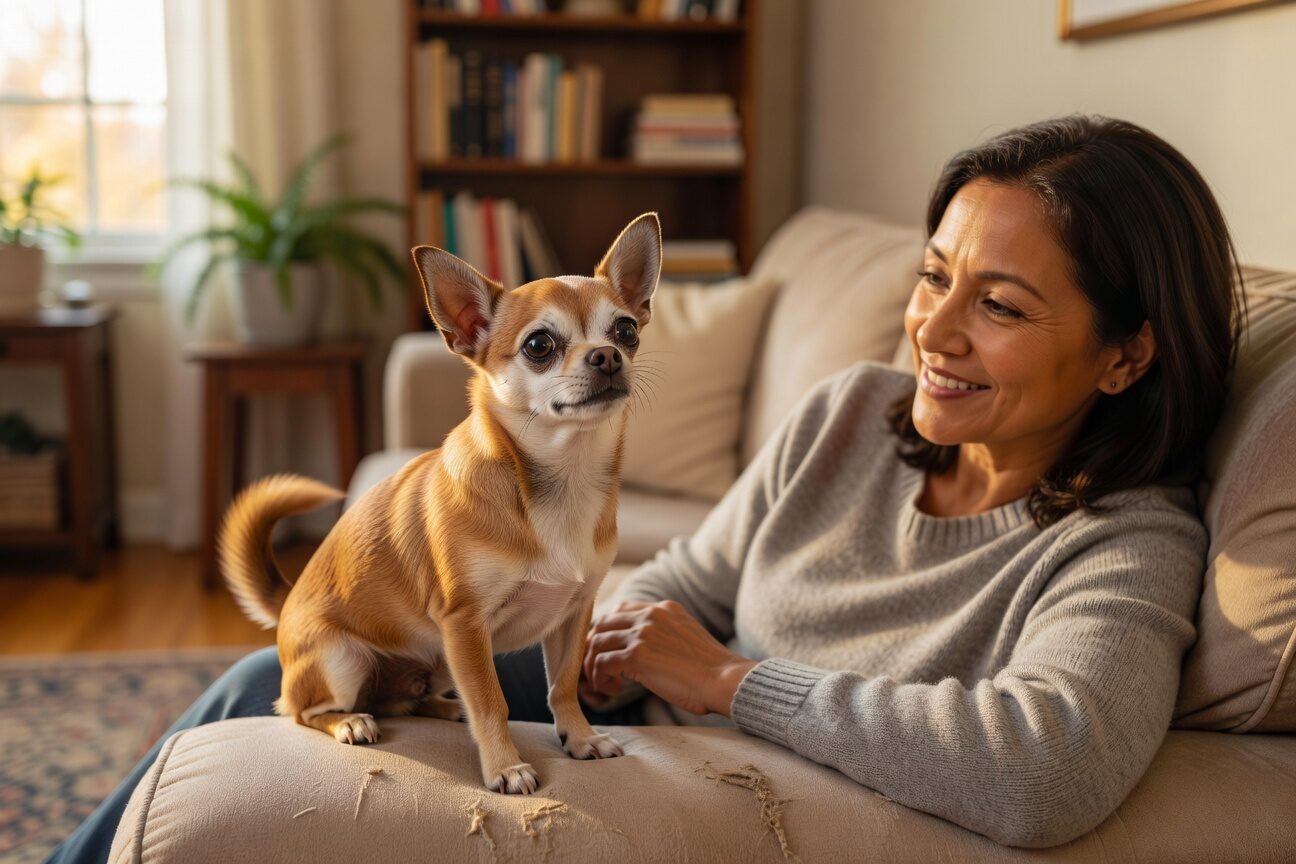
Being the person a chihuahua is attached to is not always convenient. You cannot go to the bathroom alone. You cannot shift positions on the couch without apologizing. You cannot leave the house without a small face watching you from the window with an expression that suggests you are committing a war crime. But it is, without question, one of the most profoundly loving experiences a person can have.
Your chihuahua chose you. Out of everyone in their world, you are the one they trust completely. That is not nothing. That is everything. Accept it. Protect it. And every once in a while, when they are sleeping on your chest and you can feel their tiny heartbeat against yours, let yourself be amazed that something so small can love so enormously. For more on building the best life with your chihuahua, explore our body language guide.
Why does my chihuahua follow me everywhere?
Chihuahuas follow their primary person due to a combination of breed-specific attachment genetics, oxytocin bonding, and learned behavior. The breed was developed as a companion animal and is predisposed to forming intense bonds with one person. Your chihuahua’s proximity to you triggers neurochemical rewards in their brain. This following behavior is normal for the breed, though it can become problematic if it escalates into separation anxiety.
Is it normal for a chihuahua to only like one person?
Yes, single-person preference is a well-documented chihuahua breed trait. They typically imprint on one primary person and invest their deepest emotional bond in that relationship. This does not mean they cannot love other family members, but the intensity of the primary bond is usually noticeably stronger. Encouraging positive interactions between your chihuahua and other household members can help broaden their social comfort, though the primary bond will likely always be strongest.
How do I know if my chihuahua has separation anxiety?
Signs of separation anxiety include destructive behavior, excessive barking or howling, house soiling, refusal to eat, trembling, and panting when you prepare to leave. A chihuahua with separation anxiety may also show escape attempts or self-harm during your absence. If these behaviors only occur when you are gone and not at other times, separation anxiety is the likely cause. Consult your vet or a veterinary behaviorist for a formal assessment and treatment plan.
How do I help my chihuahua be less clingy?
Build independence gradually through short practice separations. Leave the room for thirty seconds, return calmly without fanfare, and slowly increase the duration over days and weeks. Provide a comfortable bed or crate in a different room where your chihuahua can relax independently. Use puzzle toys and treat-dispensing toys to create positive associations with alone time. Never punish clingy behavior, as this increases anxiety. The goal is to build confidence, not break the bond.
Do chihuahuas bond more closely than other breeds?
Yes, chihuahuas are among the most intensely bonding dog breeds. Their history as companion animals bred specifically for close human contact has produced a breed with an unusually strong attachment drive. Combined with their small size, which makes them physically dependent on their person for warmth and safety, chihuahuas form bonds that are often described as more intense than almost any other breed. This deep bonding is one of the most rewarding aspects of chihuahua ownership.