

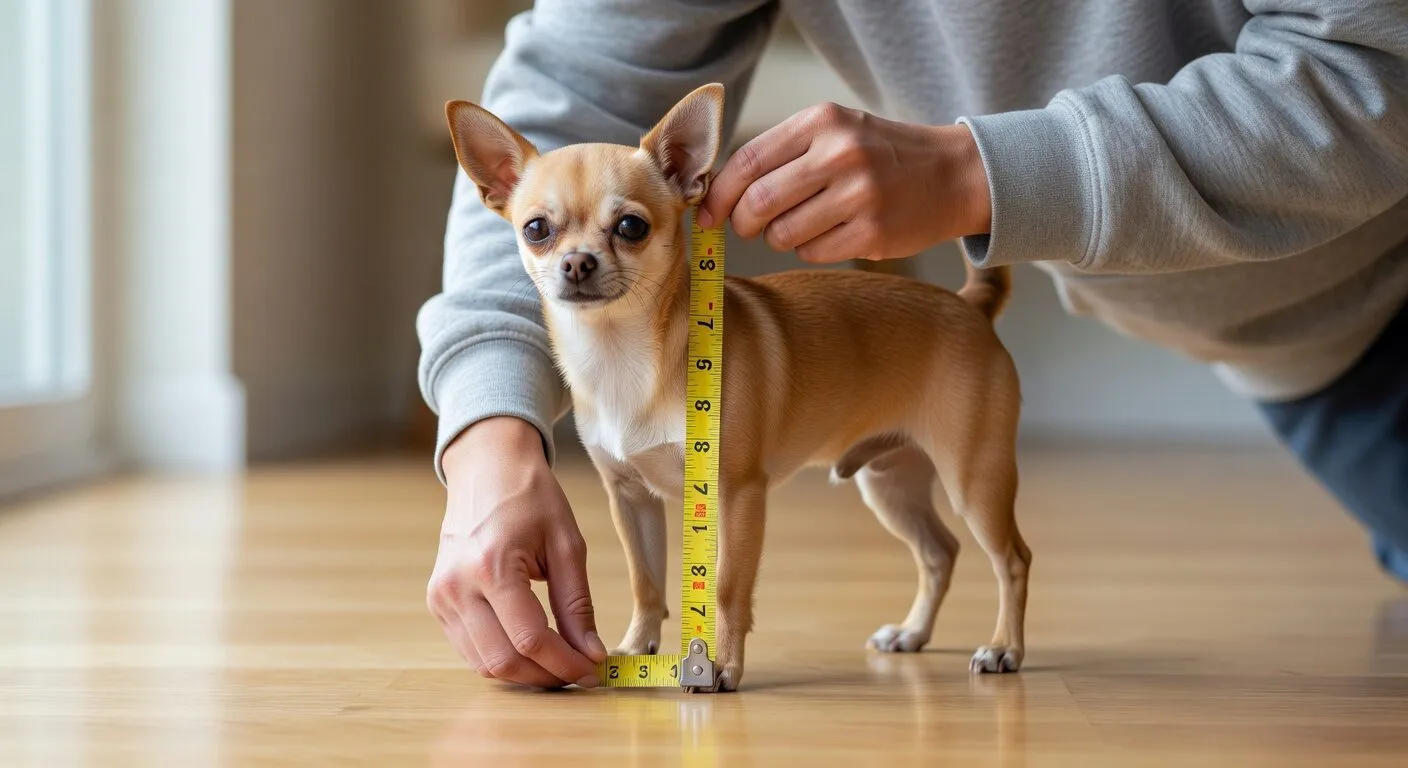
How big will your chihuahua actually get? In one sentence: most adults land between 3 and 7 pounds, with the AKC standard ceiling at 6 pounds and a meaningful pet-population tail above and below. The math veterinarians use to estimate adult weight from a puppy is approximate but useful, and a few specific milestones are worth knowing.
I am going to walk through the realistic size range, the growth curve, and the practical considerations as your puppy moves toward adulthood.
The realistic adult range
A 2019 cohort study of small-breed weights, drawing on insurance claims data, placed the average adult chihuahua at around 5.2 pounds, with most dogs falling between roughly 3.8 and 6.6 pounds. Show-line dogs cluster more tightly within the 3-to-6-pound AKC standard. Pet-line dogs span a slightly wider range, with some dogs reaching 7 to 8 pounds at a healthy weight.
article_in_feed
A handpicked find for your tiny companion.
A few practical numbers:
- 3 pounds: The lower edge of the standard. Dogs under this weight are often the result of breeding for extreme miniaturization and carry elevated health risk.
- 4 to 6 pounds: The breed average. The AKC ring lives here.
- 6 to 8 pounds: Above the standard but a perfectly normal adult chihuahua at a healthy weight. Common in pet lines.
- Over 8 pounds: Either a larger pet-line dog at a healthy weight or, more commonly, a chihuahua carrying excess body mass. A separate piece on weight gain covers the math.
The growth curve, week by week
A chihuahua puppy follows a roughly predictable growth curve, with the most rapid growth in the first three to four months and a slower asymptotic approach to adult weight by 9 to 12 months.
- Birth: 2.5 to 5.5 ounces.
- 4 weeks: 8 to 12 ounces.
- 8 weeks: 1 to 1.5 pounds.
- 12 weeks: 1.5 to 2.5 pounds.
- 4 months: 2 to 3.5 pounds.
- 6 months: 3 to 5 pounds (often around 70 to 80 percent of adult weight).
- 9 months: Most dogs at 90 to 95 percent of adult weight.
- 12 months: Adult weight reached for most chihuahuas; some line variation.

The math for estimating adult weight
A reasonably accurate informal formula, used by veterinarians and breeders: take the puppy's weight at 8 weeks, multiply by 3, and you have a rough estimate of adult weight in pounds. The 16-week weight, multiplied by 2, is a slightly more accurate estimate.
These are approximations. Genetics, nutrition, and health events shift the curve. The most reliable estimate is at the 6-month wellness visit; most chihuahuas are at 70 to 80 percent of adult weight by then, and your veterinarian can extrapolate from the curve and the parents' adult weights, if known.
Growth-related flags worth knowing
A few patterns to watch for during puppyhood:
- Failure to thrive. A puppy who is not gaining weight on the expected curve is a vet visit. Hypoglycemia, parasitic infection, and several congenital conditions present this way.
- Plateaus. A short pause in growth around the 4-to-5-month mark is normal and corresponds to the transition from puppy to adolescent.
- Rapid late growth. A puppy still gaining significant weight after 12 months is unusual and worth a vet conversation, often around endocrine work-up.
- The molera and the soft spot. A small soft spot on the skull is a breed trait, not a defect; it usually closes by adulthood but may persist. This does not affect size.
The AKC chihuahua breed page covers the standard adult conformation.
Size implications for daily care
A chihuahua's adult size affects several practical care decisions:
- Harness sizing. A Y-front harness sized to the dog at 6 months will likely need replacement at 9 to 12 months as the chest finishes filling out.
- Crate sizing. A puppy crate may need to be replaced once for an adult-size crate at around 6 months.
- Dental considerations. Smaller adult dogs at the lower end of the standard often have more pronounced dental crowding. The dental section of the common health issues list covers the cadence.
- Calorie budget. Adult calorie needs at 4 pounds versus 7 pounds are meaningfully different; recalibrate at the wellness visit when your dog reaches adult weight.
Genetics, nutrition, and what the curve actually responds to
A common owner question is whether feeding more or less can change the eventual adult size. The answer, in plain terms, is no for the upper bound and yes for the lower one. A puppy on a calorie-restricted diet will be smaller than her genetic ceiling and is at risk for several developmental issues; a puppy on an over-fed diet will not be larger than her genetic ceiling but may be heavier and at higher risk for orthopedic problems during the rapid-growth months.
The right move is to feed the breeder's recommended amount, weigh weekly, and trust the curve. The genetics set the ceiling. The nutrition fills in the curve below it.
The honest bottom of the question
A chihuahua's adult size is, mostly, set by the time you bring the puppy home, even if the puppy looks much smaller than the adult will be. The genetics, the nutrition, and the health events of the first year are the variables; the breeding line and the parents' adult weights are the strongest predictors.
If you have a chihuahua puppy at home and are wondering how big she will be, the most useful thing you can do is weigh her weekly on a kitchen scale and plot the curve. By month three or four, the trajectory is usually clear. A companion piece on the breed's size standard covers the AKC framework. The adult dog you eventually live with will be a small dog with a long life ahead, regardless of which point on the curve she lands.
Is this Chihuahua right for you? auto_awesome
Want to learn more about your Chihuahua? Compare breeds and find your perfect match.
favorite