


How big is a chihuahua, really? The AKC breed standard is unambiguous: not exceeding six pounds. The reality in the pet population is broader, with most adults landing between three and seven pounds, and a small but nontrivial number of dogs marketed as "teacup" coming in below three. The honest answer requires reading the breed standard and the marketing claims at the same time, and being clear about the difference.
I am going to walk through what the standard actually says, what the breed weighs in practice, and the quiet ethical trouble with the teacup label.
What the AKC standard actually says
The AKC chihuahua breed standard, adopted in its current form in the 1970s with revisions, specifies a weight not exceeding six pounds. There is no "teacup" classification; there is no "standard" classification. The breed has two coat varieties (smooth and long) and a single weight ceiling. Anything labeled otherwise is a marketing term, not a registered designation.
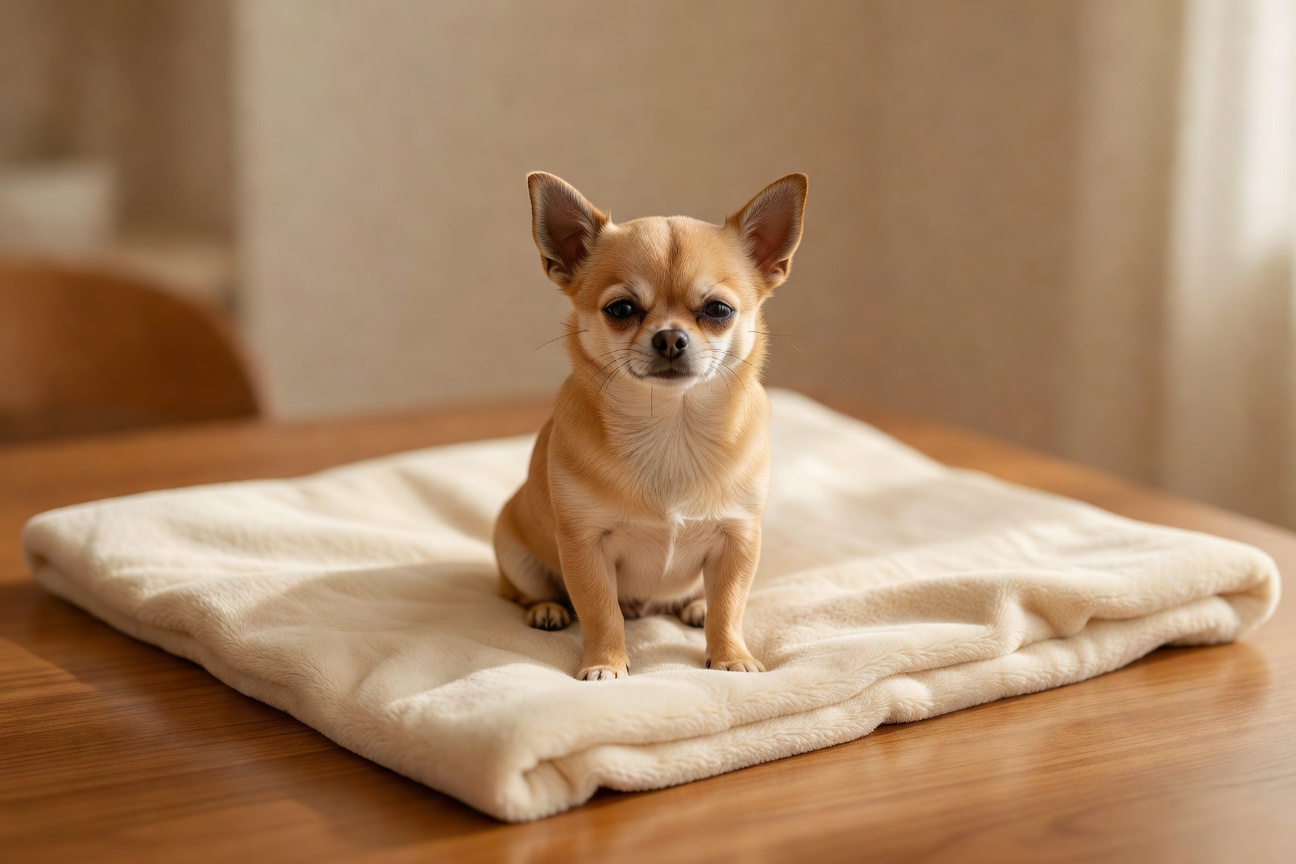
The standard also specifies the apple-head conformation: a well-rounded skull (the molera, or soft spot, optional in adulthood), large erect ears, and a relatively short muzzle. The "deer-head" type, which is taller and more elongated in the muzzle, is common in the pet population but is not part of the standard; it is a conformational variant rather than a separate breed.
What the pet population actually looks like
Walk into any chihuahua-friendly veterinary practice and the size distribution is wider than the standard. A 2019 cohort study of small-breed weight in the United States, drawing on insurance claims data, found that companion-line chihuahuas average around 5.2 pounds, with a standard deviation of about 1.4 pounds. That puts most adult dogs between roughly 3.8 and 6.6 pounds. Show-line dogs cluster more tightly within the standard.
A few practical observations from this:
- The dog at 7 to 8 pounds is not, by the standard, a chihuahua of show quality. She is, in everyday terms, a perfectly normal pet, often slightly overweight or carrying more body mass for her frame.
- The dog at 4 to 5 pounds is squarely in the breed average and the show ring.
- The dog under 3 pounds is the marketing target for "teacup" labeling, which is where the conversation gets harder.

The "teacup" conversation, with the welfare math
A chihuahua weighing under three pounds in adulthood is not a separate breed; she is, usually, a runt of the litter or the product of breeding for extreme miniaturization. The under-3-pound chihuahua has a documented elevated risk profile for several conditions, including hypoglycemia (more pronounced reserve issues at lower body mass), hydrocephalus, dental crowding, patellar luxation, and orthopedic injury from minor falls.
I do not write this to be moralistic. I write it because the marketing of teacup chihuahuas has a known welfare profile, and a serious breed-history desk should not look away from that. The breed standard is six pounds, full stop; chihuahuas under three pounds are an outlier population whose health needs are real and whose lifespan is, on average, shorter.
The common chihuahua health issues list is, in some ways, more relevant for a dog at the lower end of the size distribution. The risks scale.
How to measure your own dog, in practice
Three small things you can do this week:
- Weigh on a kitchen scale. Record the number. The veterinary scale is more accurate, but the kitchen scale is enough for week-to-week trend tracking.
- Body condition score (BCS) at home. A 5/9 is the target. You should be able to feel the ribs with light pressure; you should see a waist from above; you should see a tucked-up belly from the side.
- Compare to the breed range, not the bag chart. 3 to 7 pounds is the range; the 5-pound dog at a 5/9 BCS is the median picture.
Size and what it means for daily life
The practical implications of a chihuahua’s size are larger than the size itself.
- Heat loss. A small dog has a high surface-area-to-volume ratio; the breed loses heat fast. A working primer on safe temperatures covers cold and hot.
- Joint loads. Falls from couches and beds are not trivial at four pounds; an orthopedic injury can require surgical correction. A small ramp or a different couch height changes the math.
- Trachea pressure. A small windpipe under leash pressure is at risk of tracheal collapse over time; a Y-front harness, not a collar, distributes pressure across the chest.
- Calorie math. The daily portion is small; treat creep is the most common driver of overweight chihuahuas. A working taxonomy of the breed’s variants covers conformational variation that interacts with weight.
A short note on the six-pound ceiling
The six-pound limit was not arbitrary; it reflects the founder population of the modern AKC chihuahua, which clustered around the 4-to-6-pound range in early-20th-century Texas and California breeding records. The standard codified what the breeding population already was, rather than imposing a new ideal. Modern attempts to push below three pounds operate outside that historical range and outside the temperament and structural balance the standard was meant to preserve. A related breed-history conversation about size and feasibility covers some of the same territory.
The honest bottom of the question
A chihuahua is, by the standard and by the typical exam, a four- to six-pound adult dog with a particular set of structural features and a recognizable temperament. The dog at seven pounds is still a chihuahua, slightly above standard. The dog at three pounds is at the lower edge of the standard, and the dog under three is in a different welfare conversation entirely.
If you have a chihuahua at home and you have not weighed her in six months, do it this week. The number is not a verdict; it is a baseline. The work of breed-appropriate care starts there.
Is this Chihuahua right for you? auto_awesome
Want to learn more about your Chihuahua? Compare breeds, check the standard, and find the chihuahua that matches your home.
favorite