

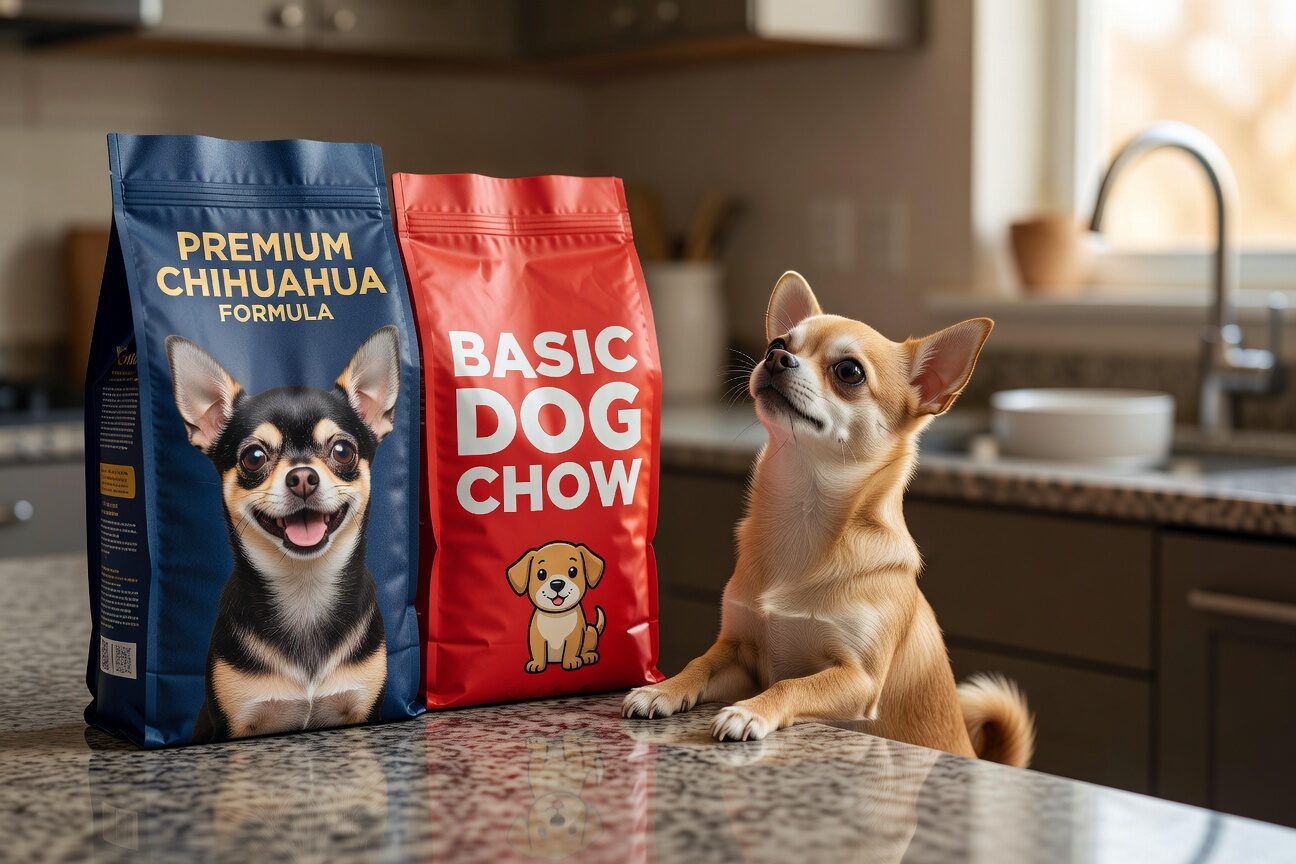
For the first three months I had my chihuahua Luna, I fed her whatever was cheapest at the grocery store. Bright-colored bag, cartoon dog on the front, kibble inside that she ate without obvious complaint. I assumed that the dog eating it meant the food was fine. The food was not, on later examination, the disaster I sometimes hear about in pet-blog opinion pieces. It was also not, on careful reading of the label and a brief conversation with my veterinarian, the right choice. Below is what I learned, and the practical framework for picking food in the kibble aisle without spending forty-five minutes comparing labels.
I want to be honest about scope. This piece is about picking a quality complete-and-balanced commercial food for a healthy adult chihuahua. It does not cover prescription diets, home-cooked diets, or special-condition diets; those are individualized clinical decisions. A separate piece on home-cooked diet covers that path.
The AAFCO statement, the most useful single label feature
The single most useful piece of information on a dog food bag is the AAFCO nutritional adequacy statement. The statement appears in small print, usually on the back of the bag. It looks like one of these:
article_in_feed
A handpicked find for your tiny companion.
- "[Product name] is formulated to meet the nutritional levels established by the AAFCO Dog Food Nutrient Profiles for [life stage]."
- "Animal feeding tests using AAFCO procedures substantiate that [Product name] provides complete and balanced nutrition for [life stage]."
- "[Product name] provides complete and balanced nutrition for all life stages."
The statement is, on the available regulatory framework, the closest thing to a third-party verification of the food's nutritional adequacy. The "feeding tests" version is somewhat stronger than the "formulated to meet" version, but both are meaningful. A bag without an AAFCO statement is, on careful reading, not a complete-and-balanced food and should not be the dog's primary diet.
The life stage, plainly
The life-stage designation matters. A chihuahua puppy needs different nutritional ratios than a chihuahua adult or senior. The AAFCO life stages:
- Growth (puppy): higher protein and fat, more calcium and phosphorus.
- Maintenance (adult): standard ratios for healthy adults.
- All life stages: meets growth requirements, suitable across the lifespan.
For a chihuahua, "growth" or "all life stages" is appropriate for a puppy; "maintenance" or "all life stages" is appropriate for an adult. The "small breed" or "toy breed" subcategory, where it appears, is calibrated for the higher metabolic rate per pound that small dogs have.
The ingredients list, what to look for
The first five ingredients are the most informative. A few things I look for:
- A specific named animal protein in the first or second slot. "Chicken," "lamb," "beef," "salmon," or similar. Generic "meat" or "meat by-products" are less informative.
- Whole grains or quality carbohydrate sources. "Brown rice," "barley," "sweet potato," "peas." Some chihuahuas do well on grain-free; others do not. The DCM (dilated cardiomyopathy) literature on grain-free diets is evolving; many veterinarians have moved back toward grain-inclusive recommendations.
- Named fat sources. "Chicken fat," "fish oil," "flaxseed oil." Generic "animal fat" is less informative.
- A short ingredient list overall. Twenty ingredients is reasonable; sixty is, on most readings, more than necessary.
What I am less concerned about than the marketing suggests:
- "By-products." The term is not, in itself, a quality indicator. Some by-products are organ meats with nutritional value; some are less useful. The blanket avoidance is not necessarily warranted.
- "Grain-free." The current evidence, summarized at the FDA's investigation page, suggests that some grain-free diets may be associated with DCM in some dogs. The grain-free claim is, in my view, not a positive feature.
- "Holistic" or "natural." These terms are not regulated in dog food labeling. The marketing is, on examination, not informative.
Kibble versus canned versus fresh, briefly
The format question is, on the available data, less important than the AAFCO compliance. A few honest comparisons:
- Kibble. Cheapest, most convenient, longest shelf life. The dental scraping benefit is mild but real.
- Canned wet food. Higher moisture content, more aromatic, often more palatable. Higher cost. Useful for dogs with reduced appetite or dental issues.
- Fresh-cooked subscription services (Farmer's Dog, Nom Nom, etc.). Higher cost; nutritional adequacy varies by brand. Some have AAFCO compliance; verify before subscribing.
- Raw diets. The food-safety considerations are real; the nutritional balance is harder to hit without veterinary nutritionist input. Talk to your veterinarian before considering.
For a chihuahua, a quality kibble or a 50-50 kibble-and-canned mix is the most common practical choice and is, on the nutritional adequacy math, equivalent to the more expensive options when AAFCO compliance is verified.
A few brand considerations, briefly
I do not, in this column, want to recommend specific brands. The right brand depends on your dog's specific needs, your veterinarian's recommendation, your geography, and your budget. A few practical points:
- The brands with the most veterinary nutritional research tend to be the major established ones: Royal Canin, Hill's, Purina Pro Plan, and a few others. The research investment is reflected in the AAFCO feeding-test substantiation.
- Mid-tier brands often have good AAFCO compliance and lower price points; many work well for healthy chihuahuas.
- Boutique brands vary widely. Some have nutritional research investment; some do not. The marketing language is sometimes louder than the underlying science. Verify the AAFCO statement.
How much and how often, briefly
Once you have picked the food, the daily portion math comes from the label combined with the dog's specific weight and activity level. A few specifics:
- Read the feeding chart on the bag, find the row for your dog's weight, and use that as the starting point.
- Adjust based on body condition. If the dog is gaining weight, reduce by 10 percent and reassess in two weeks. If losing, increase by 10 percent.
- Two meals a day for adults; three or four for puppies. The feeding-schedule reference covers the timing.
- Treats and human food count. Subtract roughly 10 percent of the kibble portion if the dog is getting regular treats.
When to switch foods, briefly
Reasons to consider a food change, with veterinary input:
- Persistent GI signs that resolve only on a different formula.
- Skin or coat changes consistent with food sensitivity. The allergy-workup piece covers the elimination-diet protocol.
- Life-stage transitions (puppy to adult, adult to senior).
- Weight management goals.
- Specific medical conditions that warrant a prescription diet.
When you do switch, transition over one to two weeks: 25% new mixed with 75% old for a few days; then 50/50; then 75/25; then full new. Abrupt changes produce GI upset in many dogs.
The bottom line, with the usual caveat
Picking a chihuahua food is mostly about the AAFCO statement, the life stage, and the first few ingredients. Five minutes in the aisle is enough for the decision once you know what to look for. Talk to your veterinarian about your specific dog and any specific medical considerations; the wellness visit is the right place to refine the choice. The common health-issues primer covers conditions that can change the food math; for healthy adults, the framework above is the working version.
Health at a Glance: What to Watch monitor_heart
| Condition | Key Signs | Prevention Tips |
|---|---|---|
| Dental Disease | Bad breath, tartar, red gums | Daily brushing, dental treats |
| Patellar Luxation | Limping, skipping, leg lifting | Weight control, avoid high jumps |
| Tracheal Collapse | Dry cough, gagging | Harness walking, avoid smoke |
| Heart Disease | Coughing, fatigue, fainting | Regular check-ups, heart-healthy diet |
| Hypoglycemia | Shaking, weakness, lethargy | Small, frequent meals |
Community Insights – FAQ help
help_outline What should every Chihuahua owner know about Health? expand_more
Stay observant — small changes in routine, energy, or appetite are usually the first signal something needs attention.
help_outline Is a tailored approach really necessary for Chihuahuas? expand_more
Yes. Their tiny size means smaller portions, gentler activity, and more frequent check-ins than larger breeds.
help_outline How often should we revisit our routine? expand_more
At least quarterly, and any time you notice a change. Small dogs, small adjustments — early and often.
Have a health question? Ask in the comments and we’ll bring it up with our vet team.
favorite