

Can a chihuahua actually have hip dysplasia, and if so, what does the small-breed presentation look like and what is the management plan? In short: yes, hip dysplasia occurs in chihuahuas at meaningful rates, the small-breed presentation is more often missed because owners and clinicians associate the condition with large breeds, and the management plan is mostly conservative (weight management, controlled exercise, joint support, NSAIDs as needed), with surgical options for advanced cases.
I want to walk through why this is more common than the large-breed framing suggests, what the diagnostic process looks like in clinic, and the practical management plan for a chihuahua with the diagnosis.
Why the "big-dog problem" framing is wrong
Hip dysplasia is a developmental abnormality of the hip joint in which the femoral head and the acetabulum (the socket) do not fit together properly. The malformed joint produces abnormal wear, secondary osteoarthritis, and pain.
The condition is often associated with large breeds (German Shepherds, Labradors, Goldens), partly because the absolute incidence in those breeds is higher and partly because the clinical signs are more dramatic in a 70-pound dog. In small breeds, including chihuahuas, the condition occurs at rates that are not negligible (the Orthopedic Foundation for Animals tracks the breed-specific data), and the smaller absolute joint forces produce a milder, longer-developing clinical picture that is easier to miss.
The result is that chihuahuas with hip dysplasia often present at older ages, with subtle signs that have been gradually progressing for a year or more before the diagnosis is made.
The presenting signs in a small dog
In contrast to the large-breed presentation (clear lameness, "bunny hopping" gait, reluctance to climb stairs), the chihuahua presentation is often more subtle:
- Reluctance to jump up onto familiar furniture. The dog used to jump onto the couch in one motion; now she pauses, asks to be picked up, or finds an alternate route via a cushion.
- Stiffness after rest, often brief at the start of a walk and then resolving once the dog warms up.
- Slight bunny-hopping in faster gait, particularly when running. The hindlimbs move together rather than alternating.
- Reduced enthusiasm for longer walks. The dog wants the walk to be shorter than it used to be.
- Mild discomfort on extension of the hindlimb, sometimes noted only on careful palpation.
These signs overlap meaningfully with normal aging, with patellar luxation, and with several other small-dog orthopedic conditions. The differential is the reason imaging is the diagnostic step rather than physical exam alone.
The diagnostic process, briefly
A typical workup, in clinic:
Step 1: Physical exam. The veterinarian assesses the dog's gait, the range of motion of each hip, and looks for signs of pain on palpation or extension. The exam is suggestive but not definitive.
Step 2: Radiographs. Hip X-rays are the standard imaging. The dog is typically sedated for proper positioning. The X-rays show the joint conformation, the degree of subluxation if present, and any secondary arthritic changes.
Step 3: Grading. The findings are graded on the OFA scale (Excellent, Good, Fair, Borderline, Mild, Moderate, Severe). Most chihuahuas with clinical signs are in the Mild or Moderate range; the dramatic Severe presentations more common in large breeds are less common in small dogs.
Step 4: Treatment plan. The plan depends on the grade, the age of the dog, the severity of clinical signs, and the response to initial conservative management.
The conservative management plan, plainly
For most chihuahuas with mild to moderate hip dysplasia, conservative management is the first line. The components:
- Weight management. A lean weight (you can feel the ribs without pressing) reduces joint loading meaningfully. For a chihuahua, a half-pound weight reduction is, on the joint math, equivalent to a five-pound reduction in a 50-pound dog.
- Controlled exercise. Two short walks per day (15 to 20 minutes each) on level ground. Avoid jumping, hard surfaces, and high-impact play. Swimming, where available and the dog is comfortable, is the gold standard for low-impact joint exercise.
- Joint support supplements. Glucosamine and chondroitin, with omega-3 fatty acids. The evidence is modest but real; the safety profile is good. The supplement guide covers the products in detail.
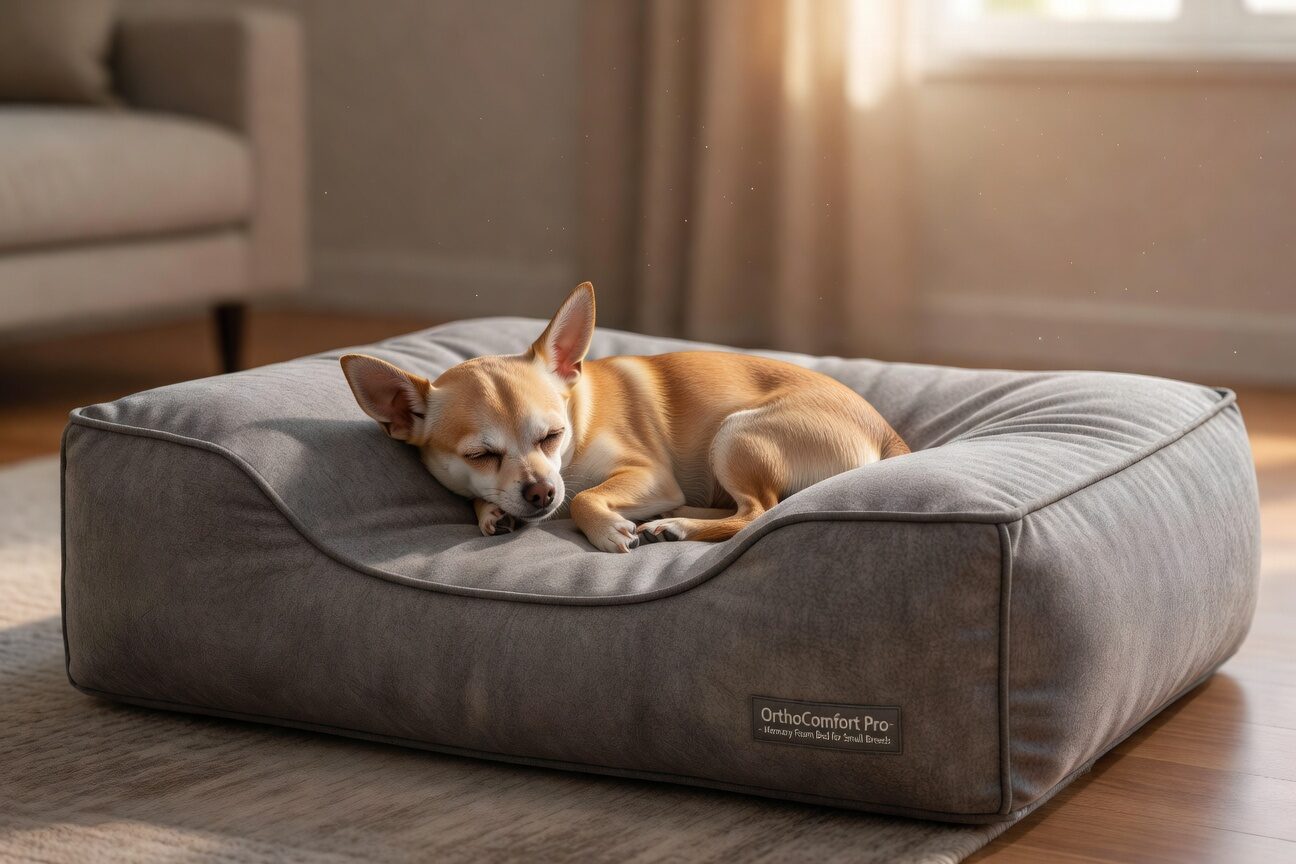
- Orthopedic bedding. A foam-filled bed sized for a small dog; the support during rest is meaningful for dogs who spend much of the day on the bed.
- NSAIDs as needed. Veterinary-prescribed nonsteroidal anti-inflammatory drugs for breakthrough pain. Not all chihuahuas tolerate NSAIDs equally; the choice and dose are individualized.
Surgical options, briefly
For chihuahuas with severe hip dysplasia or with conservative management failure, surgical options exist:
- Femoral head and neck excision (FHO). The femoral head is removed and the body forms a "false joint" of fibrous tissue. The surgery is well-suited to small dogs; the small body weight does not require the structural strength a hip replacement provides. Recovery is typically several months; most dogs return to comfortable function.
- Total hip replacement. Available for some chihuahuas at specialty surgical centers, with the smallest implant sizes. More expensive, more involved recovery, but produces a functional joint rather than a false one.
The choice of surgery, when surgery is appropriate, is a specialty consultation. Most general-practice veterinarians will refer to a board-certified surgeon for the conversation.
The long-term trajectory, plainly
A chihuahua with mild to moderate hip dysplasia, on appropriate conservative management, typically has a normal lifespan with manageable comfort. Periods of stiffness or discomfort recur, particularly in cold weather or after high-activity days; the management plan is adjusted as the dog ages.
The annual wellness visit becomes more important; orthopedic exams at each visit catch progression early, and the medication or supplement plan is refined as the joints change. The general warning-signs piece covers the broader watch-list; for a chihuahua with diagnosed hip dysplasia, the watch is tighter for orthopedic signs specifically.
Prevention and breeding considerations, briefly
Hip dysplasia has a genetic component. Reputable breeders who participate in OFA hip screening of their breeding stock reduce the incidence in their lines. The OFA database tracks the certification of individual breeding dogs.
For owners considering a chihuahua puppy from a breeder, asking about the parents' OFA hip certification is a reasonable question. The breeder-versus-adopt comparison covers the broader screening conversation.
The bottom line, with the usual caveat
Hip dysplasia in chihuahuas is more common than the large-breed framing suggests, the presentation is subtler, and conservative management produces good outcomes for most dogs. Talk to your veterinarian if your chihuahua is showing any of the gradual-onset signs above; the imaging is straightforward and the management plan is concrete. The diagnosis is not a small-dog tragedy; it is a manageable condition with a known protocol.
Health at a Glance: What to Watch monitor_heart
| Condition | Key Signs | Prevention Tips |
|---|---|---|
| Dental Disease | Bad breath, tartar, red gums | Daily brushing, dental treats |
| Patellar Luxation | Limping, skipping, leg lifting | Weight control, avoid high jumps |
| Tracheal Collapse | Dry cough, gagging | Harness walking, avoid smoke |
| Heart Disease | Coughing, fatigue, fainting | Regular check-ups, heart-healthy diet |
| Hypoglycemia | Shaking, weakness, lethargy | Small, frequent meals |
Community Insights – FAQ help
help_outline When should I call my vet about a behavior change? expand_more
Sooner than feels reasonable. A change in appetite, energy, or routine that lasts more than 48 hours is worth a phone call, not a wait-and-see.
help_outline How often should a healthy adult chihuahua see the vet? expand_more
Once a year through age seven. Twice a year from eight on. Dental checks are part of every visit.
help_outline Do chihuahuas need different care than larger breeds? expand_more
Yes. Smaller medication dosing, more frequent dental work, and closer monitoring for tracheal and patellar issues are standard in toy-breed care.
Have a health question? Ask your question in the comments. We will bring it up with the vet team.
favorite