
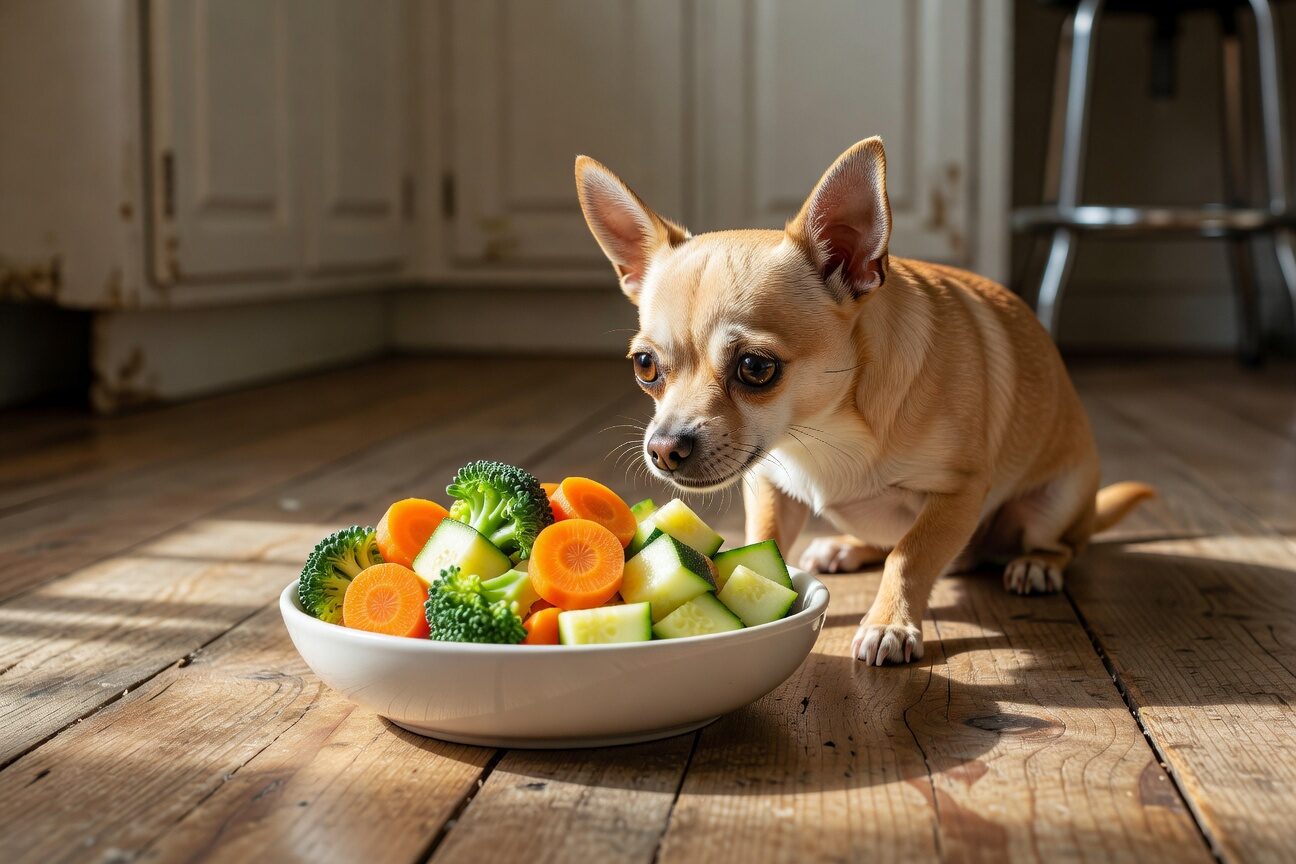
I gave my chihuahua Mochi a baby carrot once. Whole. I handed it to her like she was a normal-sized dog who could handle a normal-sized vegetable. She looked at it. She looked at me. She tried to swallow it whole, and what followed was ten seconds of gagging that aged me approximately eighteen months. The lesson, on later examination, was that the baby carrot was the right vegetable but the wrong portion. The honest version of the chihuahua-vegetable conversation is that several specific vegetables are excellent treats, the portion math is much smaller than for larger dogs, and a few specific items are unsafe at any size.
Below is the practical, household-tested list, with portions sized for a four-to-seven-pound chihuahua.
The safe vegetables, plainly
Carrots. Excellent. Cut into thin coin-sized slices or shredded into bite-sized pieces. Raw or lightly cooked. Low calorie, good for dental scraping when crunched. Daily portion: a few thin slices.
article_in_feed
A handpicked find for your tiny companion.
Green beans. Excellent. Plain, no salt or seasoning. Fresh, frozen-thawed, or canned (low-sodium variety only). Cut into half-inch pieces. Daily portion: two or three pieces.
Sweet potato. Cooked plain (no butter, no salt, no seasoning), mashed or in small cubes. Small portions; the carbs are real. Daily portion: a teaspoon-sized amount.
Plain pumpkin. Pure canned pumpkin (not pumpkin pie filling, which contains sugar and spices) or fresh cooked pumpkin. Useful for mild GI support. Daily portion: a teaspoon for mild GI support; a half teaspoon as a regular treat.
Cucumber. Fresh, peeled or unpeeled. Cut into thin coins. High water content, low calorie. Daily portion: a few thin slices.
Zucchini. Plain, raw or lightly cooked, in small thin pieces. Daily portion: a few small pieces.
Celery. In moderation, cut into very small pieces (the strings can cause issues if too large). Daily portion: a couple of small pieces.
Spinach (limited). Small amounts only; the oxalates can be an issue at higher doses. Daily portion: a tablespoon, occasionally.
Broccoli (limited). Small amounts of the florets only. Can cause gas; introduce gradually. Daily portion: a small floret, occasionally.
Bell peppers. Red, yellow, or orange (these are higher in vitamins than green). Plain, raw, in small pieces. Daily portion: a few small pieces.
The vegetables to avoid, briefly
Onions, garlic, leeks, chives, shallots. All members of the allium family are toxic to dogs. Even small amounts in cooked human food can be harmful for a four-pound dog. Avoid entirely.
Mushrooms (most varieties). Some are safe; many are not. The safer rule is to avoid mushrooms entirely rather than try to identify which ones are safe.
Avocado. Contains persin, which is toxic to dogs. The flesh is sometimes tolerated in small amounts, but the safer rule is to avoid.
Raw potatoes. Contain solanine, which is toxic. Cooked plain potatoes in small amounts are fine.
Tomatoes (green parts). The leaves and stems contain solanine; the ripe fruit is generally safe in small amounts. Cherry tomatoes can be a choking hazard at chihuahua mouth size.
Rhubarb. Contains oxalates that can affect calcium absorption. Avoid.
Asparagus (limited). Not toxic, but tough to digest for small dogs. Avoid or feed in tiny portions.

The small-dog portion math, plainly
The single most common mistake in chihuahua-vegetable feeding is portion sizing. A treat sized for a 25-pound dog is a meal-sized piece for a 5-pound chihuahua. The math:
- The 10% rule. Treats and non-meal food should account for no more than 10% of the dog's daily calories. For a 5-pound chihuahua, that is roughly 20 calories. The feeding-schedule reference covers the underlying math.
- The choking-hazard size. Pieces should be smaller than the back of the dog's throat. For most chihuahuas, that is roughly half-inch cubes or thinner. The baby carrot, whole, is too large; the same baby carrot in three thin slices is fine.
- The introduction principle. Any new vegetable should be introduced in a tiny amount the first time. Wait 24 hours; if no GI upset, the vegetable is added to the rotation.
How to feed vegetables, briefly
A few practical approaches:
- As training treats. Cut into very small pieces, used in training sessions. The variety keeps the dog engaged; the calorie cost is small.
- Mixed into kibble. A small amount of cooked sweet potato or pumpkin stirred into the regular meal. Useful for picky eaters or for mild GI support.
- As a fresh-snack rotation. One or two times a week, the dog gets a "fresh treat" of a few cucumber coins or thin carrot slices. The variety adds enrichment without becoming routine.
- In food puzzle toys. Small vegetable pieces can be loaded into a puzzle toy along with kibble; the dog has to work for the treat, which slows eating and adds enrichment.
When to skip vegetables entirely, briefly
A few situations where the vegetable rotation is not the right addition:
- Dogs on prescription elimination diets. The protocol requires strict exclusivity; vegetables interrupt the trial. A separate piece on allergy workups covers the underlying logic.
- Dogs with specific medical conditions (kidney disease, diabetes, pancreatitis). The vegetable choices may need to be customized; ask your veterinarian.
- Dogs with sensitive GI systems who have shown reactions to dietary changes in the past. Introductions should be slower and more carefully monitored.
If something does go wrong, briefly
If the dog has eaten a non-safe vegetable in any meaningful amount:
- Identify the vegetable and the approximate amount.
- Call the ASPCA Animal Poison Control number (888-426-4435) for specific dose-based guidance.
- Contact your veterinarian based on the poison control recommendation.
- Do not induce vomiting at home unless specifically directed by poison control or your veterinarian.
The ASPCA Poison Control resource is the standard reference. A separate piece on chihuahua emergencies covers the broader protocol.
The bottom line, with the usual caveat
Vegetables are a useful addition to a chihuahua's diet in small portions, properly sized, from the safe list. The choking-on-a-baby-carrot incident is avoidable with the size-and-introduction approach. Talk to your veterinarian if your dog has any specific dietary or medical considerations; the general list above is the starting point, and the individualized read is the refinement.
Health at a Glance: What to Watch monitor_heart
| Condition | Key Signs | Prevention Tips |
|---|---|---|
| Dental Disease | Bad breath, tartar, red gums | Daily brushing, dental treats |
| Patellar Luxation | Limping, skipping, leg lifting | Weight control, avoid high jumps |
| Tracheal Collapse | Dry cough, gagging | Harness walking, avoid smoke |
| Heart Disease | Coughing, fatigue, fainting | Regular check-ups, heart-healthy diet |
| Hypoglycemia | Shaking, weakness, lethargy | Small, frequent meals |
Community Insights – FAQ help
help_outline What should every Chihuahua owner know about Health? expand_more
Stay observant — small changes in routine, energy, or appetite are usually the first signal something needs attention.
help_outline Is a tailored approach really necessary for Chihuahuas? expand_more
Yes. Their tiny size means smaller portions, gentler activity, and more frequent check-ins than larger breeds.
help_outline How often should we revisit our routine? expand_more
At least quarterly, and any time you notice a change. Small dogs, small adjustments — early and often.
Have a health question? Ask in the comments and we’ll bring it up with our vet team.
favorite