


Should your chihuahua wear a flat collar for walking, and if so, when is it appropriate and when is it actually causing harm? In short: the cervical and tracheal anatomy of toy breeds, including chihuahuas, makes collar pressure during walks a clinically meaningful risk, and most chihuahuas should walk on a Y-front harness rather than a flat collar. The collar is fine for ID-tag purposes; it is not the right pulling-attachment point for a four-pound dog.
I am going to walk through the anatomy that drives the recommendation, the clinical signs of cumulative collar damage that most owners miss, and the harness setup that has held up across our practice's small-dog patient population.
The cervical anatomy that matters, briefly
A chihuahua's trachea is roughly the diameter of a thin drinking straw. The cartilage rings around the trachea are, in many chihuahuas, weaker than in larger breeds; tracheal collapse is a recognized condition in toy breeds, and the breed is overrepresented in clinical case series.

The cervical vertebrae are similarly small and tightly arranged. The seven cervical vertebrae in a chihuahua are about the size of small peas; the intervertebral discs and ligaments are correspondingly small. A pulling force applied via a collar (the dog lunging at a squirrel; the owner correcting with a leash pop) translates through this small structure rather than dispersing across a larger body mass.
The Merck Veterinary Manual entry on tracheal collapse covers the underlying disease process; the practical implication is that repeated collar pressure during walks contributes meaningfully to long-term tracheal and cervical injury risk.
The clinical signs of cumulative collar damage
The signs are subtle and accumulate gradually. Most owners do not connect them to the collar:
- Honking cough, particularly during excitement or after pulling on the leash. The chihuahua sounds primer covers the honking cough as a sign of tracheal compromise.
- Reluctance to put the head down during normal activities (eating, drinking, sniffing).
- Yelping when picked up under the chest or torso; the cervical pain is referred during handling.
- Stiff neck or reduced range of motion, often noticed when the dog turns to look behind her.
- Worsening reverse sneeze episodes, sometimes triggered by collar pressure during routine walks.
Any of these warrants a vet exam with attention to the cervical and tracheal area. Imaging (typically a lateral cervical radiograph) is sometimes warranted; in dogs with tracheal collapse confirmed, the management protocol includes harness-only walking among other interventions.
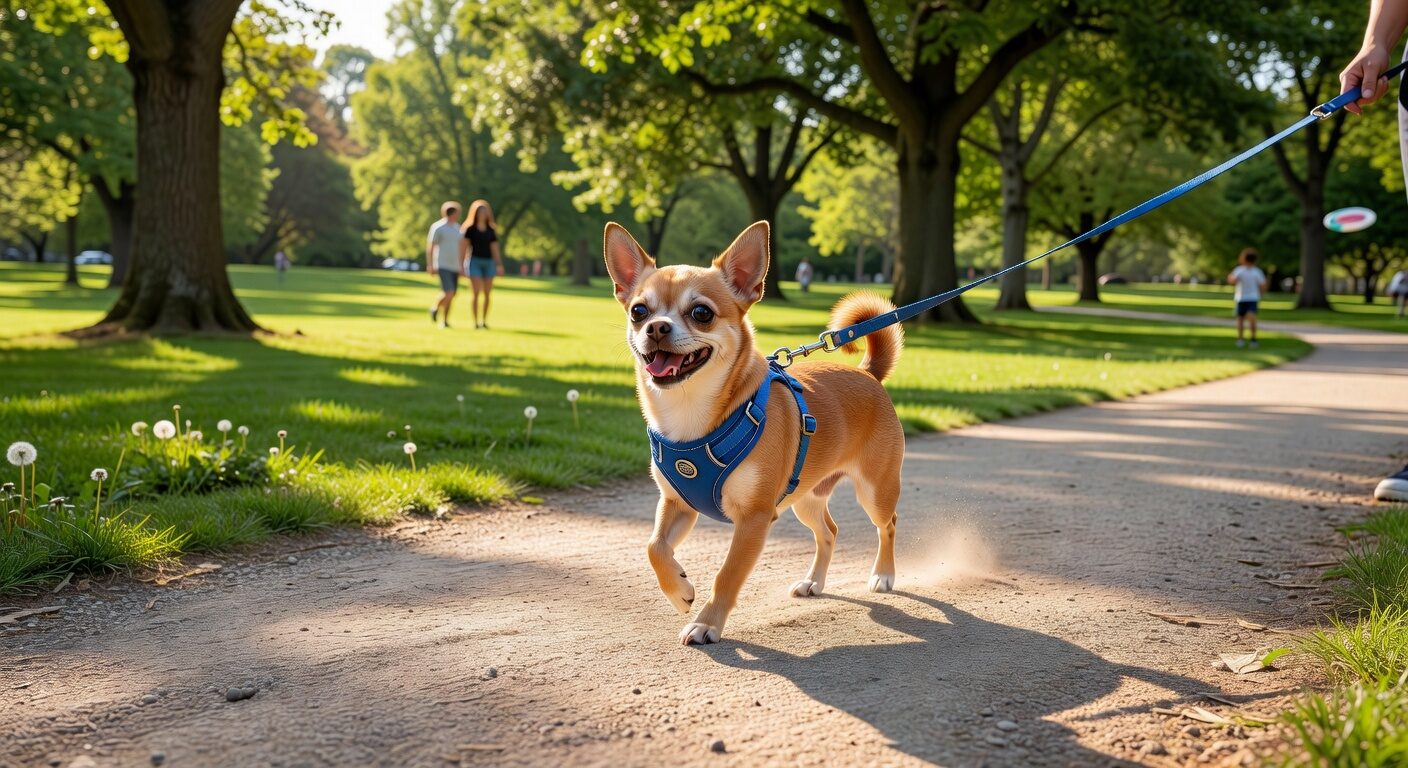
What "the right harness" actually means, plainly
A few specific design features matter:
- Y-front, not H-front. The Y-front harness has the chest strap forming a Y between the front legs; the H-front (or step-in) has the strap perpendicular across the front of the chest, which interferes with shoulder mobility on small dogs.
- Proper fit. Two finger-widths under the neck strap; the chest strap should sit two finger-widths behind the front legs; the dog should be able to extend the front legs fully without the harness binding.
- Front-clip ring or back-clip ring. For a chihuahua who pulls, the front-clip ring (on the chest) gives more control without translating the pulling force into cervical pressure. For a chihuahua who walks calmly, a back-clip ring is fine.
- Soft padded fabric, not narrow webbing. Wider, padded contact surfaces distribute the pressure better.
The cost is typically $15 to $40 for a quality harness. Plan to replace it once or twice during the dog's life as the original padding wears.
When the collar is fine, briefly
A flat collar is appropriate for one purpose: holding the ID tag. The collar should be loose enough that the dog can comfortably extend her neck without restriction; the leash should never attach to the collar during a walk.
If you are using a Y-front harness for walks, the collar can be a thinner soft fabric or break-away style with the ID tag. Many owners migrate to attaching the ID tag to the harness and skipping the collar entirely; this is also fine, as long as the harness is on whenever the dog is in a situation where she could be lost.
What to do this week, if you have been using a collar
A practical owner-side checklist:
- Buy a Y-front harness sized to your dog. Most chihuahuas fit an XS or S; measure the chest girth (behind the front legs) and the neck girth (where a collar would sit) before ordering.
- Transition gradually over several days. Let the dog wear the new harness for short periods indoors first, paired with treats. Some chihuahuas accept it immediately; some need a few days of habituation. The leash-training primer covers the broader walking protocol.
- Schedule a vet exam if your dog has any of the cumulative-damage signs above. The exam can rule out an underlying issue and establish a baseline.
- Consider a wellness visit regardless if your dog is over five and has been on a collar for years. The exam is brief and the information is useful.
The broader walking question, briefly
Walking style also matters. A chihuahua who lunges at squirrels is, on the harness, transferring force to the chest rather than the throat, but the lunge is still a pattern worth managing. Force-free leash training to reduce the lunging both protects the dog physically and improves the walk for everyone.
The barking and reactivity piece covers the broader on-leash management; the harness is the equipment side and the training is the behavioral side, and both contribute to the long-term outcome.
The bottom line, with the usual caveat
The standard flat collar is a poor pulling attachment for a chihuahua. The cervical and tracheal anatomy of the breed makes the cumulative pressure during walks a real clinical concern; the Y-front harness is the appropriate alternative for the walking attachment. Talk to your veterinarian about your specific dog if you have any of the cumulative-damage signs; the exam is brief and the information is, on every available measure, useful.
Health at a Glance: What to Watch monitor_heart
| Condition | Key Signs | Prevention Tips |
|---|---|---|
| Dental Disease | Bad breath, tartar, red gums | Daily brushing, dental treats |
| Patellar Luxation | Limping, skipping, leg lifting | Weight control, avoid high jumps |
| Tracheal Collapse | Dry cough, gagging | Harness walking, avoid smoke |
| Heart Disease | Coughing, fatigue, fainting | Regular check-ups, heart-healthy diet |
| Hypoglycemia | Shaking, weakness, lethargy | Small, frequent meals |
Community Insights – FAQ help
help_outline When should I call my vet about a behavior change? expand_more
Sooner than feels reasonable. A change in appetite, energy, or routine that lasts more than 48 hours is worth a phone call, not a wait-and-see.
help_outline How often should a healthy adult chihuahua see the vet? expand_more
Once a year through age seven. Twice a year from eight on. Dental checks are part of every visit.
help_outline Do chihuahuas need different care than larger breeds? expand_more
Yes. Smaller medication dosing, more frequent dental work, and closer monitoring for tracheal and patellar issues are standard in toy-breed care.
Have a health question? Ask your question in the comments. We will bring it up with the vet team.
favorite