

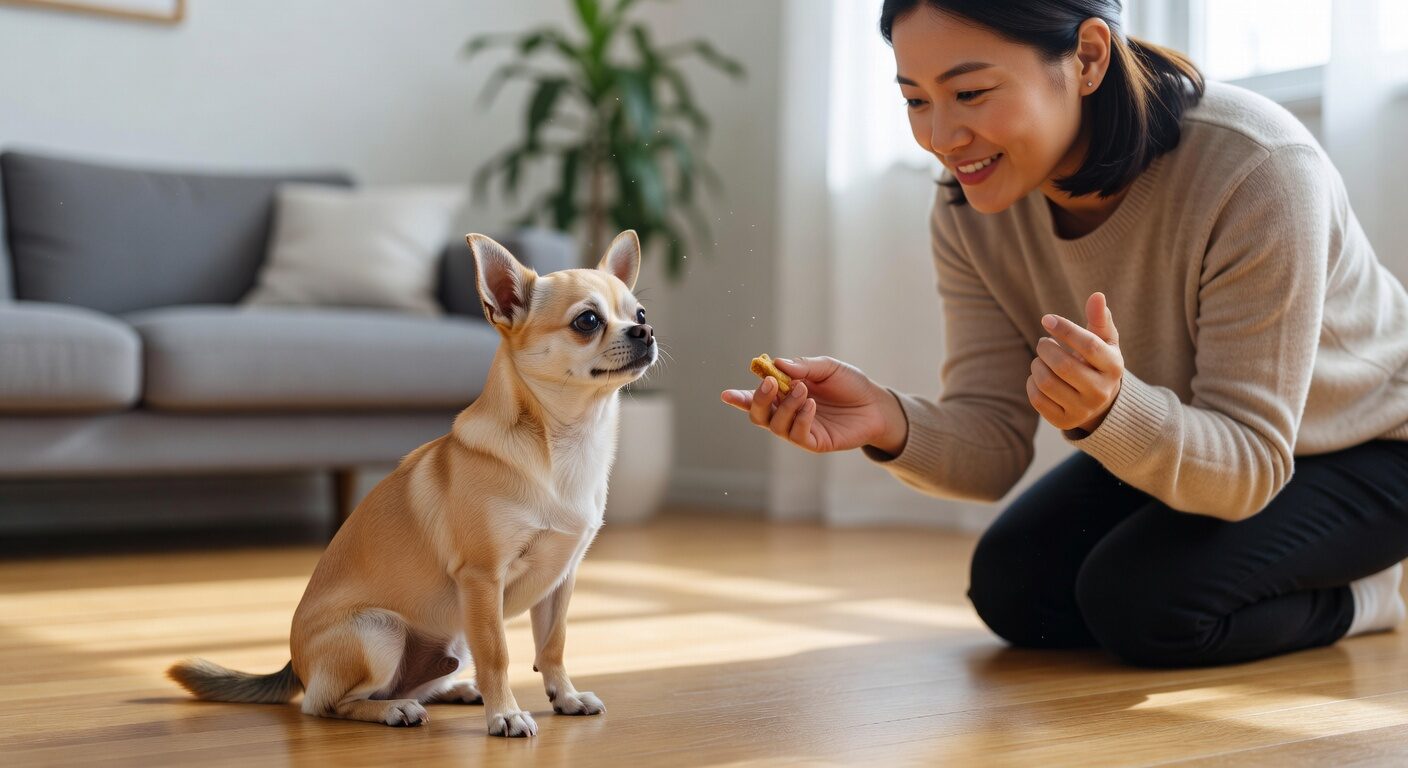
Confession to start. The first time someone asked me, in a question-and-answer session at a chihuahua specialty in 2014, whether dogs use "words" when they bark, I gave the standard breeder-club answer: no, dogs do not have language. The truthful answer, which I have refined since reading the canine cognition literature more carefully, is more interesting. Dogs do not have language in the linguistic sense; chihuahuas, by selection, have something specific and rich and worth paying attention to.
What the Research Actually Found
The 2008 study by Pongrácz and colleagues at Eötvös Loránd University in Budapest, published in Animal Cognition, played recorded dog barks to human listeners across multiple cultures and asked them to classify the bark by context. The listeners were correct above chance levels at distinguishing alarm barks, play barks, and isolation barks across breeds and across human linguistic backgrounds. The 2010 follow-up by Yin and McCowan, in Animal Behaviour, identified specific acoustic features (frequency, duration, amplitude modulation) that vary systematically with context.
This does not make barking a "language." It does make barking a structured, context-specific signal that humans, including those who have never owned a dog, decode with measurable accuracy. AKC's why-dogs-bark reference summarizes the practical taxonomy.
article_in_feed
A handpicked find for your tiny companion.
The Chihuahua's Specific Vocabulary
The breed is acoustically more variable than the average toy dog. A working chihuahua in a household setting will produce, in my own household and in the dogs I have observed at shows for nearly two decades, at least eight distinguishable bark types: the sharp door-alarm, the low food-bowl rumble, the high-pitched squirrel signal, the rolling fence-line patrol, the territorial visitor warning, the play invitation, the isolation distress call, and the slightly indignant "you have ignored me for forty-five seconds" production that older breed columnists used to call "the opera."
Why so many? Because the breed has been selected over centuries for individual companionship, and because in the chihuahua's working world a small dog with a long memory needs a small dog with a varied signaling repertoire. The companion twenty-five chihuahua facts piece covers the breed-history reasons for the alert vigilance that produces the vocal range.

How to Read the Bark Without Over-Reading It
Three practical cues, drawn from the body-language literature and from the breeder-exhibitor reading I trust most:
First, pitch tracks emotional intensity. Higher pitch generally signals higher arousal; lower pitch generally signals threat assessment or resource defense. Second, rhythm tracks duration of perceived threat. Sharp, repeated, evenly-spaced barks signal an active concern; sustained or rolling barks signal an ongoing one. Third, pauses matter. The chihuahua who has been barking and abruptly goes silent has not calmed; she has climbed past the bark into the freeze. The companion seven nervous-aggression signs piece covers the specific transition.
When Excessive Barking Is a Real Problem
Persistent barking that has no contextual trigger is not vocabulary; it is, in most cases, under-enrichment, anxiety, or pain. The companion entertaining your chihuahua piece covers the enrichment side; the four things to do when your chihuahua is stressed guide covers the anxiety side. Punishing the bark, including via shock collars or compressed-air devices, has documented welfare costs and tends to increase, not decrease, the underlying behavior; the AVSAB position on punishment is the standard reference.
A Small Final Observation
The chihuahua I currently live with has, as best I can count, eleven distinguishable bark types. The eleventh, the most recent addition to the repertoire, is a short, doubled "hyp-hyp" she produces only when the front door has opened to admit me specifically, and only between the hours of six and nine in the evening. I do not know what she calls it. I know what it means.
For more on the breed, explore the Breed desk or subscribe for the next dispatch.
Is this Chihuahua right for you? auto_awesome
Want to learn more about your Chihuahua? Compare breeds and find your perfect match.
favorite